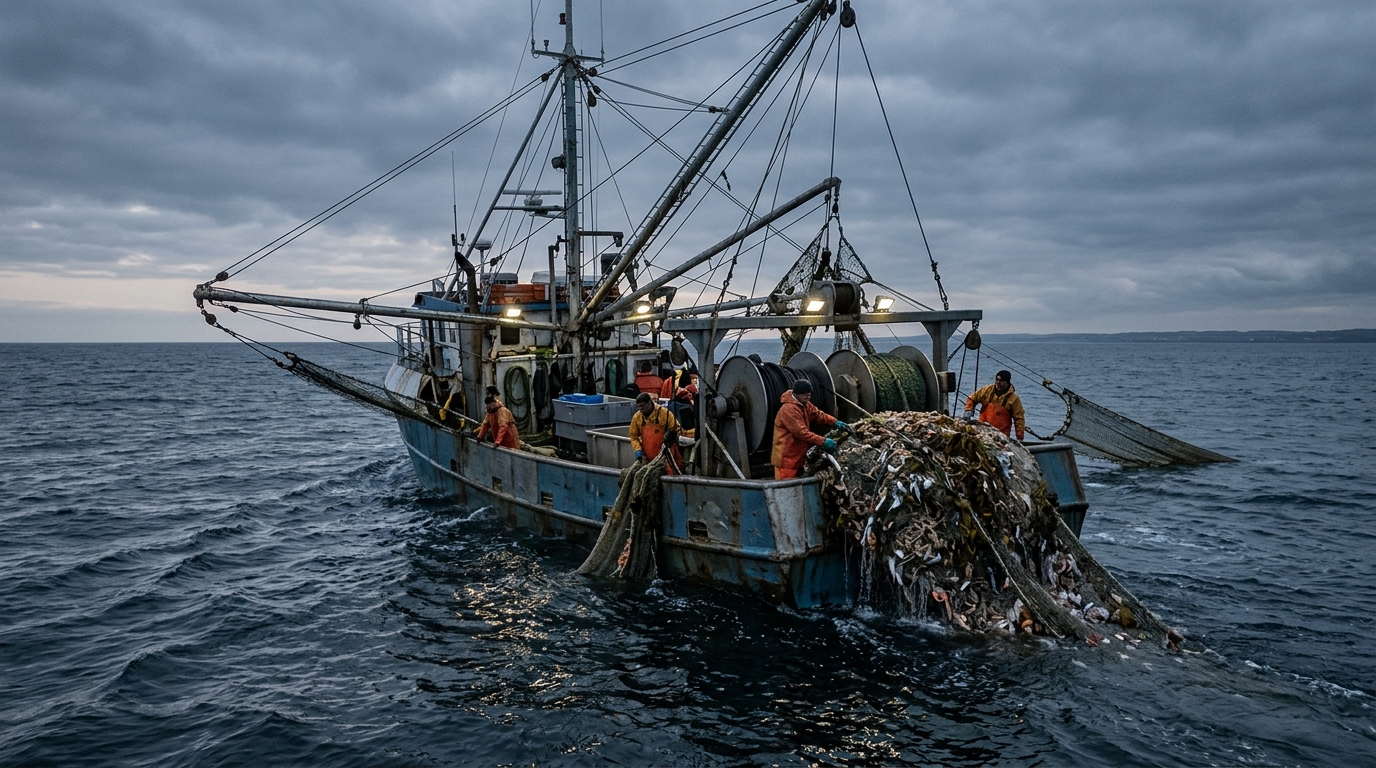
Picture the freezer aisle of an ordinary grocery store, cold air fogging against your face. In your hand is a bag of peeled shrimp, pink and tidy, priced low enough that you don’t think twice. Now follow that bag backwards: past the warehouse, past the container ship, to a shed behind a residential wall where workers peel by the kilogram. Then out to sea, to a trawler that hasn’t touched land in months, and finally to a coastline where a forest of mangrove trees once stood. Today we’ll uncover what sits behind some of the cheapest seafood we buy: forced labour, vanishing coastal forests, and animals caught and thrown away. And we’ll ask what it means for our freezers, our wallets, and our health.
The Article
One Bag, Three Hidden Stories
Shrimp is a food that hides its past. Most of the shrimp Canadians eat is imported [1], and by the time it lands in a freezer bag, its trail has crossed boats, farms, processing sheds and several borders.
Three problems run along that trail, and one unlikely ingredient ties them together. Some shrimp farms feed their animals on “trash fish,” a term for small, low-value fish scooped up by fishing boats and ground into feed. Reporters have documented enslaved workers catching that fish [2]. In some regions, the farm ponds themselves replaced mangroves, the salt-tolerant trees that grow in tidal mud along tropical coasts. And the nets that catch wild shrimp pull up far more than shrimp. Labour, land and living animals: none of those bills appears on the price tag.
One caution before we go further. Much of the strongest evidence below is five to ten years old, and Thailand is one well-documented case, not the only one. We’ll say where things have improved, and where they haven’t.
Hidden in Plain Sight
In 2015, Associated Press reporters described hundreds of shrimp-peeling sheds in Samut Sakhon, a port town about an hour from Bangkok. Many sat on residential streets or behind walls with no signs [3][4]. In one shed, a Myanmar couple said they were made to peel nearly eighty kilograms of shrimp a day for one hundred forty-four baht [5]. The AP reported that some workers were locked inside, and that children were among the peelers [3][4].
The reporters then traced shrimp from that shed to major Thai exporters, and from there to roughly forty U.S. brands sold in more than one hundred fifty stores, including Whole Foods and Walmart [6]. Here is the part that makes shrimp so slippery. Under United Nations and U.S. standards, if some of an exporter’s shrimp was processed by forced labour, meaning work a person can’t walk away from, enforced by threats, debt or confinement, all of that exporter’s shrimp is considered associated with it [3]. Shrimp from many sheds gets mixed together, so no one can honestly promise that a given bag is clean.
There is another side to this story. Thai government spokesmen rejected the claim that officials looked away, and said the couple’s experience wasn’t representative of the roughly three million foreign workers in the country [7]. A company statement reported at the time said it did not buy shrimp from peeling sheds [8]. Still, police inspected a shed within days of the report [5].
The boats are the other half of the story. Human Rights Watch found in 2018 that migrant fishers from neighbouring countries were often trafficked into Thai fishing work [9]. The AP described vessels travelling ever farther from shore, sometimes without docking for months or years, effectively floating prisons [2]. Thailand’s own 2015 report said inspections of more than four hundred seventy-four thousand fishery workers found not one case of forced labour. Human Rights Watch cited that number as a sign the inspections weren’t catching what researchers kept documenting [9].
There has been real change. The European Union issued a “yellow card” warning over illegal fishing in 2015, and lifted it in January 2019. That same month Thailand became the first country in Asia to ratify the International Labour Organization’s Work in Fishing Convention, a treaty setting minimum standards for fishers [10]. In 2020 the ILO found improved conditions, but also that fourteen percent of fishers and seven percent of seafood processing workers it interviewed had experienced both involuntary work and coercion, the two elements of forced labour [11]. A 2025 study in Ranong province concluded that conditions still fell short of the convention, and that many fishers were too afraid to report violations [12].
The Forest Under the Pond
Mangroves are coastal trees that stand in salty tidal water, their tangled roots sheltering young fish and holding shorelines together. They also store large amounts of carbon, which is released when they’re cleared [13].
A 2025 review of the research estimated that shrimp farming was responsible for about thirty-eight percent of global historic mangrove loss, and named it the leading human driver in the large majority of the studies it examined [13]. Ecuador shows the scale. Its mangrove cover fell from about 363,000 hectares in 1969 to about 154,000 in 1999, a drop of fifty-seven percent, attributed mainly to uncontrolled shrimp farm expansion [14]. One study estimated that about eighty percent of the living carbon lost from Ecuador’s mangroves traces directly to shrimp ponds [15].
The human cost lands on coastal families. In Esmeraldas Province, researchers described communities that depend on the mangrove for their livelihoods, including gathering cockles, now squeezed by shrimp farms, many of them illegal [14]. And the boom can be short-lived. Around Sri Lanka’s Puttalam lagoon, disease forced the abandonment of about ninety percent of the shrimp farm area, leaving degraded land where forest had stood [16].
The trend is not all bad. The UN Food and Agriculture Organization reports that pond shrimp’s share of global mangrove loss fell from thirty-one percent between 2000 and 2010 to twenty-one percent between 2010 and 2020 [17]. And farms don’t have to be forest-free. In Vietnam’s Ca Mau province, researchers found that keeping thirty to fifty percent mangrove cover in integrated farms gave the best benefits, and that more forest cover tracked with better shrimp survival and yield [18]. For a country where shrimp is the biggest export earner, that matters.
The Net Doesn’t Choose
Bycatch is the accidental catch of animals a fishing net wasn’t meant to take. Shrimp trawling, which drags a funnel-shaped net along the seafloor, is among the worst offenders. A landmark FAO assessment found that tropical shrimp trawl fisheries produced about a third of the world’s discarded catch [19]. A later FAO review of 1992 to 2001 data put the discard rate for shrimp trawling at about sixty-two percent by weight, among the highest of any fishery type [20].
To be fair, those figures come with limits. FAO analysts themselves warned that some estimates may run high, because they assumed all non-shrimp catch was thrown back, when in some places it’s kept for food or animal feed [21].
Sea turtles show both the harm and the fix. In the U.S., turtle excluder devices, metal grids that steer turtles out through an escape flap while shrimp pass through, have been required since 1987. NOAA says they are ninety-seven percent effective when properly installed and maintained [22]. U.S. law also bars imports of wild-caught shrimp from nations without equivalent turtle protections [23]. Canada has its own example: in the northern shrimp fishery, sorting grates nearly eliminated redfish bycatch [21]. The lesson is that bycatch can be engineered down.
What’s in Our Freezers, Pockets and Bodies
Start with health. In 2019, CBC’s Marketplace sent fifty-one packages of imported shrimp from major Canadian grocery stores to a University of Saskatchewan lab. Seventeen percent carried bacteria resistant to at least one antibiotic, and two packages carried MRSA, a multidrug-resistant staph [24][25]. The lab’s expert said the worry is that resistance genes can pass to other bacteria in our guts. The Public Health Agency of Canada called the results “of concern” [24]. Note what this does not show: that people were getting sick from those packages. An aquaculture industry group called the report misleading, arguing resistant bacteria occur naturally and can’t be linked to antibiotic misuse on the farms of origin [25].
The oversight gap is real, though. The CFIA samples about five percent of imported seafood lots, and tests for antibiotic residues, not resistant bacteria [24]. And a 2019 analysis from SeaChoice noted that Canadian labelling rules didn’t let shoppers reliably tell where a bag of shrimp was farmed [26].
Now our pockets. The low price isn’t magic. It reflects costs carried by someone else: the worker paid next to nothing, the family losing its coastline, the turtle in the net. That’s our reasoning, not a measured figure, but it points to a gap between what shrimp costs and what it takes.
Canada has been trying to close that gap. Since 2020 it has banned imports made with forced labour [27]. But a law firm’s 2026 trade outlook noted no publicly reported enforcement actions in 2025 [28], and the U.S. trade representative found Canada’s enforcement deficient [29]. In June 2026 the federal government introduced a new standalone law meant to strengthen the ban [27].
Earth Reform’s view is that the fix belongs upstream, not at the till. Traceability requirements and gear standards for producers and importers, backed by tax credits that offset the cost of better equipment, put the work where the power is. The turtle excluder story suggests that approach can work.
So, here’s what we’re taking away. The cheapest shrimp often carries costs we never see: people working without freedom, mangrove forests traded for ponds, and wildlife discarded at sea. And the same long, murky supply chain that hides those costs also hides some of the health risks from us. But we’ve also seen that nets can be redesigned, laws can be strengthened, and farms can keep their forests. The tools exist. Next time you stand in front of that freezer, think about what a price tag actually measures. If a bag of shrimp could list everything it really cost, who do you think would be paying the biggest share?
Stay curious, and take care of the only planet we’ve got.
Footnotes and Sources
- Majority of shrimp consumed in Canada is imported: Canadian foodborne antimicrobial resistance risk profile for seafood (carbapenem resistance), PubMed Central, https://pmc.ncbi.nlm.nih.gov/articles/PMC9386791/
- Associated Press, “Shrimp processed by slaves sold in major U.S. stores” (trash fish feed, floating prisons), via WPTV, https://www.wptv.com/news/world/ap-shrimp-processed-by-slaves-sold-in-major-us-stores
- CBC News, coverage of the AP investigation into Thai shrimp-peeling sheds and association with forced labour, https://www.cbc.ca/1.3364048
- Associated Press via The Globe and Mail, “Forced labour used to process shrimp finding way to big U.S. retailers,” https://www.theglobeandmail.com/report-on-business/international-business/asian-pacific-business/forced-labour-used-to-process-shrimp-finding-way-to-big-us-retailers-report/article27742643/
- Bangkok Post, “Govt boosts slave labour crackdown” (Gig Peeling Factory, 144 baht, police inspection), https://www.bangkokpost.com/thailand/general/798092/govt-boosts-slave-labour-crackdown
- Food Dive, “Shrimp from Whole Foods, Wal-Mart linked to slavery: AP,” https://www.fooddive.com/news/shrimp-from-whole-foods-wal-mart-linked-to-slavery-ap/410839
- Bangkok Post, Thai government response to the AP report, https://www.bangkokpost.com/thailand/politics/801948
- Fortune, “Thailand slaves shrimp,” December 14, 2015, https://www.fortune.com/2015/12/14/thailand-slaves-shrimp/
- Human Rights Watch, “Thailand: Forced Labor, Trafficking Persist in Fishing Fleets,” January 23, 2018, https://www.hrw.org/news/2018/01/23/thailand-forced-labor-trafficking-persist-fishing-fleets
- The Freedom Fund, Thailand Hotspot Annual Report 2019, https://www.freedomfund.org/app/uploads/2024/04/thailandimpactreport-2019.pdf
- International Labour Organization, endline research findings on fishers and seafood workers in Thailand, March 10, 2020, https://www.ilo.org/resource/news/endline-research-findings-fishers-and-seafood-workers-thailand
- Rangsit Journal of Social Sciences and Humanities, “Examining Migrant Workers’ Rights in Fishing Industry of Thailand after Ratification of ILO C188” (Ranong case study), published June 2025, https://jcsh.rsu.ac.th/files/issues/V12N1/249_20250529184540.pdf
- Khanjani, Mohammadi and Sharifinia, “The environmental cost of shrimp aquaculture,” Annals of Animal Science, DOI 10.2478/aoas-2025-0097, https://reference-global.com/article/10.2478/aoas-2025-0097?tab=article
- Ocampo-Thomason, “Mangroves, People and Cockles: Impacts of the Shrimp-Farming Industry on Mangrove Communities in Esmeraldas Province, Ecuador,” IWMI, https://publications.iwmi.org/pdf/H039112.pdf
- “Ecuador’s mangrove forest carbon stocks: a spatiotemporal analysis of living carbon holdings and their depletion since the advent of commercial aquaculture,” arXiv:1412.0517, https://arxiv.org/pdf/1412.0517
- Bournazel et al., “The impacts of shrimp farming on land-use and carbon storage around Puttalam lagoon, Sri Lanka,” Ocean and Coastal Management 113, 2015, https://doi.org/10.1016/j.ocecoaman.2015.05.009
- FAO, “Global effort to safeguard mangroves steps up” (publication date not shown in the retrieved copy), https://www.fao.org/newsroom/detail/global-effort-to-safeguard-mangroves-steps-up
- Lai et al., “A closer look into shrimp yields and mangrove coverage ratio in integrated mangrove-shrimp farming systems in Ca Mau, Vietnam,” 2022, https://agris.fao.org/search/en/records/65df8a320f3e94b9e5d98f43
- Alverson et al., “A global assessment of fisheries bycatch and discards,” FAO Fisheries Technical Paper 339, 1994, https://www.fao.org/3/t4890e/T4890E00.htm
- FAO, estimated discards in world fisheries (1992 to 2001 data), https://www.fao.org/4/y5936e/y5936e09.htm
- FAO, “Discards and bycatch in shrimp trawl fisheries” (caveats on estimates; Canadian grate example), https://www.fao.org/3/w6602e/w6602e09.htm
- NOAA Fisheries, “Gearing Up: Turtle Excluder Devices Strengthen Fisheries and Help Recover Sea Turtle Populations,” November 26, 2025, https://www.fisheries.noaa.gov/feature-story/gearing-turtle-excluder-devices-strengthen-fisheries-and-help-recover-sea-turtle
- NOAA Fisheries, “Reducing Bycatch Through Decades of Research and Innovation” (import requirement), https://www.fisheries.noaa.gov/feature-story/reducing-bycatch-through-decades-research-and-innovation
- CBC Marketplace, “Shrimp containing antibiotic-resistant bacteria found in Canadian grocery stores,” March 2019, https://amp.cbc.ca/news/canada/shrimp-antibiotics-resistance-amr-marketplace-1.5055101
- SeafoodSource, “GAA: CBC report on antibiotics in shrimp misleading,” https://www.seafoodsource.com/news/food-safety-health/gaa-cbc-report-on-antibiotics-in-shrimp-misleading
- SeaChoice, “It matters where your seafood comes from, but you usually have no idea,” 2019, https://seachoice.org/?p=11515
- Global Affairs Canada, backgrounder on the Act respecting the prohibition of the importation of goods produced by forced labour, June 12, 2026, https://www.canada.ca/en/global-affairs/news/2026/06/canada-introduces-legislation-to-strengthen-the-ban-on-importing-goods-produced-with-forced-labour0.html
- Baker McKenzie, 2026 Canadian Trade and Customs Outlook: forced labour, March 6, 2026, https://globalimportblog.bakermckenzie.com/2026/03/06/2026-canadian-trade-customs-outlook-forced-labour/
- Gowling WLG, “Canada responds to US tariff threat,” 2026, https://gowlingwlg.com/insights-resources/articles/2026/canada-responds-to-us-tariff-threat