
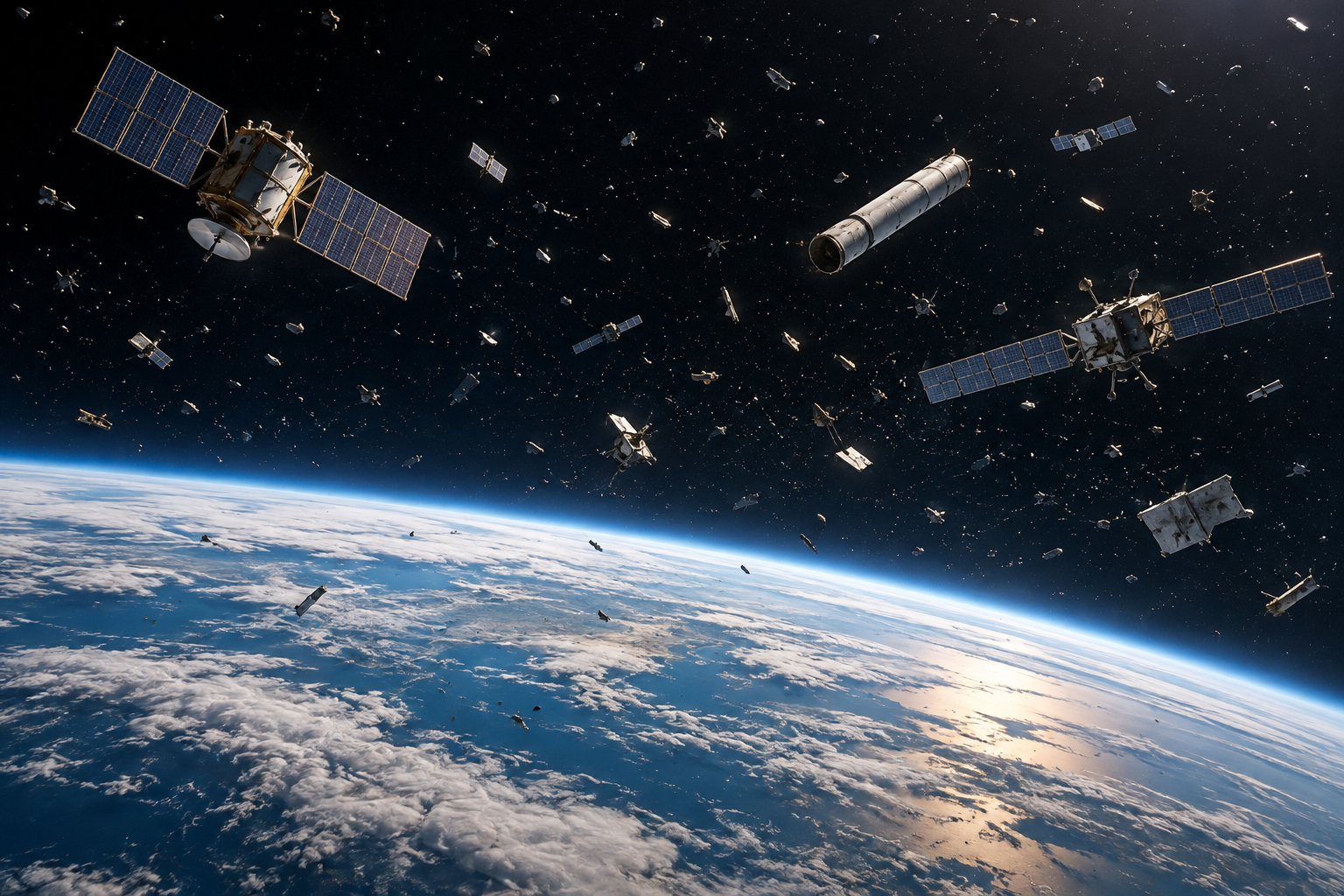
When we picture space, we picture silence: a vast, clean, empty dark. But the few hundred kilometres above our heads have quietly become one of the busiest and messiest neighbourhoods humans have ever built. There are tens of thousands of satellites up there, a growing blizzard of broken-off fragments, and a new kind of pollution that rockets and falling satellites deliver straight into the layer of air that shields us from the Sun.
Here’s why it lands close to home. Your phone’s map, your bank’s transaction timestamps, tomorrow’s weather forecast and the radio link in a rural ambulance all depend on a ring of orbits that we are filling faster than we are cleaning. So let’s go and see what is really up there.
A Much Busier Sky Than You Think
The sky above us is now a working neighbourhood, and the headcount is startling. ESA’s Space Debris Office, which keeps the most widely cited public tally, lists about 47,000 objects regularly tracked in Earth orbit, of which about 15,900 are working satellites.[1][2] One company dominates the working fleet. Orbital Radar’s tracking showed roughly 11,000 Starlink satellites in orbit on 1 November 2026, about 9,900 of them operational, which works out to roughly six in every ten active satellites on the planet.[3]
Traffic keeps climbing. In 2025, more than 300 launches put over 4,000 new payloads into orbit, around ten every day, while more than three intact satellites or rocket bodies fell back into the atmosphere daily.[4] The rest of what circles us is junk. ESA records more than 660 break-ups, explosions, collisions and other fragmentation events since the space age began, and more than 17,500 tonnes of hardware now orbit the planet.[1] Counts differ a little between catalogues and change daily, so treat every figure here as a snapshot.
What We Can’t See Is the Real Danger
Everything we can track is only the visible part of the problem. Tracking networks can only follow objects above a certain size, so the rest are estimated by models. ESA’s best estimate is about 1.5 million pieces between one and ten centimetres across, and about 230 million between one millimetre and one centimetre.[1] At orbital speeds, which are many times faster than a rifle bullet, even a speck can damage a spacecraft.
That is why scientists worry less about the total than about a feedback loop. In 1978, NASA researchers Donald Kessler and Burton Cour-Palais published a paper in the Journal of Geophysical Research predicting that as satellites multiplied, collisions would create fragments, and each fragment would raise the odds of further collisions, until a belt of debris circled the planet. They also noted that early launch rules and operating procedures could delay that belt significantly.[5] This idea is now called Kessler syndrome, and it is not just theory: China’s 2007 anti-satellite test alone increased the trackable debris population by 25%.[6]
ESA’s 2026 report says the loop is becoming visible sooner than expected. Even if no new satellites were launched, ESA warns, debris would keep growing, because fragmentation creates it faster than the atmosphere removes it. ESA’s Space Environment Health Index, normalised against a 2014 benchmark for acceptable behaviour, jumped from about 4 to about 50 in a single year, which means strain on orbit that is many times beyond what is sustainable. ESA is clear that this is a projection, not a count of collisions.[4]
A newer measure makes the fragility easier to feel. Sarah Thiele of Princeton, with Aaron Boley of the University of British Columbia and Samantha Lawler of the University of Regina, proposed the CRASH Clock: how many days it would take for a damaging collision if satellites suddenly lost the ability to manoeuvre, for example after a severe solar storm.[7] Their first estimate for mid-2025 was 2.8 days, compared with about 121 days in 2018. A later revision put it at 5.5 days, compared with 164 days for 2018.[8][9] Either way, the safety margin has shrunk from months to days. Starlink alone performed roughly 145,000 collision-avoidance manoeuvres in six months, and the authors stress that the clock is a probabilistic stress indicator, not a prediction that disaster arrives on a set date.[10] It is also a preprint, and as far as we could find it has not completed peer review.
Why This Is Your Problem Too
Orbit is infrastructure, and the bill for a bad day up there lands on the ground.
Weather. Satellites supply the bulk of the data behind modern forecasts. The UK Met Office estimates that around three quarters of existing forecast accuracy comes from satellite data.[11] A peer-reviewed study of forecast models found that in the southern hemisphere, a one-day forecast without satellite data was about as accurate as a four-day forecast with it.[12] Those forecasts decide when farmers plant, when airlines reroute and when storm warnings go out, and many weather satellites fly in polar low Earth orbits around 850 kilometres up, in the same orbital region where traffic is growing fastest.[11][4]
Money. A World Economic Forum and Novaspace analysis projects that debris could cost the space industry between $25.8 billion and $42.3 billion over 2025 to 2035, even without a major collision, through lost service, replacement satellites and extra avoidance manoeuvres. The report calls it a “hidden tax.”[13][14] A single major collision could push costs far higher, and the report puts the chance of a serious collision by 2032 at as high as 29% in certain altitude zones if nothing changes.[13][15] Costs like these rarely stay inside an industry for good; they tend to show up eventually in what the services cost.
GPS and your bank. The GPS satellites fly much higher, around 20,000 kilometres up, where the debris problem is far less severe today, so they are not the first thing at risk. What matters is how much of the ground economy sits on top of space systems. RTI International estimated for the US National Institute of Standards and Technology that GPS has generated about $1.4 trillion in economic benefits for the US private sector since the 1980s, and that losing it would cost about $1 billion a day.[16] A 2011 US government analysis found that 15 of 18 critical-infrastructure sectors use GPS timing, chiefly to timestamp data and transactions in banking and finance.[17] Anything that makes space operations riskier or pricier, from congestion in low orbit to the cost of launching replacements, reaches that economy sooner or later.
Connectivity, and a Canadian angle. Many remote and Indigenous communities in Canada now rely on low-orbit satellite internet. A 2025 analysis cited by Global News calls Starlink the only realistic option for rural and remote Canada until Telesat’s Lightspeed network comes online, and an expert quoted there pointed to northern wildfires as a case where low-orbit connectivity helped communities and first responders.[18] Lightspeed is planned for about 1,300 kilometres up, higher than Starlink.[19] If orbits become riskier, the people with the fewest alternatives would feel a disruption first, which is our reading of the evidence rather than a finding in those sources.
What falls back down. Canada learned long ago that space hardware can land. On 24 January 1978 the Soviet nuclear-powered satellite Cosmos 954 re-entered the atmosphere and scattered radioactive debris across roughly 124,000 square kilometres of the Northwest Territories and what is now Nunavut, Alberta and Saskatchewan.[20][21] Most of the reactor core burned up on re-entry, but crews still spent about nine months recovering more than 4,000 flakes of radioactive debris, at a cost of about $14 million at the time.[20] The debris field lay on lands where Dené, Métis and Inuit communities live, and scholars have documented how the government’s scientific authority was challenged from the very start of the cleanup.[21][22] Today ESA tracks a new metric, the on-ground casualty risk from fragments that survive re-entry. It remains low compared with everyday risks but has risen as traffic has grown.[4]
The Pollution Nobody Sees
Space traffic also pollutes the layer of the atmosphere that shields living things from harmful ultraviolet light, and the research on this is still early, mostly modelled, and honest about its uncertainty.
Rockets come first. Kerosene-burning rocket engines emit soot, or black carbon, directly into the stratosphere, where the ozone layer sits. NOAA-led modelling estimates that spaceflight puts about 1,000 tonnes of black carbon into the stratosphere each year, and that launch rates have more than tripled in recent decades.[23] Soot at that altitude absorbs sunlight and warms the air around it. When the NOAA team modelled a ten-fold larger emission of 10,000 tonnes a year, the stratosphere warmed by as much as about 1.5 degrees and ozone fell, mainly at high northern latitudes. The lead author said the outcome could expose people in the Northern Hemisphere to more harmful UV radiation.[23] A separate study by researchers at UCL, Cambridge and MIT found that, per unit of mass, soot from rockets traps heat about 500 times more efficiently than soot from surface and aviation sources. It also estimated that today’s launches and re-entries cut global ozone by only about 0.01%, but that a decade of sustained growth could reduce the upper stratosphere’s ozone by about 0.15% over high northern latitudes in spring, which could undermine part of the recovery won by the Montreal Protocol.[24]
Then there is what comes down. When satellites burn up on re-entry, their aluminium turns into aluminium oxide particles. These are known to speed up the chemistry that destroys ozone, and because the particles are not used up in the reaction, they can keep working for decades. A University of Southern California team estimated that a typical 250-kilogram satellite releases about 30 kilograms of aluminium oxide, that falling satellites released about 17 tonnes in 2022 (an eightfold rise since 2016), and that fully deployed planned constellations could release more than 360 tonnes a year, around 646% above natural levels.[25]
The metals are not just a modelling exercise. In 2023, NOAA-led researchers flying aircraft in the stratosphere found that about 10% of large sulfuric acid particles there contained aluminium and other elements matching spacecraft alloys, more than 20 elements in all. They calculated that the share could climb toward half if planned satellite numbers are launched, and they say the effect of that on the stratosphere is unknown.[26]
Here is a twist worth sitting with. One way to reduce the risk of fragments reaching the ground is design-for-demise, building satellites so they burn up completely. ESA says this needs to be coordinated with the atmosphere’s needs, and that the first job is collecting data on how much re-entry pollution there is.[4] Put the findings side by side and a fix for one problem could feed the other.
Keeping It in Proportion
None of this means the sky is falling tomorrow. Day to day, collision avoidance largely works, and Samantha Lawler, one of the CRASH Clock authors, has said that what operators can control is the number and density of satellites.[10] ESA also reports that adherence to debris-mitigation measures is rising, though it says progress needs to be faster and more consistent.[4] On the pollution side, rocket soot’s effect on the stratosphere currently looks small next to wildfires, although one researcher interviewed by National Observer argues it is clearly growing, and the NOAA-led team notes that direct measurements of pollutants in rocket plumes are still lacking.[27] The honest summary is that today’s damage is modest, the science is young, and the worry is the trend.
What Can Be Done
The levers with the best track record are the ones aimed at the people who build and launch the hardware. In 2022 the US Federal Communications Commission voted 4-0 to require low-Earth-orbit satellites to be disposed of within five years of the end of their mission, replacing a 25-year guideline, with a two-year transition for industry.[28] ESA’s 2026 report credits that shift from 25 years to five, along with better compliance, for the high number of satellites now being brought down at end of life, and notes that controlled re-entries of rocket bodies have outnumbered uncontrolled ones for a second year running.[4] The World Economic Forum report goes further: launch providers should commit to controlled re-entries and stop abandoning upper stages in congested orbits, while regulators write best practices into licensing conditions and, where appropriate, financial incentives that reward sustainable behaviour.[14] ESA adds that prevention alone is no longer enough, and that removing existing debris needs to begin soon.[4]
Mandates set the floor, and well-designed incentives can pull manufacturers above it, particularly for designs that come down cleanly and keep re-entry pollution low, an area where the science is still too young to write detailed rules.
So that is what is really up there: a crowded, fast-moving and increasingly fragile layer of infrastructure that we lean on every day, plus a quiet stream of exhaust and metal that we are only beginning to measure. None of it makes a bang on the evening news. But the weather forecast on your phone, the timestamp on your payment and the connection in a remote northern community all sit on top of it. What goes up does come down, one way or another: as heat in the stratosphere, as particles in the air, or as a bill.
Until next time, keep looking up, and keep asking what else is up there.
Sources
Numbered to match the footnotes above. Peer-reviewed papers are listed first where a claim rests on one; agency pages and news reports are noted as such. Counts of objects and satellites change daily and differ between catalogues.
- ESA Space Debris Office. Space debris by the numbers (statistics page, updated 2 November 2026).
- New Space Economy. ESA Space Environment Statistics Separate Satellites From Tracked Objects, 28 October 2026 (reports ESA’s 23 October 2026 statistics: about 47,270 tracked objects, 15,900 functioning satellites).
- Orbital Radar. 9,929 Starlink satellites active: Orbital Briefing, 1 November, 2026 (commercial tracker; the six-in-ten share is calculated from its Starlink and all-operator active counts).
- European Space Agency. ESA Space Environment Report 2026, 14 September 2026 (data through end of 2025).
- Kessler, D. J., and Cour-Palais, B. G. (1978). Collision frequency of artificial satellites: The creation of a debris belt. Journal of Geophysical Research, 83(A6), 2637-2646. doi:10.1029/JA083iA06p02637.
- European Space Agency. About space debris.
- Thiele, S., Heiland, S. R., Boley, A. C., and Lawler, S. M. (2025). An orbital house of cards: Frequent megaconstellation close conjunctions. arXiv preprint. doi:10.48550/arXiv.2512.09643 (not peer reviewed as far as we could find).
- The Register. The CRASH Clock is ticking as satellite congestion in low Earth orbit worsens, 12 December 2025 (first estimate: 2.8 days versus 121 days in 2018).
- TechSpot community report. The “Crash Clock” shows how close we are to the next satellite collision (revised estimate: 5.5 days versus 164 days in 2018).
- Space.com. Crash Clock reveals how soon satellite collisions would occur after a severe solar storm (Starlink manoeuvre count; comments from Thiele and Lawler).
- UK Met Office. Seeing the bigger picture: How satellite data shapes Met Office forecasts, 2025.
- The considerable impact of earth observations from space on numerical weather prediction. CSIRO Publishing (open-access journal article).
- World Economic Forum and Centre for Space Futures. Clear Orbit, Secure Future: A Call to Action on Space Debris, January 2026 (economic modelling by Novaspace).
- Advanced Television. Orbital debris a real danger, 3 February 2026 (summary of the WEF report’s cost range and recommendations).
- Leonard David. Report: Crowded orbits, a call to action on space debris (summary of the WEF report’s 29% collision-probability finding).
- National Institute of Standards and Technology. Economic Benefits of the Global Positioning System to the U.S. Private Sector Study, 2019 (study by RTI International; range of $0.9 to $1.8 trillion in RTI’s presentation).
- Caverly, R. J. (2011). GPS Critical Infrastructure: Usage, Loss Impacts, Backups, Mitigation. NOAA Space Weather Prediction Center presentation.
- Global News. Satellite communications, defence and Telesat’s low-orbit network.
- iPhone in Canada. Carney touts Telesat Lightspeed as Canada’s $7 billion rival to Starlink, 9 March 2026.
- Canadian Nuclear Safety Commission. Alan T. Prince (1975-1978): Operation Morning Light.
- CBC. In 1978, a Soviet satellite exploded over traditional Dene land. Its effects are still felt today.
- Cleaning up Cosmos: Satellite debris, radioactive risk, and the politics of knowledge in Operation Morning Light. The Northern Review, 48 (2018), 81-109. doi:10.22584/nr48.2018.004.
- Maloney, C. M., Portmann, R. W., Ross, M. N., and Rosenlof, K. H. (2022). The climate and ozone impacts of black carbon emissions from global rocket launches. Journal of Geophysical Research: Atmospheres, 127, e2021JD036373. doi:10.1029/2021JD036373; see also NOAA’s news release.
- Ryan, R. G., Marais, E. A., Balhatchet, C. J., and Eastham, S. D. (2022). Impact of rocket launch and space debris air pollutant emissions on stratospheric ozone and global climate. Earth’s Future, 10(6). doi:10.1029/2021EF002612.
- Ferreira, J. P., Huang, Z., Nomura, K., and Wang, J. (2024). Potential ozone depletion from satellite demise during atmospheric reentry in the era of mega-constellations. Geophysical Research Letters, 51(11). doi:10.1029/2024GL109280; see also the AGU press release and Scientific American’s report (eightfold rise since 2016).
- Murphy, D. M., et al. (2023). Metals from spacecraft reentry in stratospheric aerosol particles. Proceedings of the National Academy of Sciences, 120(43), e2313374120. doi:10.1073/pnas.2313374120 (link goes to NOAA’s summary of the paper; full text via doi.org/10.1073/pnas.2313374120).
- National Observer. The black carbon stain of rocket launches, 30 June 2022.
- Satellite Today. FCC adopts 5-year rule for deorbiting satellites, 30 September 2022 (FCC Second Report and Order, FCC 22-74).
Get new research articles and podcast episodes in your inbox