Category: Space

  • The Moon’s Dirty Secret: Why Lunar Bases Are Harder Than They Look

    The Moon’s Dirty Secret: Why Lunar Bases Are Harder Than They Look

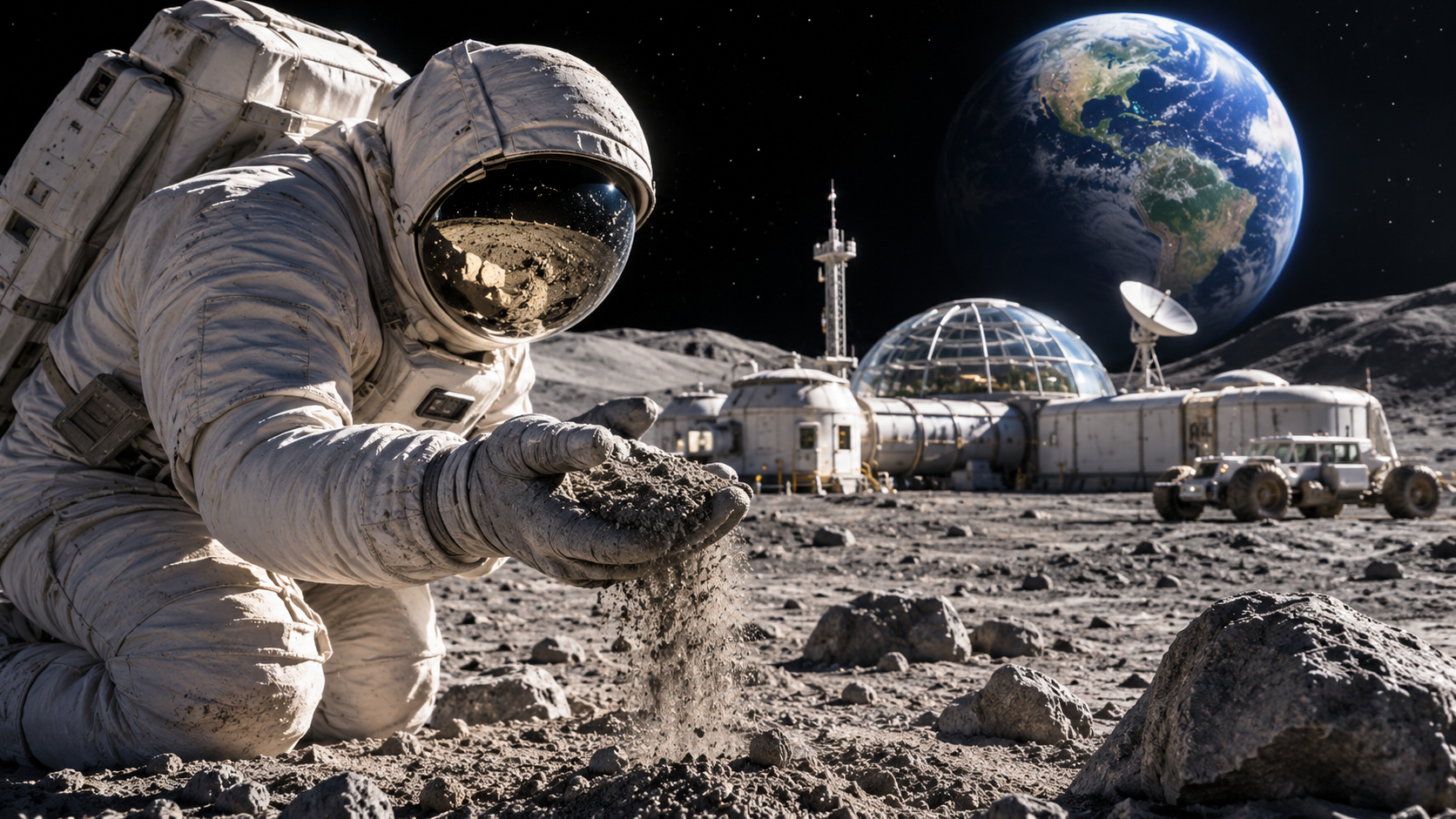
    Apollo 17 astronaut Harrison Schmitt walked on the Moon in 1972, and decades later he gave a verdict that engineers still repeat: dust is the single largest technical challenge to a long stay there. [1] Not rockets. Not radiation. Dust.

    That’s the first dirty secret. The second one is quieter, and it’s about who gets to dig. The Moon’s most valuable real estate may be dark, frozen craters at its poles, and 76 countries have now signed a US-led set of principles for how lunar resources can be used. [2] Whether those principles are fair, or even legal, is a live argument among space lawyers.

    So in this episode we’ll do two things. First, we’ll see why a lunar base is a much dirtier, harder project than the glossy artist renderings suggest. Second, we’ll follow the law and the money, because “who owns the Moon?” has a more complicated answer than “nobody.” If you caught our Mars episode, you’ll spot a few familiar themes, but you don’t need it. Let’s dig in.
    1. The dust is sharp, clingy and strange

    Moon dust is nothing like beach sand or the stuff under your couch. The Moon has no wind or water to wear its grains smooth, and researchers describe the dust as super-fine and sharp-edged. [4] It also clings to nearly everything it touches. [3]

    NASA engineer James Gaier combed through the records of all six Apollo landings and sorted the dust problems into nine categories: blocked vision, false instrument readings, dust coating, loss of footing, clogged mechanisms, abrasion, thermal control trouble, failed seals, and irritation from breathing it. [3] On Apollo 12, Pete Conrad’s suit lost pressure faster after each moonwalk. The leak rate climbed from 0.15 to 0.25 pounds per square inch per minute, against a safety limit of 0.30. [3] Planetary geologist Larry Taylor has said the dust wore through three layers of tough, Kevlar-like material on Jack Schmitt’s boot. [4]

    Remember, Apollo crews were on the surface for days. A lunar base means years of exposure, with more machines to keep alive. The dust is not a detail to be solved later. It is the main engineering problem.

    2. What the dust does to your lungs

    The honest answer is that nobody knows yet. Apollo astronauts reported irritation of the skin, eyes and airways after dust hitched a ride into the cabin on their suits. [4] A 2012 review in Planetary and Space Science, led by Dag Linnarsson, concluded that lunar dust is still incompletely characterized when it comes to human health. [5] For materials like asbestos, quartz and volcanic ash, the dangers have been studied in great detail, and lunar dust may behave very differently. [5] Breathing fine particles in general is linked to airway inflammation and more respiratory and cardiovascular illness, and the review argues that real answers will need measurements made on the Moon itself. [5]

    Think about who would face the longest exposure: not visiting astronauts, but the workers running machinery day after day. We know the dust is rude. We don’t yet know how rude.

    3. Rocket exhaust turns dust into shrapnel

    Landing on the Moon is a sandblasting event. When Apollo 12 came down, the crew’s view was essentially blind for the last 40 feet because of blowing dust. [6] Analysis of the plume suggests the dust moves at around 1 kilometre per second, which is about 3,600 kilometres an hour. [6]

    Apollo 12 landed about 160 metres from an older robot lander, Surveyor 3, and the astronauts brought pieces of it home. It had been scoured, and its surface carried hundreds of tiny pits, some about 100 microns wide, from high-speed soil grains. [6] That is the damage at 160 metres.

    Now scale it up. Artemis landers will be bigger and more powerful than Apollo’s, and NASA says it is unknown how much they will erode the surface or whether they will dig craters in the landing zone. [7] One analysis notes that if landers return to the same place again and again, as they would at a base, it will be necessary to prevent or block the spray. [6] Every arrival becomes a small sandstorm aimed at your neighbours.

    4. Cooked by day, frozen by night, and no shield

    The Moon’s temperature swings are brutal. At the equator, daytime surface temperatures reach about 387 to 397 kelvin, roughly 114 to 124 °C, and fall to around 95 kelvin, about −178 °C, just before sunrise. [8] The night lasts about 14 Earth days, with temperatures hovering near 100 kelvin for most of it. [9] In permanently shadowed polar craters it gets far colder: the crater floor hit by NASA’s LCROSS probe was estimated at about 38 kelvin, near −235 °C. [10]

    Radiation is the other invisible hazard. The Moon has no atmosphere and no global magnetic field to blunt it. China’s Chang’e-4 lander carried a German-built detector that measured about 1,369 microsieverts per day, roughly 2.6 times the daily dose inside the International Space Station and about 200 times the dose on Earth’s surface. [11] The researchers’ advice is to cover habitats with a thick layer of lunar soil. [11]

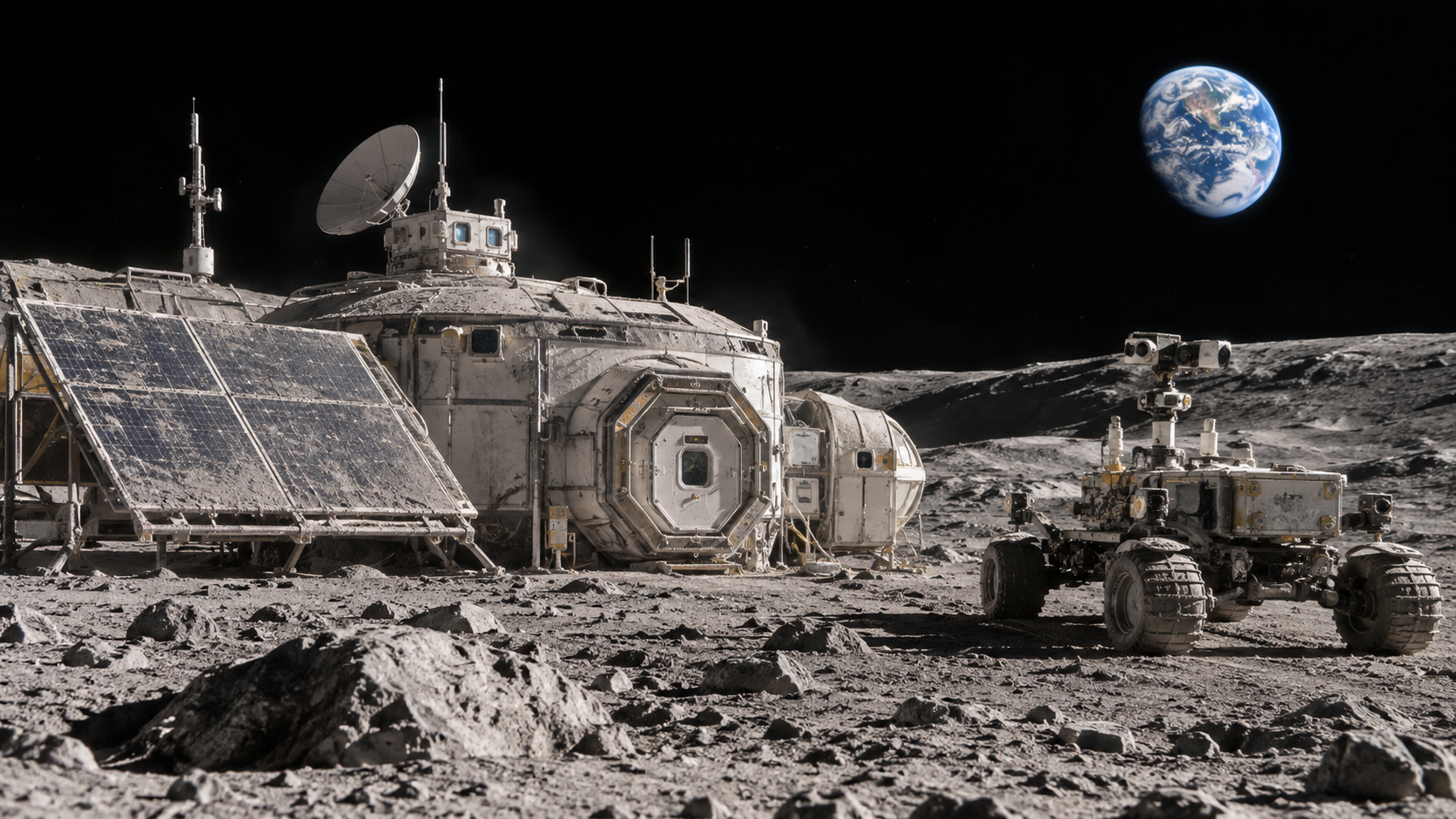
    So a lunar base likely means living under dirt and running machines that survive both a 120 °C afternoon and a deep-freeze night. It’s an engineering challenge, and nowhere near camping with a view.

    5. The prize: water in the dark

    So why go to such a hostile place? Water. In 2009, NASA’s LCROSS mission slammed a spent rocket stage into Cabeus crater near the south pole and measured the debris. It detected about 155 kilograms of water vapour and ice, and estimated that water ice made up roughly 5.6% of the soil at the impact site. [12] Later analysis found the water is patchy, concentrated in pockets rather than spread evenly. [13] In 2018, a study of Chandrayaan-1 data reported direct evidence of ice exposed on the surface in the shadowed polar regions. [14]

    Water matters because it can be drunk, split into oxygen to breathe, or turned into hydrogen and oxygen for rocket fuel. [14] That is why ice on the Moon is so attractive.

    It is also why NASA’s March 2026 “Ignition” plan puts a permanent base at the south pole. Reports put the cost at around $20 billion over seven years, though some say $30 billion over a decade. [15] And it is why China is eyeing the same landing sites. [16] The best real estate on the Moon is tiny: a few cold, dark craters. That sets up the question everybody should be asking next.

    6. Who owns the Moon?

    Short answer: no country can claim it. Article II of the 1967 Outer Space Treaty says the Moon and other celestial bodies are not subject to national appropriation by claim of sovereignty, use, occupation or any other means. [17] Long answer: that rule is murky on whether anyone can take things from the Moon and keep them.

    The United States has answered with a law. A 2015 statute says US citizens who commercially recover a space resource are entitled to own, transport, use and sell what they obtain. [18] The logic is a fishing analogy: no nation owns the ocean, but fishermen own their catch. Critics reply that a country cannot hand out rights it does not itself hold. [19] An older treaty, the 1979 Moon Agreement, calls the Moon’s resources the common heritage of humankind and promises an international regime, but it had only 18 parties as of 2023, none of them a leading space power. [17][20]

    Enter the Artemis Accords, a US-led set of non-binding commitments saying that extracting space resources does not by itself amount to national appropriation. They also allow “safety zones” around operations. [17][20] Critics argue the zones create quasi-territorial effects, claims by another name. [21][22] Defenders say zones are needed to keep operations safe in a hostile environment. [22] A total of 76 countries have signed, though the Accords bind only governments and cover only civil activities. [2][23]

    There is a rival club. China and Russia lead the International Lunar Research Station, which aims to build a basic base by 2035 and hopes to work with 50 countries. [24] China targets a crewed landing by 2030, and the US aims for its first Artemis landing in 2028, on Artemis IV. [25][26]

    Two clubs, two rulebooks, one frozen crater.

    7. The mining dream

    Water is the practical prize. The glamorous one is helium-3, a rare isotope that is scarce on Earth but deposited across the Moon’s surface by the solar wind. Scientists estimate on the order of a billion kilograms is lying there, and one lunar geoscientist calls it “where the money is.” [27] Interlune, a Seattle company, says a kilogram could be worth around $20 million, and it plans an exploration mission in 2027 to measure how much is really at its target site. [28][29] Helium-3 is wanted for things like cooling quantum computers and, possibly, fusion fuel. [27][29]

    Here comes the cold water. USGS geologist Laszlo Keszthelyi estimates that 100,000 to 1 million tons of regolith would have to be processed to get one kilogram, a ratio comparable to copper mining on Earth, and a USGS study classes helium-3 as probably unmineable. [29] There are too few measurements so far to say whether it will pay. [29]

    The law is just as untested. Helium-3 would be among the first things miners try to own under the 2015 US law, in a place where the international rules are disputed. [17][18] That’s a land rush before the rulebook.

    8. Lessons from Earth’s mines

    Space-mining scholars keep looking back at Earth, because we have been here before. A 2025 perspective in Frontiers in Space Technologies compares seabed mining with lunar extraction and argues that without just and equitable regulation of the oceans, similar oversights are likely on the Moon. [30] Planetary astronomer Andrew Rivkin points out that space mining needs advanced technology and large amounts of starting capital, which concentrates the wealth, and that mining on Earth has a long history of colonial decision-making that harmed Indigenous people. [31] He suggests environmental impact assessments, now standard for big mines on Earth, could be applied to space. [31]

    Academic geographers add an Earth-side worry: the uneven distribution of space-mining wealth, and the impacts on existing mining communities in the Global South. [32] A 2025 policy brief from the Centre for International Governance Innovation suggests that Indigenous frameworks, which govern how to use land without owning it, could be a model for shared international use of outer space, and says a legal system should be in place before claims are made. [33]

    The scholars’ message is consistent: write the fair rules first, because they are much harder to fix after the digging starts.

    9. A fair hearing for the Moon, and a Canadian footnote

    The Moon deserves a fair hearing. It is days away rather than months, and in April 2026 the Artemis II crew flew a 10-day loop around it, farther from Earth than any humans have travelled. [34] NASA frames a Moon base as a proving ground for Mars. [35] That makes sense: it is a far better place to learn how to live off-world, because help is days away rather than years. Even the dust, radiation and water questions are things we can only really answer by going. So the honest verdict is: worth exploring, still hard, and the legal map needs drawing before the digging starts.

    A Canadian footnote. Jeremy Hansen, from London, Ontario, flew on Artemis II as the first non-American to travel beyond low Earth orbit, and Canada was the first nation to join the Artemis program. [36] But the plan has shifted around Canada’s contributions. NASA paused the Gateway station for which Canada’s Canadarm3 robotic arm was being built, and the Canadian Space Agency cancelled its water-seeking lunar rover in its 2026-27 spending plan, though a utility rover continues. [37] The agency says it will repurpose the Canadarm3 work toward lunar surface operations. [38]
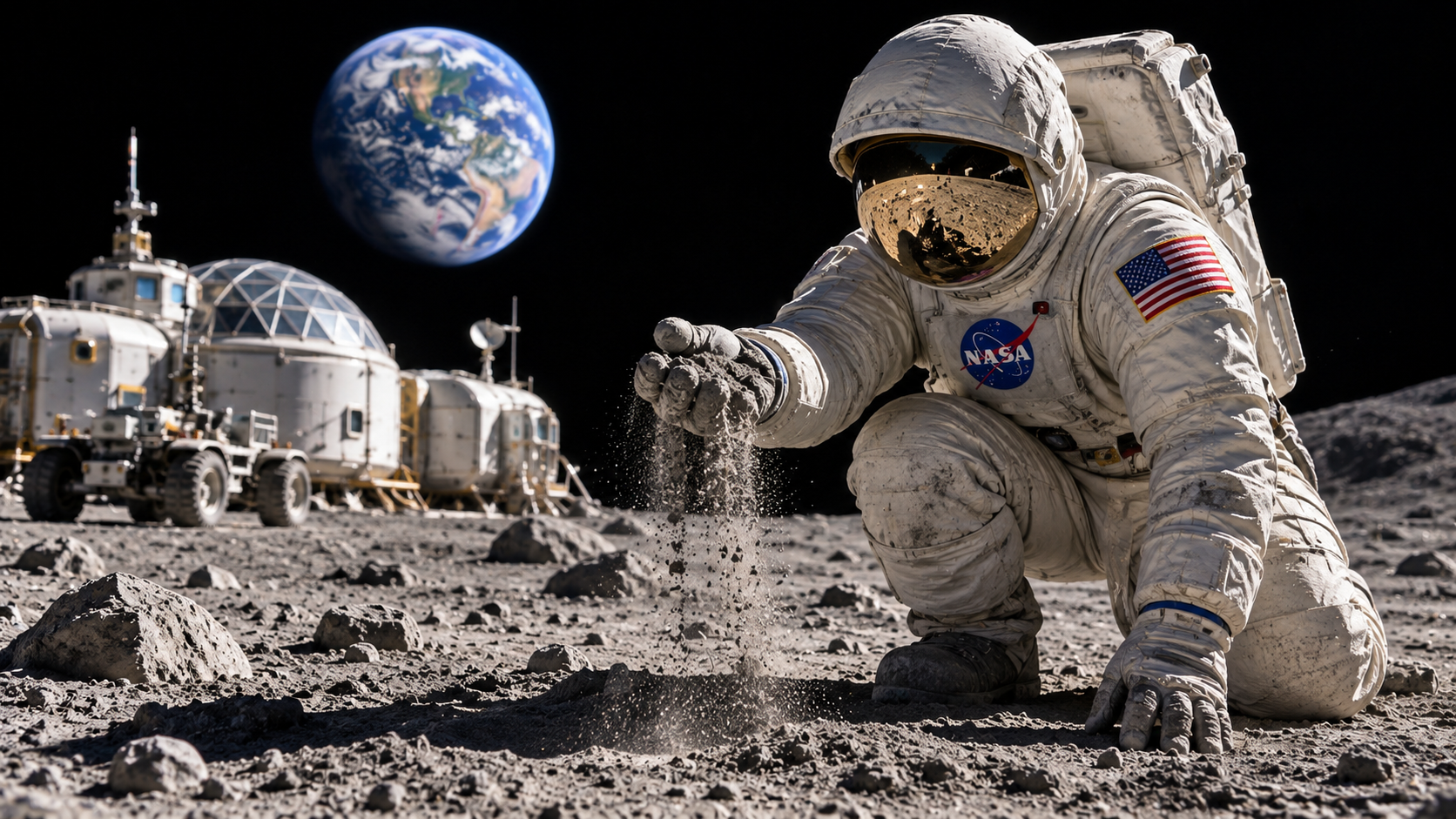
    Let’s do the scorecard. Dust that chews through boots and seals. Lungs we haven’t tested against it. Landings that sandblast the neighbours. A 120 °C afternoon followed by a two-week freeze. Radiation about 200 times what you get on Earth. And a handful of frozen craters that two rival clubs both want.

    The Moon is still worth the trip. It’s the closest place to learn how to live off-world, and what we find there will teach us a lot. But the story we’re told is usually about rockets and flags. The harder story is about dirt, and about rules. Who owns what’s in those craters? Who writes the rulebook? And who gets left out when the digging starts?

    Those rules are being written right now, long before anyone has built so much as a bathroom on the Moon, and the habits we set there tend to stick. So pay attention, ask who benefits, and keep asking. Thanks for listening.

    Footnotes and sources

    Numbers in brackets match the notes below. Peer-reviewed papers are listed with journal and DOI where available. Temperature conversions from kelvin to Celsius and the speed conversion (1 km/s to 3,600 km/h) are our own arithmetic.

    1. NASA, conference paper NASA/CP-2007-214995 (2007), quoting Apollo 17 astronaut Harrison Schmitt on lunar dust. Link
    2. NASA, “NASA Celebrates as Artemis Accords Surpasses 75 Signatories” (updated Sep 28, 2026; 76 countries).Link
    3. Gaier JR. The effects of lunar dust on EVA systems during the Apollo missions. NASA/TM-2005-213610/REV1 (2007). Link; see also NASA Glenn presentation on Apollo 12 suit pressure decay. Link
    4. Phys.org / Universe Today, “The moon is toxic” (July 11, 2012), reporting the Linnarsson et al. review and quoting Larry Taylor. Link
    5. Linnarsson D, Carpenter J, Fubini B, et al. Toxicity of lunar dust. Planetary and Space Science 2012;74:57–71. arXiv:1206.6328. Link
    6. “ISRU implications for lunar and Martian plume effects,” arXiv:2104.06248 (Apollo 12 landing, Surveyor III damage, plume velocity). Link
    7. NASA, plume-surface interaction simulation of the Apollo 12 landing and Artemis lander implications. Link
    8. Williams J-P, Paige DA, Greenhagen BT, Sefton-Nash E. The global surface temperatures of the Moon as measured by the Diviner Lunar Radiometer Experiment. Icarus 2017;283:300–325. doi:10.1016/j.icarus.2016.08.012.
    9. Paige DA, et al. The Lunar Reconnaissance Orbiter Diviner Lunar Radiometer Experiment. Space Science Reviews (2010), on the 14-day lunar night and polar temperatures. Link
    10. Paige DA, Siegler MA, Zhang JA, et al. Diviner Lunar Radiometer observations of cold traps in the Moon’s south polar region. Science 2010;330(6003):479–482. doi:10.1126/science.1187726.
    11. Zhang S, Wimmer-Schweingruber RF, Yu J, et al. First measurements of the radiation dose on the lunar surface. Science Advances 2020;6(39):eaaz1334. doi:10.1126/sciadv.aaz1334; Kiel University / DLR news release (Sept 2020). Link
    12. Colaprete A, Schultz P, Heldmann J, et al. Detection of water in the LCROSS ejecta plume. Science 2010;330(6003):463–468. doi:10.1126/science.1186986.
    13. NASA Ames, LCROSS/LRO results release (Oct 2010). Link
    14. Li S, et al. Direct evidence of surface exposed water ice in the lunar polar regions. PNAS 2018, as reported by Scientific American (link) and Astronomy (link).
    15. SpacePolicyOnline, “NASA rolls out new Moon plan” (Mar 2026) (link); Astronomy, “NASA’s $30B plan to build a Moon base” (Mar 25, 2026) (link); 21st Century Tech (about $20 billion over seven years) (link).
    16. Live Science, “NASA announces near-impossible space plans including $20B Moon base” (Mar 2026). Link
    17. Bartóki-Gönczy B, Nagy B. Introductory note to the Artemis Accords. International Legal Materials 2023. doi:10.1017/ilm.2023.17 (quotes Outer Space Treaty Article II; Moon Agreement membership).
    18. Commercial Space Launch Competitiveness Act of 2015, 51 U.S.C. § 51303 (asteroid and space resource rights). Link
    19. The Space Review, commentary on the SPACE Act and the Outer Space Treaty (2015). Link
    20. American Society of International Law, “The Artemis Accords and the future of international space law,” ASIL Insights vol. 24, issue 31. Link
    21. O’Brien D. “Is outer space a de jure common-pool resource?” The Space Review (commentary arguing safety zones conflict with Article II). Link
    22. Fritz G. “Who owns the Moon? Non-appropriation, commercial use, and the new space economy” (Apr 15, 2026). Link
    23. SpacePolicyOnline, “Serbia, Mauritius bring Artemis Accords to 70” (July 2026), noting the Accords apply only to governments and civil activities. Link
    24. SpaceNews, “China aims to work with 50 countries on ILRS lunar south pole base program.” Link
    25. Asia Times, “US-China space race shifts into a higher lunar gear” (Apr 2026). Link
    26. BBC Sky at Night Magazine, “Artemis III won’t land on the Moon, as NASA adds an extra mission.” Link
    27. Scientific American, “Can helium-3 create a ‘gold rush’ on the Moon?” Link
    28. Popular Science, “A startup wants to mine the moon for helium.” Link
    29. heise online, “Interlune: Helium-3 from the moon for quantum computers on Earth” (interview-based report citing USGS geologist Laszlo Keszthelyi). Link
    30. Pelton JN, Mishra N, Elia Vitoloni M. Mining the ocean floor vs mining the Moon: what can we learn from our past experiences? Frontiers in Space Technologies 2025;5:1499486. doi:10.3389/frspt.2024.1499486.
    31. Rivkin A. “The problems with space mining no one is talking about,” 360info (Sept 2022). Link
    32. Deberdt R, Le Billon P. Outer space mining: exploring techno-utopianism in a time of climate crisis. Annals of the American Association of Geographers 2023;113(8):1878–1899. doi:10.1080/24694452.2023.2201339.
    33. Silk MSW, Redfern M. Developing a space ethic respectful of Indigenous cultures. Centre for International Governance Innovation, Policy Brief No. 211 (Oct 2025). Link
    34. NASA, “NASA welcomes record-setting Artemis II moonfarers back to Earth” (Apr 10, 2026). Link
    35. SpaceQ, “NASA unveils new Moon base plans, pauses Lunar Gateway.” Link
    36. The Canadian Press / CTV News, “Canadian astronaut Jeremy Hansen and NASA crewmates to hold news conference” (Apr 2026). Link
    37. Space.com, “Canada cancels its 1st moon rover: ‘It’s hopefully not a lost cause’” (Mar 2026). Link
    38. The Logic, “CSA adapts to Gateway cancellation” (Apr 10, 2026). Link

    Earth Reform Logo

    Subscribe For Our Latest News

    ← Back

    Thank you for your response. ✨

  • Plan B Doesn’t Exist: Why Mars Can’t Save Us

    Plan B Doesn’t Exist: Why Mars Can’t Save Us

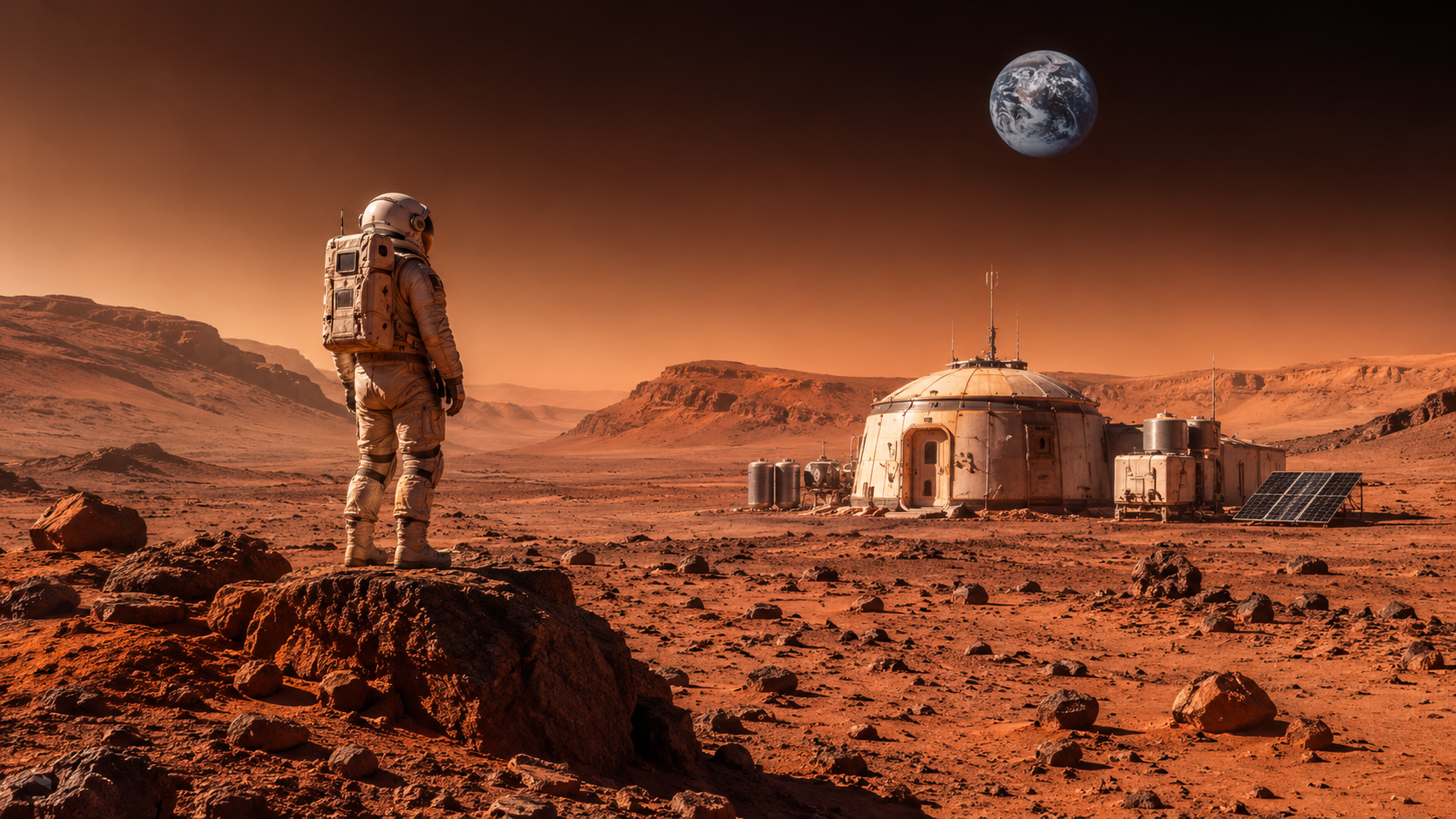
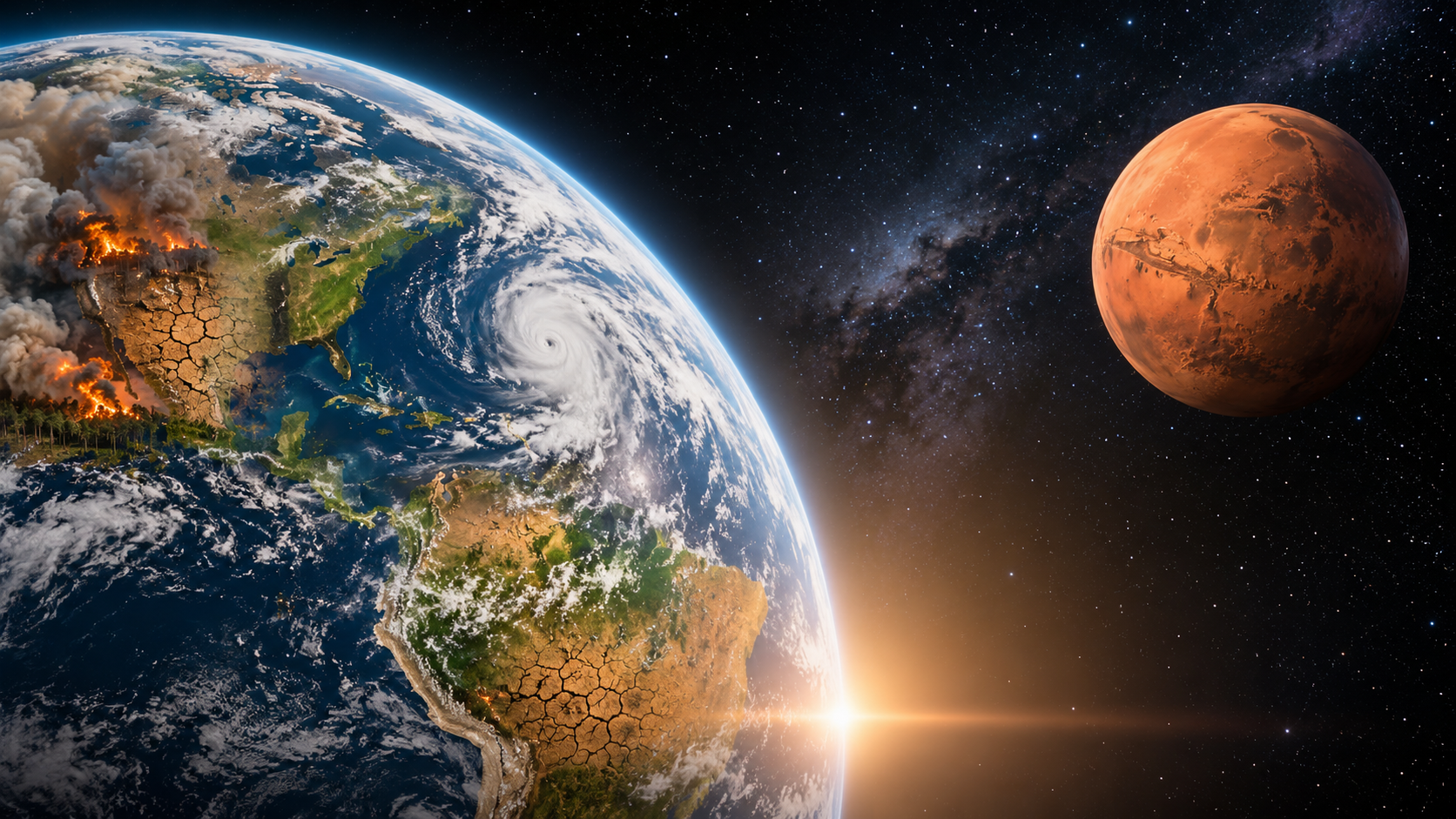
    Picture the worst day Earth could ever have. A dinosaur-sized asteroid. A full-scale nuclear war. Runaway climate change. Now picture Mars on its best day, when absolutely nothing goes wrong. Which planet would you rather wake up on?

    Astrophysicist Adam Becker says the wrecked Earth wins, and it isn’t close. Even a battered Earth keeps breathable air, liquid water in many places, and usable gravity. Mars offers none of those. [1]

    The timing for this conversation is perfect. Earth and Mars line up for an efficient trip only about every 26 months, and the current window is open right now. [2] SpaceX once planned to send up to five uncrewed Starships through it, but in February 2026 Elon Musk shifted the company’s focus to the Moon, and no Starship is scheduled for this window. [3]

    So let’s be a little rude to the “Plan B” fantasy and check it against the physics. We’ll start with the strangest fact of all: on Mars, water can’t decide whether to boil or freeze. Stay with me.

    1. The planet where water boils and freezes at the same time

    Water boils at 100 °C only at sea level, and on Mars it can barely stay liquid at all. Boiling happens when water’s vapor pressure matches the air pressure around it, so lower the air pressure and the boiling point drops. At the summit of Mount Everest, where the pressure is about a third of sea level (33.7 kilopascals), water boils at roughly 70 °C. [4] That’s why a mountaineer’s cup of tea is always a disappointment.

    Now keep climbing. About 19 kilometres above Earth, the pressure falls to roughly 6.3 kilopascals, a point called the Armstrong limit. Here water boils at 37 °C, which is normal human body temperature. Without a full pressure suit, the water in your tissues begins turning to vapor, a condition called ebullism. It is generally considered fatal, though a few exposures have been survived when pressure was restored quickly. [5]

    Now the punchline. The average air pressure on Mars is about 600 pascals. That is roughly a tenth of the Armstrong limit and about 0.6% of Earth’s sea-level pressure. [6] It sits almost exactly on the “triple point” of water, the narrow condition where ice, liquid and vapor can coexist. Below about 6.1 millibars, water can only exist as ice or vapor. [7] Add a temperature that averages around −60 °C, swinging from −140 °C at the poles to about 20 °C at an equatorial noon. [6]

    In plain terms, a puddle of melted ice on Mars would boil or evaporate almost immediately, and ice tends to skip the liquid stage entirely. Salty brines can resist freezing and boiling a bit better, and Mars has plenty of salts, so brief films of liquid may be possible. But that’s no lake you could drink from. [6]

    Here is why this matters to anyone dreaming of moving there: every human on Mars would live inside a sealed pressure vessel. One cracked seam or power failure puts you in the situation described above. On even the most damaged corner of Earth, you can still step outside and breathe.

    2. Nothing to breathe

    Mars’s air is about 95% carbon dioxide, so there is nothing there to breathe. [1] We can pull oxygen out of that CO₂, and NASA proved it: the MOXIE experiment on the Perseverance rover made oxygen from Martian air. That is a genuine milestone. It is also tiny. MOXIE made about 6 grams an hour, roughly 50 grams across its first seven runs in 2021, and about 122 grams in total according to later coverage, which is around ten hours of air for a small dog. [8]

    Scaling up is the real problem. MOXIE’s own team says a full-size unit would need to produce 2 to 3 kilograms an hour, and that is just to stockpile enough oxygen for a rocket to leave, not to supply a town. [9] Every breath on Mars would have to be manufactured, forever, by machines that cannot be allowed to break.

    3. A radiation problem you can’t see

    Mars has almost no shield against radiation. Earth has two: a thick atmosphere and a global magnetic field. Mars has a very thin atmosphere and no global magnetic field. [1] NASA’s Curiosity rover carried a radiation detector that measured about 0.67 millisieverts per day on the surface, and 1.8 millisieverts per day during the trip, inside the spacecraft. [10]

    For scale, the average person on Earth absorbs about 2.4 millisieverts in an entire year. In Canada it is about 1.8. [11] By our arithmetic, 0.67 millisieverts a day adds up to roughly 245 a year on the Martian surface, about a hundred times the world average.

    NASA caps an astronaut’s career at 600 millisieverts, a limit designed to hold the extra lifetime risk of dying from cancer to about 3%. [12] The six-month journey alone is estimated at about 300 millisieverts. [10] Researchers have noted that a full Mars mission would far exceed that career limit. [13]

    This is a hard biological ceiling, not an engineering inconvenience. You can’t out-enthuse a cosmic ray.

    4. The dirt is poisonous

    Martian soil contains perchlorate, a salt that interferes with the thyroid. NASA’s Phoenix lander found it in the arctic plains in 2008, and it was the mission’s biggest surprise. [14] Later reviews put perchlorate at roughly 0.5% to 1% of Martian soil. [15] It blocks the thyroid from taking up iodine, and thyroid hormones help run your metabolism and growth. [15] Unlike on the Moon, even the finest Martian dust is a potential hazard, because it carries the chemical. [15] The only place on Earth with comparable natural levels is Chile’s Atacama Desert. [16]

    Growing food means treating or washing the soil first, which complicates farming. [1] So on Mars the dirt, the dust and the air are all working against you. There is one small silver lining: perchlorate can also be a source of oxygen and a resource for fuel. [15]

    5. Gravity, and the next generation

    Mars’s gravity is only 38% of Earth’s, and nobody knows whether that is enough for a healthy life. [17] We know what weightlessness does: even healthy astronauts lose bone and muscle. [17] Mars is better than orbit, but no human has ever lived long-term at 0.38 g.

    The biggest unknown is children. No mammal has yet conceived, gestated and given birth in space. [17] Reviews of reproductive health in microgravity flag major knowledge gaps, and pregnancy is considered off-limits in spaceflight today. [18] Animal studies suggest some stages of pregnancy are possible in lower gravity, but they also point to concerns for fetal development. [19]

    A settlement that can’t safely have babies isn’t a settlement. It’s an expensive camp.

    6. Far, slow, and no rescue

    A one-way trip takes roughly seven to nine months with today’s rockets. [20] The efficient launch windows open only about every 26 months, and radio messages take between roughly 3 and 22 minutes each way depending on where the planets sit. [2] Real-time conversation is impossible.

    Picture a medical emergency on Mars at 2 a.m. Earth hears about it after a coffee break, and no rescue ship can leave for about two years. On Earth, even in remote places, help is a phone call away. On Mars, you are your own ambulance.

    7. Terraforming is science fiction, for now

    Can’t we just make Mars more Earth-like? The best published inventory says not with today’s technology. A 2018 Nature Astronomy study by Bruce Jakosky and Christopher Edwards tallied the CO₂ left on Mars, in polar ice, minerals and soil, and concluded there isn’t enough accessible to thicken the atmosphere. [21] Even processing every source would only raise surface pressure to about 7% of Earth’s, according to a summary of the paper. [22]

    And Mars leaks. NASA’s MAVEN spacecraft found the solar wind strips away gas at roughly 100 grams every second, and faster during solar storms. [23] Scientists think Mars lost its global magnetic field about four billion years ago, which let the solar wind strip much of the atmosphere. [24] That loss is slow on human timescales, but it is a reminder that Mars has no shield to protect a thicker atmosphere, even if we could build one.

    Earth, by contrast, keeps its air thanks to a magnetic shield we got for free. [24]

    8. We already built a miniature Earth, and it ran short of air

    In 1991, eight people sealed themselves inside Biosphere 2, a giant glass-and-steel ecosystem in Arizona built to test whether people could live in a closed system. [25] Within about 16 months, oxygen fell from 20.9% to roughly 14.4%. [26] Scientists eventually worked out that soil microbes were using up oxygen while exposed concrete soaked up the carbon dioxide, locking the oxygen away as calcium carbonate. [25] Outside oxygen was pumped in during 1993 to keep the crew safe. [27]

    Here is the sobering part. Biosphere 2 had Earth’s own stable atmosphere right outside the glass, and it still got into trouble. A sealed bubble on Mars would have a poisonous, near-vacuum atmosphere outside.

    The story has a nice ending, though. Biosphere 2 is now a University of Arizona research facility, used to study things like drought, ocean acidification and the effects of carbon dioxide. [28] The failed escape pod became an Earth-science lab.

    9. A fair hearing for the other side

    Not everyone thinks going to Mars is a bad idea, and the best arguments deserve a hearing. The strongest is insurance. Philosopher Joseph Gottlieb argues that settling Mars could help ensure the long-term survival of the human species, a goal with enormous moral weight. [29] Mars exploration also drives science, discovery and inspiration. Even Adam Becker’s critique is not anti-space: he says exploring Mars still matters for science. [1]

    Where it gets tricky is the details. Scientific American’s review of the space-ethics debate notes that a Mars settlement only lowers extinction risk if it is genuinely self-sufficient, and that some risks, such as rogue AI, would follow us there. [30] Everything above is why self-sufficiency is so hard. The same review argues that many of the other goals could be met with far less risk and expense through smaller exploration missions. [30] So explore Mars, absolutely. Just don’t mistake it for a lifeboat.

    A Canadian footnote. Canada has a hand in this story. Researchers test Mars exploration gear at the Haughton-Mars Project on Devon Island, Nunavut, the largest uninhabited island on Earth, a cold, dry, rocky polar desert. [31] Even so, its average temperature of about −17 °C is far milder than Mars’s roughly −60 °C. [32] Canadian instruments have flown there too: the Phoenix lander’s Canadian laser instrument detected snow falling from Martian clouds. [33] And Canada’s astronaut career radiation limit is 1,000 millisieverts, higher than NASA’s 600. [34]

    10. Who gets a ticket, and who pays?

    This is where Mars stops being a space story and becomes an Earth story. NASA’s inspector general warned in 2024 that a multi-decade Moon-to-Mars effort could easily cost hundreds of billions of dollars. [35] The Artemis Moon program alone was projected to top $93 billion through 2025. [36] Those bills land on taxpayers, including in wealthy countries like Canada and the United States.

    Then there’s the question of who would actually go. Musk’s stated dream is a settlement of up to a million people. [1] Even on the most ambitious plan, most of humanity would still be left on Earth.

    Meanwhile, Earth’s own emergency is solvable. Global surface temperature is about 1.1 °C above the 1850 to 1900 average, and human activity is the cause. [37] That is already doing real harm, but it is nothing like a planet that averages −60 °C with nothing to breathe. Becker calls the Mars-as-Plan-B story a form of “insidious climate denial,” because it implies we can escape rather than repair. [1]

    It also points to where the effort belongs. If we are going to spend hundreds of billions on ambition, Earth Reform’s view is that a real share belongs in cleaning up industry here, with firm standards for manufacturers and tax incentives that help them retool, rather than pushing the bill onto people at the gas pump.

    So here’s the scorecard. Water that boils and freezes at once. Air you can’t breathe. Radiation about a hundred times Earth’s average. Soil that interferes with your thyroid. Gravity nobody has tested on children. A two-year wait for a rescue. And a glass bubble in Arizona that couldn’t keep its own air.

    Mars is a magnificent place to explore, and we should keep sending robots, scientists and, one day, maybe people to learn from it. But as a backup for Earth, it fails every test we can throw at it. A ruined Earth is still more livable than Mars at its best.

    The good news is that Earth isn’t ruined. It’s about 1.1 degrees warmer, it’s fixable, and the fix is a matter of will and smart incentives, not miracles. There is no Plan B planet, which means Plan A deserves our full attention.

    If this changed how you picture the “escape to Mars” story, share it with someone who still thinks we can just move. Thanks for listening.

    Footnotes and sources

    Numbers in brackets match the notes below. Peer-reviewed papers are listed with their journal and DOI. Two figures are our own arithmetic from the cited data: the roughly 70 °C boiling point on Everest (from standard water vapor-pressure data) and the roughly 245 millisieverts a year of Martian surface dose (0.67 × 365).

    1. Futura-Sciences, “Mars isn’t Plan B: why Earth stays more livable — no matter what” (Feb 6, 2026), summarizing astrophysicist Adam Becker’s statements to Rolling Stone (July 2025) and DeSmog (Feb 3, 2026). Link
    2. 19FortyFive, “The Mars Launch Window Opens in November 2026 and Closes About a Month Later” (link); Space.com, “How long does it take to get to Mars?” (26-month windows; 3 to 22 minute signal delay) (link).
    3. Mars Progress live tracker, checked Nov 2026 (no Starship scheduled for the late-2026 window) ([link](https://marsprogress.com/)); Promise Tracker, “Starship Mars,” on Musk’s Feb 8, 2026 Moon-first post ([link](https://spacenexus.us/promises/starship-mars)); Zafar R., Wccftech (Aug 6, 2025), on Musk’s earlier timeline slip. Link
    4. West JB, Lahiri S, Maret KH, Peters RM Jr, Pizzo CJ. Barometric pressures at extreme altitudes on Mt. Everest: physiological significance. J Appl Physiol 1983;54(5):1188–1194. doi:10.1152/jappl.1983.54.5.1188 (253 Torr, or 33.7 kPa, at the summit; see also West JB, Extreme Physiology & Medicine 2012, PMC3710103).
    5. Murray DH, Pilmanis AA, Blue RS, et al. Pathophysiology, prevention, and treatment of ebullism. Aviat Space Environ Med 2013;84(2):89–96. doi:10.3357/ASEM.3468.2013.
    6. Nair CPR, Unnikrishnan V. Stability of the liquid water phase on Mars: a thermodynamic analysis considering Martian atmospheric conditions and perchlorate brine solutions (2020). PubMed Central PMC7191838. Link
    7. NASA Mars Education, “Testing Your Hypothesis by Boiling Water Below Its Boiling Temperature” (classroom module on the triple point). Link
    8. Hoffman JA, Hecht MH, et al. Mars Oxygen ISRU Experiment (MOXIE): preparing for human Mars exploration. Science Advances 2022. doi:10.1126/sciadv.abp8636; MIT News, “MOXIE experiment reliably produces oxygen on Mars” (Aug 31, 2022), which also carries press coverage of the 122-gram total. Link
    9. Popular Science, “Perseverance’s MOXIE tool turns Martian air into pure oxygen” (Aug 2022), quoting MOXIE deputy principal investigator Jeffrey Hoffman. Link
    10. Hassler DM, Zeitlin C, Wimmer-Schweingruber RF, et al. Mars’ surface radiation environment measured with the Mars Science Laboratory’s Curiosity rover. Science 2014;343(6169):1244797. doi:10.1126/science.1244797. The 180-day trip estimate is from Phys.org’s coverage of Hassler’s findings (Feb 2014). Link
    11. Canadian Nuclear Safety Commission, “Natural background radiation” fact sheet (Nov 2020), citing UNSCEAR. Link
    12. NASA Office of the Chief Health and Medical Officer, Radiation Protection Technical Brief (Dec 2022) on NASA-STD-3001, and OCHMO Standards Overview (2021). Link
    13. Frontiers in Nuclear Medicine (2022), doi:10.3389/fnume.2022.997718, discussing NASA’s 600 mSv career limit and Mars-mission doses. Link
    14. Hecht MH, Kounaves SP, Quinn RC, et al. Detection of perchlorate and the soluble chemistry of martian soil at the Phoenix Lander site. Science 2009;325(5936):64–67. doi:10.1126/science.1172466; NASA/JPL release (July 2, 2009), via Spaceflight Now.
    15. Davila AF, Willson D, Coates JD, McKay CP. Perchlorate on Mars: a chemical hazard and a resource for humans. Int J Astrobiol 2013;12(4):321–325. doi:10.1017/S1473550413000189.
    16. Catling DC, Claire MW, Zahnle KJ, et al. Atmospheric origins of perchlorate on Mars and in the Atacama. J Geophys Res 2010;115:E00E11. doi:10.1029/2009JE003425.
    17. The Gist, “Birth beyond Earth: can we have babies in space?” (Oct 2025). Link
    18. Cutigni M, Cucina G, Galante E, Cerri M, Bizzarri M. Microgravity impairs endocrine signaling and reproductive health of women: a narrative review. Front Physiol 2025;16:1558711. doi:10.3389/fphys.2025.1558711.
    19. Life Sciences, Society and Policy (2016), article on pregnancy in space in the context of the Mars One mission. doi:10.1186/s40504-016-0043-5.
    20. NewSpace Economy, “How far away is Mars? Distance, delay and what it means for getting there” (Apr 18, 2026). Link
    21. Jakosky BM, Edwards CS. Inventory of CO₂ available for terraforming Mars. Nature Astronomy 2018;2:634–639. doi:10.1038/s41550-018-0529-6.
    22. Sci.News, “Mars terraforming is not possible using currently available technology, researchers say” (July 31, 2018). Link
    23. University of Colorado Boulder, “Solar wind strips Martian atmosphere” (Nov 5, 2015), on Jakosky BM et al., Science 2015;350(6261):aad0210. doi:10.1126/science.aad0210. Link
    24. Space.com interview with MAVEN principal investigator Bruce Jakosky, “Mars’ Lost Atmosphere: MAVEN Probe Scientist Explains New Finding.” Link
    25. Rosen J. “Benchmarks: September 26, 1991: Crew sealed inside Biosphere 2.” EARTH Magazine, Aug 25, 2015. Link
    26. Oxygen decline from 20.9% to about 14.4% over 475 days, attributed to Severinghaus JP et al. (1994, Eos), as discussed in a Biosphere 2 leak-rate analysis. Link
    27. Mental Floss, “How Living Inside Biosphere 2 Changed These Scientists’ Lives.” Link
    28. designboom, “Biosphere 2: what happens when humans try to recreate Earth?” Link
    29. Gottlieb J. Space colonization and existential risk. Journal of the American Philosophical Association. Link
    30. Scientific American, “Mars can wait: questions surround settlements on other worlds.” Link
    31. Mars Institute, Haughton-Mars Project overview. Link; NASA, Haughton-Mars Project. Link
    32. Lee P. “Mars on Earth: The NASA Haughton-Mars Project, Part 1.” SpaceRef, 2002 (average temperatures on Devon Island vs. Mars). Link
    33. SpaceQ, reproducing the NASA/JPL Phoenix results release of July 2009 (Canadian lidar detected snow). Link
    34. Memorial Sloan Kettering Cancer Center, “Out of This World: How Two MSK Doctors Helped NASA Set New Spaceflight Radiation Standard.” Link
    35. NASA Office of Inspector General, Statement of George A. Scott, Acting Inspector General, “Key Challenges Facing NASA’s Artemis Campaign” (Jan 17, 2024).
    36. Phys.org (Oct 2023), reporting NASA OIG audit of Artemis costs. Link
    37. IPCC, Sixth Assessment Report, Synthesis Report: Summary for Policymakers (2023), finding A.1. Link
    Earth Reform Logo

    Subscribe For Newly Released Content

    ← Back

    Thank you for your response. ✨