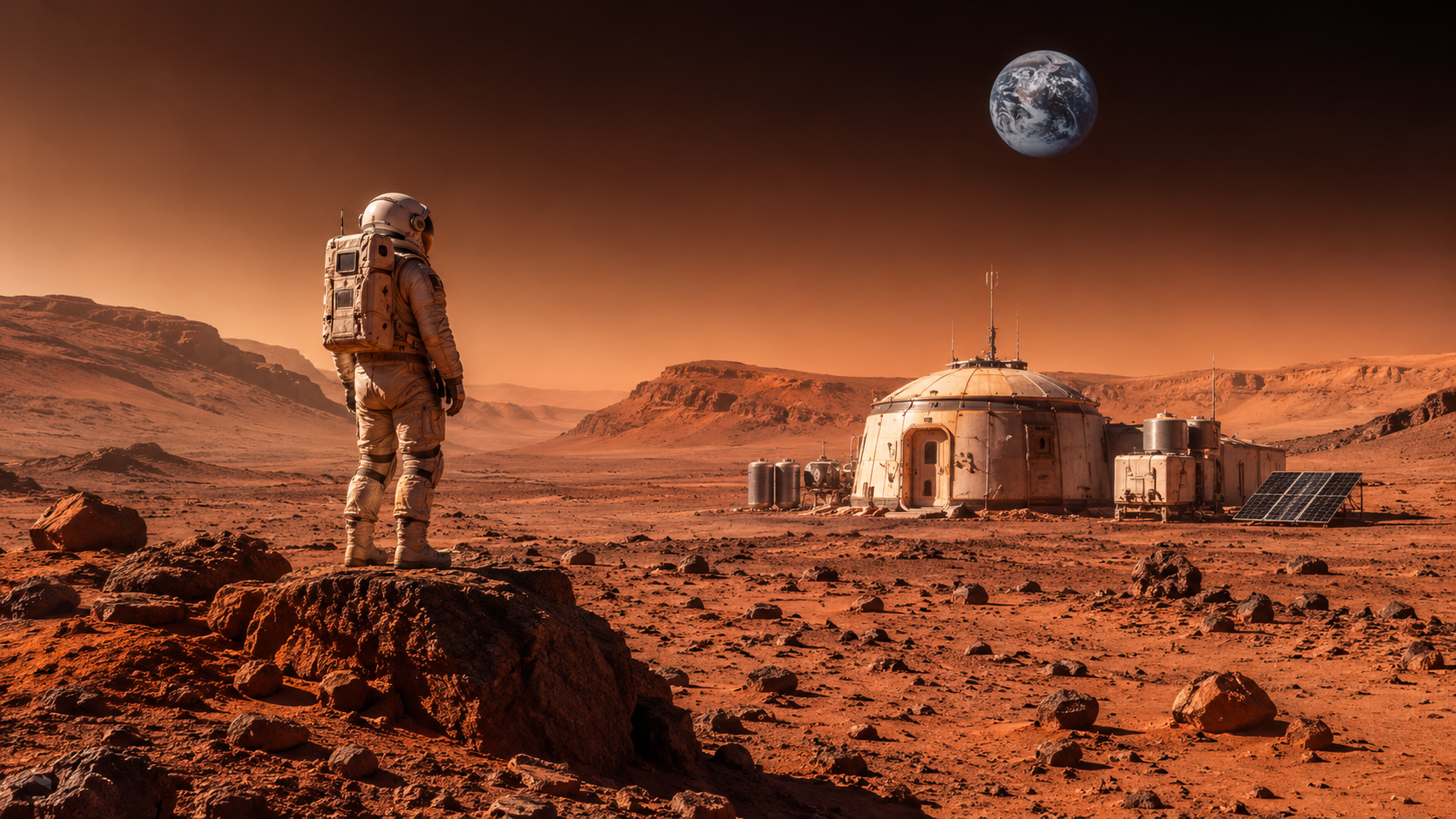
Picture the worst day Earth could ever have. A dinosaur-sized asteroid. A full-scale nuclear war. Runaway climate change. Now picture Mars on its best day, when absolutely nothing goes wrong. Which planet would you rather wake up on?
Astrophysicist Adam Becker says the wrecked Earth wins, and it isn’t close. Even a battered Earth keeps breathable air, liquid water in many places, and usable gravity. Mars offers none of those. [1]
The timing for this conversation is perfect. Earth and Mars line up for an efficient trip only about every 26 months, and the current window is open right now. [2] SpaceX once planned to send up to five uncrewed Starships through it, but in February 2026 Elon Musk shifted the company’s focus to the Moon, and no Starship is scheduled for this window. [3]
So let’s be a little rude to the “Plan B” fantasy and check it against the physics. We’ll start with the strangest fact of all: on Mars, water can’t decide whether to boil or freeze. Stay with me.
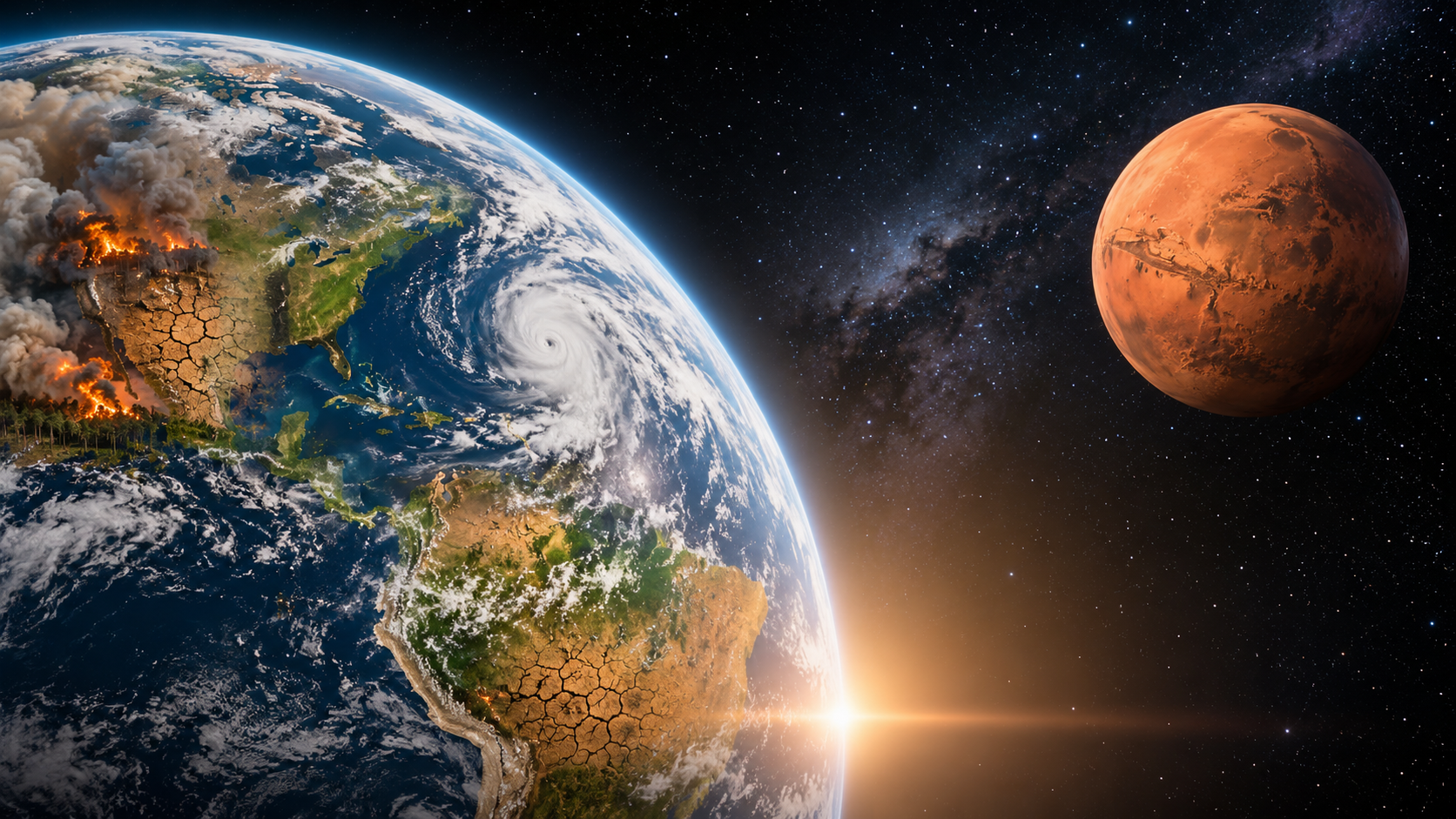
1. The planet where water boils and freezes at the same time
Water boils at 100 °C only at sea level, and on Mars it can barely stay liquid at all. Boiling happens when water’s vapor pressure matches the air pressure around it, so lower the air pressure and the boiling point drops. At the summit of Mount Everest, where the pressure is about a third of sea level (33.7 kilopascals), water boils at roughly 70 °C. [4] That’s why a mountaineer’s cup of tea is always a disappointment.
Now keep climbing. About 19 kilometres above Earth, the pressure falls to roughly 6.3 kilopascals, a point called the Armstrong limit. Here water boils at 37 °C, which is normal human body temperature. Without a full pressure suit, the water in your tissues begins turning to vapor, a condition called ebullism. It is generally considered fatal, though a few exposures have been survived when pressure was restored quickly. [5]
Now the punchline. The average air pressure on Mars is about 600 pascals. That is roughly a tenth of the Armstrong limit and about 0.6% of Earth’s sea-level pressure. [6] It sits almost exactly on the “triple point” of water, the narrow condition where ice, liquid and vapor can coexist. Below about 6.1 millibars, water can only exist as ice or vapor. [7] Add a temperature that averages around −60 °C, swinging from −140 °C at the poles to about 20 °C at an equatorial noon. [6]
In plain terms, a puddle of melted ice on Mars would boil or evaporate almost immediately, and ice tends to skip the liquid stage entirely. Salty brines can resist freezing and boiling a bit better, and Mars has plenty of salts, so brief films of liquid may be possible. But that’s no lake you could drink from. [6]
Here is why this matters to anyone dreaming of moving there: every human on Mars would live inside a sealed pressure vessel. One cracked seam or power failure puts you in the situation described above. On even the most damaged corner of Earth, you can still step outside and breathe.
2. Nothing to breathe
Mars’s air is about 95% carbon dioxide, so there is nothing there to breathe. [1] We can pull oxygen out of that CO₂, and NASA proved it: the MOXIE experiment on the Perseverance rover made oxygen from Martian air. That is a genuine milestone. It is also tiny. MOXIE made about 6 grams an hour, roughly 50 grams across its first seven runs in 2021, and about 122 grams in total according to later coverage, which is around ten hours of air for a small dog. [8]
Scaling up is the real problem. MOXIE’s own team says a full-size unit would need to produce 2 to 3 kilograms an hour, and that is just to stockpile enough oxygen for a rocket to leave, not to supply a town. [9] Every breath on Mars would have to be manufactured, forever, by machines that cannot be allowed to break.
3. A radiation problem you can’t see
Mars has almost no shield against radiation. Earth has two: a thick atmosphere and a global magnetic field. Mars has a very thin atmosphere and no global magnetic field. [1] NASA’s Curiosity rover carried a radiation detector that measured about 0.67 millisieverts per day on the surface, and 1.8 millisieverts per day during the trip, inside the spacecraft. [10]
For scale, the average person on Earth absorbs about 2.4 millisieverts in an entire year. In Canada it is about 1.8. [11] By our arithmetic, 0.67 millisieverts a day adds up to roughly 245 a year on the Martian surface, about a hundred times the world average.
NASA caps an astronaut’s career at 600 millisieverts, a limit designed to hold the extra lifetime risk of dying from cancer to about 3%. [12] The six-month journey alone is estimated at about 300 millisieverts. [10] Researchers have noted that a full Mars mission would far exceed that career limit. [13]
This is a hard biological ceiling, not an engineering inconvenience. You can’t out-enthuse a cosmic ray.
4. The dirt is poisonous
Martian soil contains perchlorate, a salt that interferes with the thyroid. NASA’s Phoenix lander found it in the arctic plains in 2008, and it was the mission’s biggest surprise. [14] Later reviews put perchlorate at roughly 0.5% to 1% of Martian soil. [15] It blocks the thyroid from taking up iodine, and thyroid hormones help run your metabolism and growth. [15] Unlike on the Moon, even the finest Martian dust is a potential hazard, because it carries the chemical. [15] The only place on Earth with comparable natural levels is Chile’s Atacama Desert. [16]
Growing food means treating or washing the soil first, which complicates farming. [1] So on Mars the dirt, the dust and the air are all working against you. There is one small silver lining: perchlorate can also be a source of oxygen and a resource for fuel. [15]
5. Gravity, and the next generation
Mars’s gravity is only 38% of Earth’s, and nobody knows whether that is enough for a healthy life. [17] We know what weightlessness does: even healthy astronauts lose bone and muscle. [17] Mars is better than orbit, but no human has ever lived long-term at 0.38 g.
The biggest unknown is children. No mammal has yet conceived, gestated and given birth in space. [17] Reviews of reproductive health in microgravity flag major knowledge gaps, and pregnancy is considered off-limits in spaceflight today. [18] Animal studies suggest some stages of pregnancy are possible in lower gravity, but they also point to concerns for fetal development. [19]
A settlement that can’t safely have babies isn’t a settlement. It’s an expensive camp.
6. Far, slow, and no rescue
A one-way trip takes roughly seven to nine months with today’s rockets. [20] The efficient launch windows open only about every 26 months, and radio messages take between roughly 3 and 22 minutes each way depending on where the planets sit. [2] Real-time conversation is impossible.
Picture a medical emergency on Mars at 2 a.m. Earth hears about it after a coffee break, and no rescue ship can leave for about two years. On Earth, even in remote places, help is a phone call away. On Mars, you are your own ambulance.
7. Terraforming is science fiction, for now
Can’t we just make Mars more Earth-like? The best published inventory says not with today’s technology. A 2018 Nature Astronomy study by Bruce Jakosky and Christopher Edwards tallied the CO₂ left on Mars, in polar ice, minerals and soil, and concluded there isn’t enough accessible to thicken the atmosphere. [21] Even processing every source would only raise surface pressure to about 7% of Earth’s, according to a summary of the paper. [22]
And Mars leaks. NASA’s MAVEN spacecraft found the solar wind strips away gas at roughly 100 grams every second, and faster during solar storms. [23] Scientists think Mars lost its global magnetic field about four billion years ago, which let the solar wind strip much of the atmosphere. [24] That loss is slow on human timescales, but it is a reminder that Mars has no shield to protect a thicker atmosphere, even if we could build one.
Earth, by contrast, keeps its air thanks to a magnetic shield we got for free. [24]
8. We already built a miniature Earth, and it ran short of air
In 1991, eight people sealed themselves inside Biosphere 2, a giant glass-and-steel ecosystem in Arizona built to test whether people could live in a closed system. [25] Within about 16 months, oxygen fell from 20.9% to roughly 14.4%. [26] Scientists eventually worked out that soil microbes were using up oxygen while exposed concrete soaked up the carbon dioxide, locking the oxygen away as calcium carbonate. [25] Outside oxygen was pumped in during 1993 to keep the crew safe. [27]
Here is the sobering part. Biosphere 2 had Earth’s own stable atmosphere right outside the glass, and it still got into trouble. A sealed bubble on Mars would have a poisonous, near-vacuum atmosphere outside.
The story has a nice ending, though. Biosphere 2 is now a University of Arizona research facility, used to study things like drought, ocean acidification and the effects of carbon dioxide. [28] The failed escape pod became an Earth-science lab.
9. A fair hearing for the other side
Not everyone thinks going to Mars is a bad idea, and the best arguments deserve a hearing. The strongest is insurance. Philosopher Joseph Gottlieb argues that settling Mars could help ensure the long-term survival of the human species, a goal with enormous moral weight. [29] Mars exploration also drives science, discovery and inspiration. Even Adam Becker’s critique is not anti-space: he says exploring Mars still matters for science. [1]
Where it gets tricky is the details. Scientific American’s review of the space-ethics debate notes that a Mars settlement only lowers extinction risk if it is genuinely self-sufficient, and that some risks, such as rogue AI, would follow us there. [30] Everything above is why self-sufficiency is so hard. The same review argues that many of the other goals could be met with far less risk and expense through smaller exploration missions. [30] So explore Mars, absolutely. Just don’t mistake it for a lifeboat.
A Canadian footnote. Canada has a hand in this story. Researchers test Mars exploration gear at the Haughton-Mars Project on Devon Island, Nunavut, the largest uninhabited island on Earth, a cold, dry, rocky polar desert. [31] Even so, its average temperature of about −17 °C is far milder than Mars’s roughly −60 °C. [32] Canadian instruments have flown there too: the Phoenix lander’s Canadian laser instrument detected snow falling from Martian clouds. [33] And Canada’s astronaut career radiation limit is 1,000 millisieverts, higher than NASA’s 600. [34]
10. Who gets a ticket, and who pays?
This is where Mars stops being a space story and becomes an Earth story. NASA’s inspector general warned in 2024 that a multi-decade Moon-to-Mars effort could easily cost hundreds of billions of dollars. [35] The Artemis Moon program alone was projected to top $93 billion through 2025. [36] Those bills land on taxpayers, including in wealthy countries like Canada and the United States.
Then there’s the question of who would actually go. Musk’s stated dream is a settlement of up to a million people. [1] Even on the most ambitious plan, most of humanity would still be left on Earth.
Meanwhile, Earth’s own emergency is solvable. Global surface temperature is about 1.1 °C above the 1850 to 1900 average, and human activity is the cause. [37] That is already doing real harm, but it is nothing like a planet that averages −60 °C with nothing to breathe. Becker calls the Mars-as-Plan-B story a form of “insidious climate denial,” because it implies we can escape rather than repair. [1]
It also points to where the effort belongs. If we are going to spend hundreds of billions on ambition, Earth Reform’s view is that a real share belongs in cleaning up industry here, with firm standards for manufacturers and tax incentives that help them retool, rather than pushing the bill onto people at the gas pump.
So here’s the scorecard. Water that boils and freezes at once. Air you can’t breathe. Radiation about a hundred times Earth’s average. Soil that interferes with your thyroid. Gravity nobody has tested on children. A two-year wait for a rescue. And a glass bubble in Arizona that couldn’t keep its own air.
Mars is a magnificent place to explore, and we should keep sending robots, scientists and, one day, maybe people to learn from it. But as a backup for Earth, it fails every test we can throw at it. A ruined Earth is still more livable than Mars at its best.
The good news is that Earth isn’t ruined. It’s about 1.1 degrees warmer, it’s fixable, and the fix is a matter of will and smart incentives, not miracles. There is no Plan B planet, which means Plan A deserves our full attention.
If this changed how you picture the “escape to Mars” story, share it with someone who still thinks we can just move. Thanks for listening.
Footnotes and sources
Numbers in brackets match the notes below. Peer-reviewed papers are listed with their journal and DOI. Two figures are our own arithmetic from the cited data: the roughly 70 °C boiling point on Everest (from standard water vapor-pressure data) and the roughly 245 millisieverts a year of Martian surface dose (0.67 × 365).
- Futura-Sciences, “Mars isn’t Plan B: why Earth stays more livable — no matter what” (Feb 6, 2026), summarizing astrophysicist Adam Becker’s statements to Rolling Stone (July 2025) and DeSmog (Feb 3, 2026). Link
- 19FortyFive, “The Mars Launch Window Opens in November 2026 and Closes About a Month Later” (link); Space.com, “How long does it take to get to Mars?” (26-month windows; 3 to 22 minute signal delay) (link).
- Mars Progress live tracker, checked Nov 2026 (no Starship scheduled for the late-2026 window) ([link](https://marsprogress.com/)); Promise Tracker, “Starship Mars,” on Musk’s Feb 8, 2026 Moon-first post ([link](https://spacenexus.us/promises/starship-mars)); Zafar R., Wccftech (Aug 6, 2025), on Musk’s earlier timeline slip. Link
- West JB, Lahiri S, Maret KH, Peters RM Jr, Pizzo CJ. Barometric pressures at extreme altitudes on Mt. Everest: physiological significance. J Appl Physiol 1983;54(5):1188–1194. doi:10.1152/jappl.1983.54.5.1188 (253 Torr, or 33.7 kPa, at the summit; see also West JB, Extreme Physiology & Medicine 2012, PMC3710103).
- Murray DH, Pilmanis AA, Blue RS, et al. Pathophysiology, prevention, and treatment of ebullism. Aviat Space Environ Med 2013;84(2):89–96. doi:10.3357/ASEM.3468.2013.
- Nair CPR, Unnikrishnan V. Stability of the liquid water phase on Mars: a thermodynamic analysis considering Martian atmospheric conditions and perchlorate brine solutions (2020). PubMed Central PMC7191838. Link
- NASA Mars Education, “Testing Your Hypothesis by Boiling Water Below Its Boiling Temperature” (classroom module on the triple point). Link
- Hoffman JA, Hecht MH, et al. Mars Oxygen ISRU Experiment (MOXIE): preparing for human Mars exploration. Science Advances 2022. doi:10.1126/sciadv.abp8636; MIT News, “MOXIE experiment reliably produces oxygen on Mars” (Aug 31, 2022), which also carries press coverage of the 122-gram total. Link
- Popular Science, “Perseverance’s MOXIE tool turns Martian air into pure oxygen” (Aug 2022), quoting MOXIE deputy principal investigator Jeffrey Hoffman. Link
- Hassler DM, Zeitlin C, Wimmer-Schweingruber RF, et al. Mars’ surface radiation environment measured with the Mars Science Laboratory’s Curiosity rover. Science 2014;343(6169):1244797. doi:10.1126/science.1244797. The 180-day trip estimate is from Phys.org’s coverage of Hassler’s findings (Feb 2014). Link
- Canadian Nuclear Safety Commission, “Natural background radiation” fact sheet (Nov 2020), citing UNSCEAR. Link
- NASA Office of the Chief Health and Medical Officer, Radiation Protection Technical Brief (Dec 2022) on NASA-STD-3001, and OCHMO Standards Overview (2021). Link
- Frontiers in Nuclear Medicine (2022), doi:10.3389/fnume.2022.997718, discussing NASA’s 600 mSv career limit and Mars-mission doses. Link
- Hecht MH, Kounaves SP, Quinn RC, et al. Detection of perchlorate and the soluble chemistry of martian soil at the Phoenix Lander site. Science 2009;325(5936):64–67. doi:10.1126/science.1172466; NASA/JPL release (July 2, 2009), via Spaceflight Now.
- Davila AF, Willson D, Coates JD, McKay CP. Perchlorate on Mars: a chemical hazard and a resource for humans. Int J Astrobiol 2013;12(4):321–325. doi:10.1017/S1473550413000189.
- Catling DC, Claire MW, Zahnle KJ, et al. Atmospheric origins of perchlorate on Mars and in the Atacama. J Geophys Res 2010;115:E00E11. doi:10.1029/2009JE003425.
- The Gist, “Birth beyond Earth: can we have babies in space?” (Oct 2025). Link
- Cutigni M, Cucina G, Galante E, Cerri M, Bizzarri M. Microgravity impairs endocrine signaling and reproductive health of women: a narrative review. Front Physiol 2025;16:1558711. doi:10.3389/fphys.2025.1558711.
- Life Sciences, Society and Policy (2016), article on pregnancy in space in the context of the Mars One mission. doi:10.1186/s40504-016-0043-5.
- NewSpace Economy, “How far away is Mars? Distance, delay and what it means for getting there” (Apr 18, 2026). Link
- Jakosky BM, Edwards CS. Inventory of CO₂ available for terraforming Mars. Nature Astronomy 2018;2:634–639. doi:10.1038/s41550-018-0529-6.
- Sci.News, “Mars terraforming is not possible using currently available technology, researchers say” (July 31, 2018). Link
- University of Colorado Boulder, “Solar wind strips Martian atmosphere” (Nov 5, 2015), on Jakosky BM et al., Science 2015;350(6261):aad0210. doi:10.1126/science.aad0210. Link
- Space.com interview with MAVEN principal investigator Bruce Jakosky, “Mars’ Lost Atmosphere: MAVEN Probe Scientist Explains New Finding.” Link
- Rosen J. “Benchmarks: September 26, 1991: Crew sealed inside Biosphere 2.” EARTH Magazine, Aug 25, 2015. Link
- Oxygen decline from 20.9% to about 14.4% over 475 days, attributed to Severinghaus JP et al. (1994, Eos), as discussed in a Biosphere 2 leak-rate analysis. Link
- Mental Floss, “How Living Inside Biosphere 2 Changed These Scientists’ Lives.” Link
- designboom, “Biosphere 2: what happens when humans try to recreate Earth?” Link
- Gottlieb J. Space colonization and existential risk. Journal of the American Philosophical Association. Link
- Scientific American, “Mars can wait: questions surround settlements on other worlds.” Link
- Mars Institute, Haughton-Mars Project overview. Link; NASA, Haughton-Mars Project. Link
- Lee P. “Mars on Earth: The NASA Haughton-Mars Project, Part 1.” SpaceRef, 2002 (average temperatures on Devon Island vs. Mars). Link
- SpaceQ, reproducing the NASA/JPL Phoenix results release of July 2009 (Canadian lidar detected snow). Link
- Memorial Sloan Kettering Cancer Center, “Out of This World: How Two MSK Doctors Helped NASA Set New Spaceflight Radiation Standard.” Link
- NASA Office of Inspector General, Statement of George A. Scott, Acting Inspector General, “Key Challenges Facing NASA’s Artemis Campaign” (Jan 17, 2024).
- Phys.org (Oct 2023), reporting NASA OIG audit of Artemis costs. Link
- IPCC, Sixth Assessment Report, Synthesis Report: Summary for Policymakers (2023), finding A.1. Link



Leave a Reply