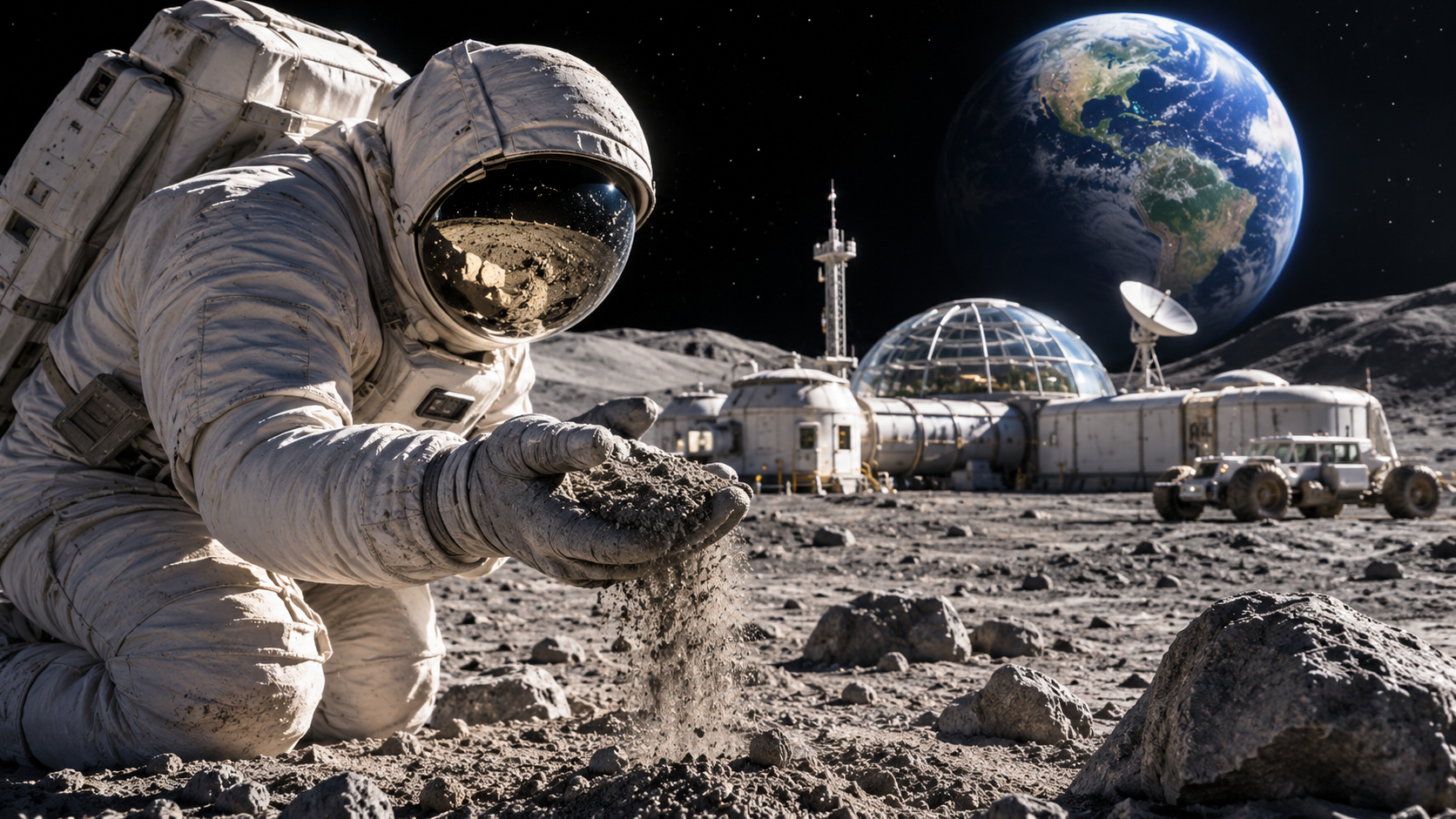
Apollo 17 astronaut Harrison Schmitt walked on the Moon in 1972, and decades later he gave a verdict that engineers still repeat: dust is the single largest technical challenge to a long stay there. [1] Not rockets. Not radiation. Dust.
That’s the first dirty secret. The second one is quieter, and it’s about who gets to dig. The Moon’s most valuable real estate may be dark, frozen craters at its poles, and 76 countries have now signed a US-led set of principles for how lunar resources can be used. [2] Whether those principles are fair, or even legal, is a live argument among space lawyers.
So in this episode we’ll do two things. First, we’ll see why a lunar base is a much dirtier, harder project than the glossy artist renderings suggest. Second, we’ll follow the law and the money, because “who owns the Moon?” has a more complicated answer than “nobody.” If you caught our Mars episode, you’ll spot a few familiar themes, but you don’t need it. Let’s dig in.
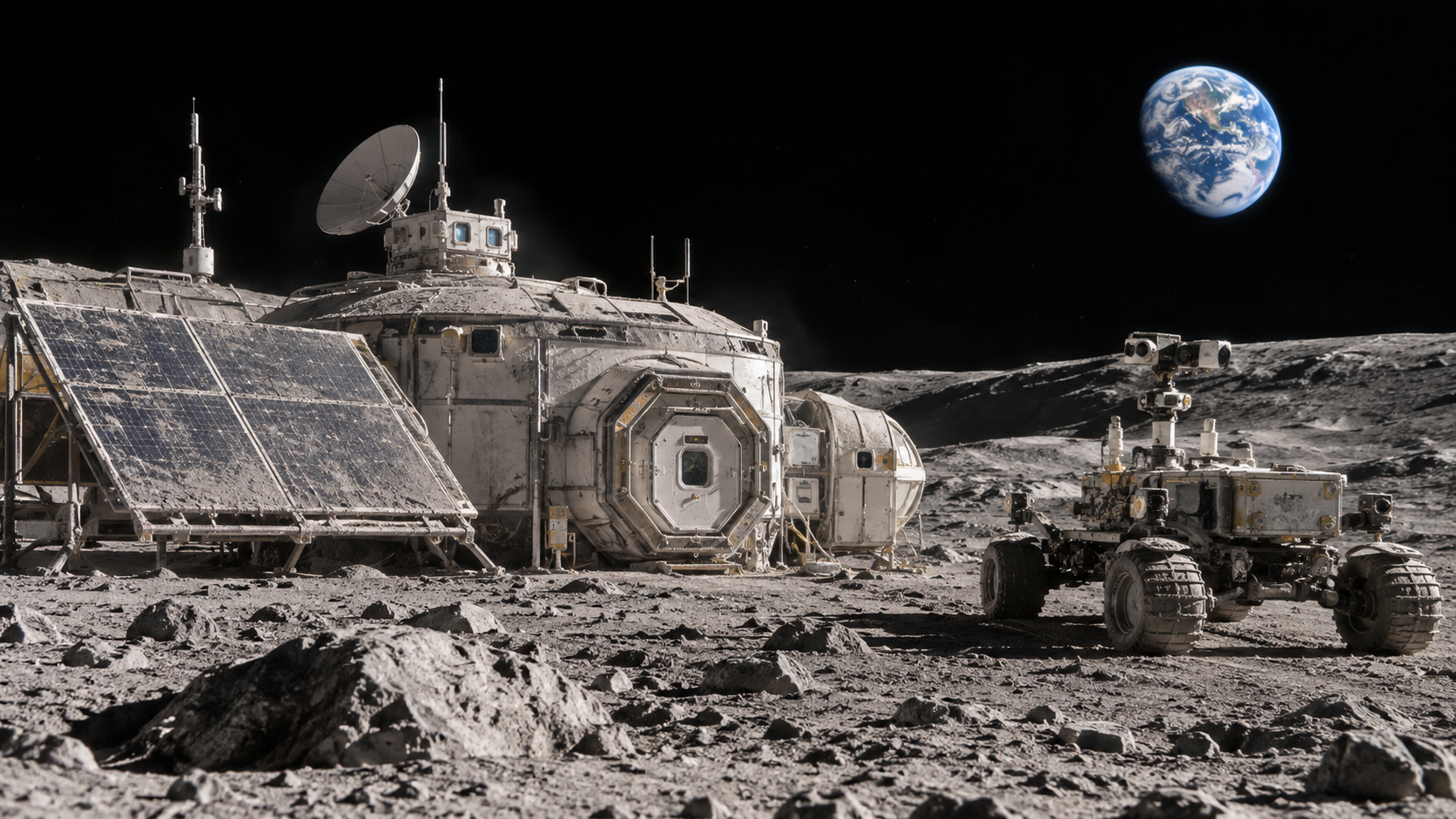
1. The dust is sharp, clingy and strange
Moon dust is nothing like beach sand or the stuff under your couch. The Moon has no wind or water to wear its grains smooth, and researchers describe the dust as super-fine and sharp-edged. [4] It also clings to nearly everything it touches. [3]
NASA engineer James Gaier combed through the records of all six Apollo landings and sorted the dust problems into nine categories: blocked vision, false instrument readings, dust coating, loss of footing, clogged mechanisms, abrasion, thermal control trouble, failed seals, and irritation from breathing it. [3] On Apollo 12, Pete Conrad’s suit lost pressure faster after each moonwalk. The leak rate climbed from 0.15 to 0.25 pounds per square inch per minute, against a safety limit of 0.30. [3] Planetary geologist Larry Taylor has said the dust wore through three layers of tough, Kevlar-like material on Jack Schmitt’s boot. [4]
Remember, Apollo crews were on the surface for days. A lunar base means years of exposure, with more machines to keep alive. The dust is not a detail to be solved later. It is the main engineering problem.
2. What the dust does to your lungs
The honest answer is that nobody knows yet. Apollo astronauts reported irritation of the skin, eyes and airways after dust hitched a ride into the cabin on their suits. [4] A 2012 review in Planetary and Space Science, led by Dag Linnarsson, concluded that lunar dust is still incompletely characterized when it comes to human health. [5] For materials like asbestos, quartz and volcanic ash, the dangers have been studied in great detail, and lunar dust may behave very differently. [5] Breathing fine particles in general is linked to airway inflammation and more respiratory and cardiovascular illness, and the review argues that real answers will need measurements made on the Moon itself. [5]
Think about who would face the longest exposure: not visiting astronauts, but the workers running machinery day after day. We know the dust is rude. We don’t yet know how rude.
3. Rocket exhaust turns dust into shrapnel
Landing on the Moon is a sandblasting event. When Apollo 12 came down, the crew’s view was essentially blind for the last 40 feet because of blowing dust. [6] Analysis of the plume suggests the dust moves at around 1 kilometre per second, which is about 3,600 kilometres an hour. [6]
Apollo 12 landed about 160 metres from an older robot lander, Surveyor 3, and the astronauts brought pieces of it home. It had been scoured, and its surface carried hundreds of tiny pits, some about 100 microns wide, from high-speed soil grains. [6] That is the damage at 160 metres.
Now scale it up. Artemis landers will be bigger and more powerful than Apollo’s, and NASA says it is unknown how much they will erode the surface or whether they will dig craters in the landing zone. [7] One analysis notes that if landers return to the same place again and again, as they would at a base, it will be necessary to prevent or block the spray. [6] Every arrival becomes a small sandstorm aimed at your neighbours.
4. Cooked by day, frozen by night, and no shield
The Moon’s temperature swings are brutal. At the equator, daytime surface temperatures reach about 387 to 397 kelvin, roughly 114 to 124 °C, and fall to around 95 kelvin, about −178 °C, just before sunrise. [8] The night lasts about 14 Earth days, with temperatures hovering near 100 kelvin for most of it. [9] In permanently shadowed polar craters it gets far colder: the crater floor hit by NASA’s LCROSS probe was estimated at about 38 kelvin, near −235 °C. [10]
Radiation is the other invisible hazard. The Moon has no atmosphere and no global magnetic field to blunt it. China’s Chang’e-4 lander carried a German-built detector that measured about 1,369 microsieverts per day, roughly 2.6 times the daily dose inside the International Space Station and about 200 times the dose on Earth’s surface. [11] The researchers’ advice is to cover habitats with a thick layer of lunar soil. [11]
So a lunar base likely means living under dirt and running machines that survive both a 120 °C afternoon and a deep-freeze night. It’s an engineering challenge, and nowhere near camping with a view.
5. The prize: water in the dark
So why go to such a hostile place? Water. In 2009, NASA’s LCROSS mission slammed a spent rocket stage into Cabeus crater near the south pole and measured the debris. It detected about 155 kilograms of water vapour and ice, and estimated that water ice made up roughly 5.6% of the soil at the impact site. [12] Later analysis found the water is patchy, concentrated in pockets rather than spread evenly. [13] In 2018, a study of Chandrayaan-1 data reported direct evidence of ice exposed on the surface in the shadowed polar regions. [14]
Water matters because it can be drunk, split into oxygen to breathe, or turned into hydrogen and oxygen for rocket fuel. [14] That is why ice on the Moon is so attractive.
It is also why NASA’s March 2026 “Ignition” plan puts a permanent base at the south pole. Reports put the cost at around $20 billion over seven years, though some say $30 billion over a decade. [15] And it is why China is eyeing the same landing sites. [16] The best real estate on the Moon is tiny: a few cold, dark craters. That sets up the question everybody should be asking next.
6. Who owns the Moon?
Short answer: no country can claim it. Article II of the 1967 Outer Space Treaty says the Moon and other celestial bodies are not subject to national appropriation by claim of sovereignty, use, occupation or any other means. [17] Long answer: that rule is murky on whether anyone can take things from the Moon and keep them.
The United States has answered with a law. A 2015 statute says US citizens who commercially recover a space resource are entitled to own, transport, use and sell what they obtain. [18] The logic is a fishing analogy: no nation owns the ocean, but fishermen own their catch. Critics reply that a country cannot hand out rights it does not itself hold. [19] An older treaty, the 1979 Moon Agreement, calls the Moon’s resources the common heritage of humankind and promises an international regime, but it had only 18 parties as of 2023, none of them a leading space power. [17][20]
Enter the Artemis Accords, a US-led set of non-binding commitments saying that extracting space resources does not by itself amount to national appropriation. They also allow “safety zones” around operations. [17][20] Critics argue the zones create quasi-territorial effects, claims by another name. [21][22] Defenders say zones are needed to keep operations safe in a hostile environment. [22] A total of 76 countries have signed, though the Accords bind only governments and cover only civil activities. [2][23]
There is a rival club. China and Russia lead the International Lunar Research Station, which aims to build a basic base by 2035 and hopes to work with 50 countries. [24] China targets a crewed landing by 2030, and the US aims for its first Artemis landing in 2028, on Artemis IV. [25][26]
Two clubs, two rulebooks, one frozen crater.
7. The mining dream
Water is the practical prize. The glamorous one is helium-3, a rare isotope that is scarce on Earth but deposited across the Moon’s surface by the solar wind. Scientists estimate on the order of a billion kilograms is lying there, and one lunar geoscientist calls it “where the money is.” [27] Interlune, a Seattle company, says a kilogram could be worth around $20 million, and it plans an exploration mission in 2027 to measure how much is really at its target site. [28][29] Helium-3 is wanted for things like cooling quantum computers and, possibly, fusion fuel. [27][29]
Here comes the cold water. USGS geologist Laszlo Keszthelyi estimates that 100,000 to 1 million tons of regolith would have to be processed to get one kilogram, a ratio comparable to copper mining on Earth, and a USGS study classes helium-3 as probably unmineable. [29] There are too few measurements so far to say whether it will pay. [29]
The law is just as untested. Helium-3 would be among the first things miners try to own under the 2015 US law, in a place where the international rules are disputed. [17][18] That’s a land rush before the rulebook.
8. Lessons from Earth’s mines
Space-mining scholars keep looking back at Earth, because we have been here before. A 2025 perspective in Frontiers in Space Technologies compares seabed mining with lunar extraction and argues that without just and equitable regulation of the oceans, similar oversights are likely on the Moon. [30] Planetary astronomer Andrew Rivkin points out that space mining needs advanced technology and large amounts of starting capital, which concentrates the wealth, and that mining on Earth has a long history of colonial decision-making that harmed Indigenous people. [31] He suggests environmental impact assessments, now standard for big mines on Earth, could be applied to space. [31]
Academic geographers add an Earth-side worry: the uneven distribution of space-mining wealth, and the impacts on existing mining communities in the Global South. [32] A 2025 policy brief from the Centre for International Governance Innovation suggests that Indigenous frameworks, which govern how to use land without owning it, could be a model for shared international use of outer space, and says a legal system should be in place before claims are made. [33]
The scholars’ message is consistent: write the fair rules first, because they are much harder to fix after the digging starts.
9. A fair hearing for the Moon, and a Canadian footnote
The Moon deserves a fair hearing. It is days away rather than months, and in April 2026 the Artemis II crew flew a 10-day loop around it, farther from Earth than any humans have travelled. [34] NASA frames a Moon base as a proving ground for Mars. [35] That makes sense: it is a far better place to learn how to live off-world, because help is days away rather than years. Even the dust, radiation and water questions are things we can only really answer by going. So the honest verdict is: worth exploring, still hard, and the legal map needs drawing before the digging starts.
A Canadian footnote. Jeremy Hansen, from London, Ontario, flew on Artemis II as the first non-American to travel beyond low Earth orbit, and Canada was the first nation to join the Artemis program. [36] But the plan has shifted around Canada’s contributions. NASA paused the Gateway station for which Canada’s Canadarm3 robotic arm was being built, and the Canadian Space Agency cancelled its water-seeking lunar rover in its 2026-27 spending plan, though a utility rover continues. [37] The agency says it will repurpose the Canadarm3 work toward lunar surface operations. [38]
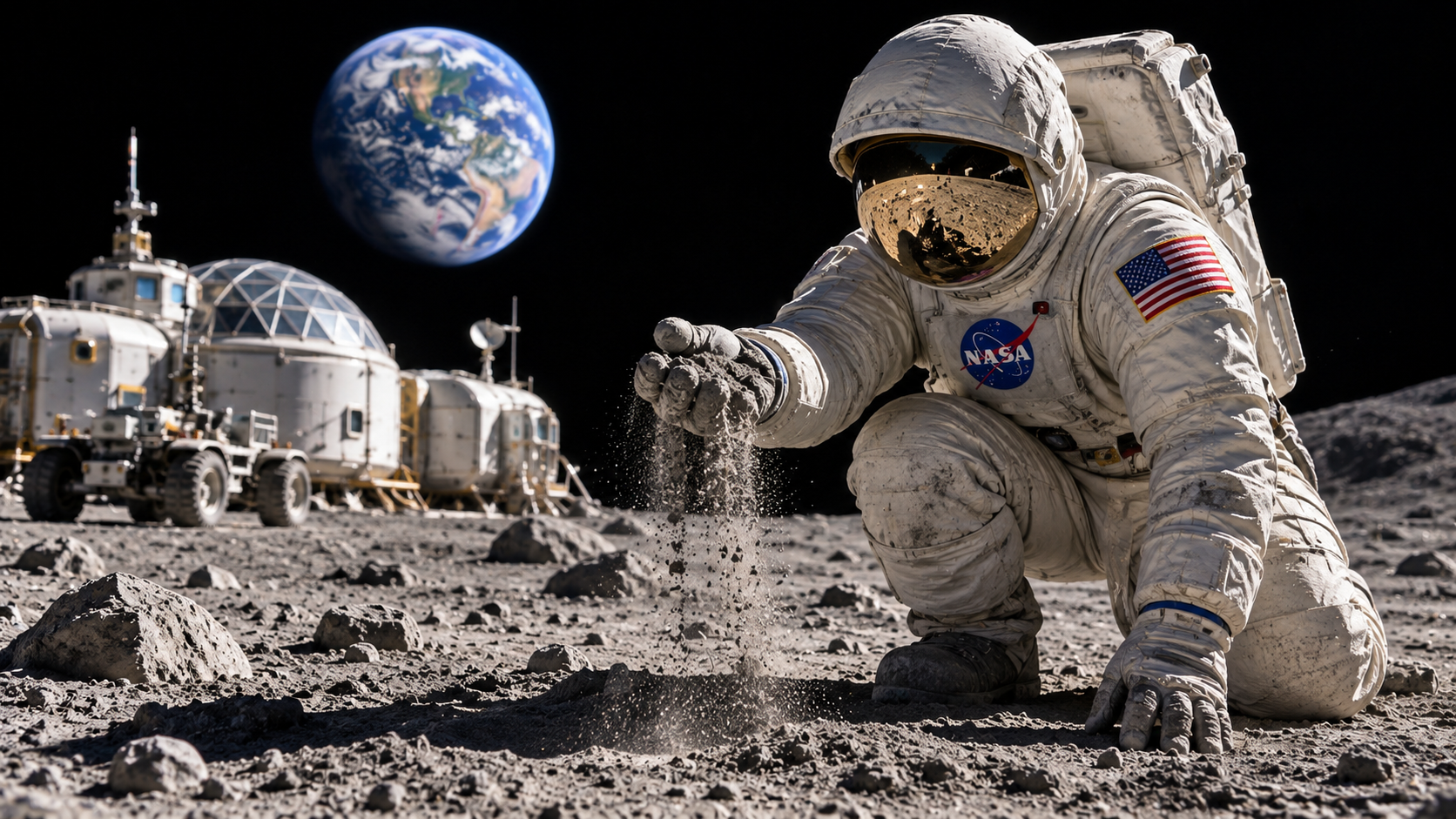
Let’s do the scorecard. Dust that chews through boots and seals. Lungs we haven’t tested against it. Landings that sandblast the neighbours. A 120 °C afternoon followed by a two-week freeze. Radiation about 200 times what you get on Earth. And a handful of frozen craters that two rival clubs both want.
The Moon is still worth the trip. It’s the closest place to learn how to live off-world, and what we find there will teach us a lot. But the story we’re told is usually about rockets and flags. The harder story is about dirt, and about rules. Who owns what’s in those craters? Who writes the rulebook? And who gets left out when the digging starts?
Those rules are being written right now, long before anyone has built so much as a bathroom on the Moon, and the habits we set there tend to stick. So pay attention, ask who benefits, and keep asking. Thanks for listening.
Footnotes and sources
Numbers in brackets match the notes below. Peer-reviewed papers are listed with journal and DOI where available. Temperature conversions from kelvin to Celsius and the speed conversion (1 km/s to 3,600 km/h) are our own arithmetic.
- NASA, conference paper NASA/CP-2007-214995 (2007), quoting Apollo 17 astronaut Harrison Schmitt on lunar dust. Link
- NASA, “NASA Celebrates as Artemis Accords Surpasses 75 Signatories” (updated Sep 28, 2026; 76 countries).Link
- Gaier JR. The effects of lunar dust on EVA systems during the Apollo missions. NASA/TM-2005-213610/REV1 (2007). Link; see also NASA Glenn presentation on Apollo 12 suit pressure decay. Link
- Phys.org / Universe Today, “The moon is toxic” (July 11, 2012), reporting the Linnarsson et al. review and quoting Larry Taylor. Link
- Linnarsson D, Carpenter J, Fubini B, et al. Toxicity of lunar dust. Planetary and Space Science 2012;74:57–71. arXiv:1206.6328. Link
- “ISRU implications for lunar and Martian plume effects,” arXiv:2104.06248 (Apollo 12 landing, Surveyor III damage, plume velocity). Link
- NASA, plume-surface interaction simulation of the Apollo 12 landing and Artemis lander implications. Link
- Williams J-P, Paige DA, Greenhagen BT, Sefton-Nash E. The global surface temperatures of the Moon as measured by the Diviner Lunar Radiometer Experiment. Icarus 2017;283:300–325. doi:10.1016/j.icarus.2016.08.012.
- Paige DA, et al. The Lunar Reconnaissance Orbiter Diviner Lunar Radiometer Experiment. Space Science Reviews (2010), on the 14-day lunar night and polar temperatures. Link
- Paige DA, Siegler MA, Zhang JA, et al. Diviner Lunar Radiometer observations of cold traps in the Moon’s south polar region. Science 2010;330(6003):479–482. doi:10.1126/science.1187726.
- Zhang S, Wimmer-Schweingruber RF, Yu J, et al. First measurements of the radiation dose on the lunar surface. Science Advances 2020;6(39):eaaz1334. doi:10.1126/sciadv.aaz1334; Kiel University / DLR news release (Sept 2020). Link
- Colaprete A, Schultz P, Heldmann J, et al. Detection of water in the LCROSS ejecta plume. Science 2010;330(6003):463–468. doi:10.1126/science.1186986.
- NASA Ames, LCROSS/LRO results release (Oct 2010). Link
- Li S, et al. Direct evidence of surface exposed water ice in the lunar polar regions. PNAS 2018, as reported by Scientific American (link) and Astronomy (link).
- SpacePolicyOnline, “NASA rolls out new Moon plan” (Mar 2026) (link); Astronomy, “NASA’s $30B plan to build a Moon base” (Mar 25, 2026) (link); 21st Century Tech (about $20 billion over seven years) (link).
- Live Science, “NASA announces near-impossible space plans including $20B Moon base” (Mar 2026). Link
- Bartóki-Gönczy B, Nagy B. Introductory note to the Artemis Accords. International Legal Materials 2023. doi:10.1017/ilm.2023.17 (quotes Outer Space Treaty Article II; Moon Agreement membership).
- Commercial Space Launch Competitiveness Act of 2015, 51 U.S.C. § 51303 (asteroid and space resource rights). Link
- The Space Review, commentary on the SPACE Act and the Outer Space Treaty (2015). Link
- American Society of International Law, “The Artemis Accords and the future of international space law,” ASIL Insights vol. 24, issue 31. Link
- O’Brien D. “Is outer space a de jure common-pool resource?” The Space Review (commentary arguing safety zones conflict with Article II). Link
- Fritz G. “Who owns the Moon? Non-appropriation, commercial use, and the new space economy” (Apr 15, 2026). Link
- SpacePolicyOnline, “Serbia, Mauritius bring Artemis Accords to 70” (July 2026), noting the Accords apply only to governments and civil activities. Link
- SpaceNews, “China aims to work with 50 countries on ILRS lunar south pole base program.” Link
- Asia Times, “US-China space race shifts into a higher lunar gear” (Apr 2026). Link
- BBC Sky at Night Magazine, “Artemis III won’t land on the Moon, as NASA adds an extra mission.” Link
- Scientific American, “Can helium-3 create a ‘gold rush’ on the Moon?” Link
- Popular Science, “A startup wants to mine the moon for helium.” Link
- heise online, “Interlune: Helium-3 from the moon for quantum computers on Earth” (interview-based report citing USGS geologist Laszlo Keszthelyi). Link
- Pelton JN, Mishra N, Elia Vitoloni M. Mining the ocean floor vs mining the Moon: what can we learn from our past experiences? Frontiers in Space Technologies 2025;5:1499486. doi:10.3389/frspt.2024.1499486.
- Rivkin A. “The problems with space mining no one is talking about,” 360info (Sept 2022). Link
- Deberdt R, Le Billon P. Outer space mining: exploring techno-utopianism in a time of climate crisis. Annals of the American Association of Geographers 2023;113(8):1878–1899. doi:10.1080/24694452.2023.2201339.
- Silk MSW, Redfern M. Developing a space ethic respectful of Indigenous cultures. Centre for International Governance Innovation, Policy Brief No. 211 (Oct 2025). Link
- NASA, “NASA welcomes record-setting Artemis II moonfarers back to Earth” (Apr 10, 2026). Link
- SpaceQ, “NASA unveils new Moon base plans, pauses Lunar Gateway.” Link
- The Canadian Press / CTV News, “Canadian astronaut Jeremy Hansen and NASA crewmates to hold news conference” (Apr 2026). Link
- Space.com, “Canada cancels its 1st moon rover: ‘It’s hopefully not a lost cause’” (Mar 2026). Link
- The Logic, “CSA adapts to Gateway cancellation” (Apr 10, 2026). Link



Leave a Reply