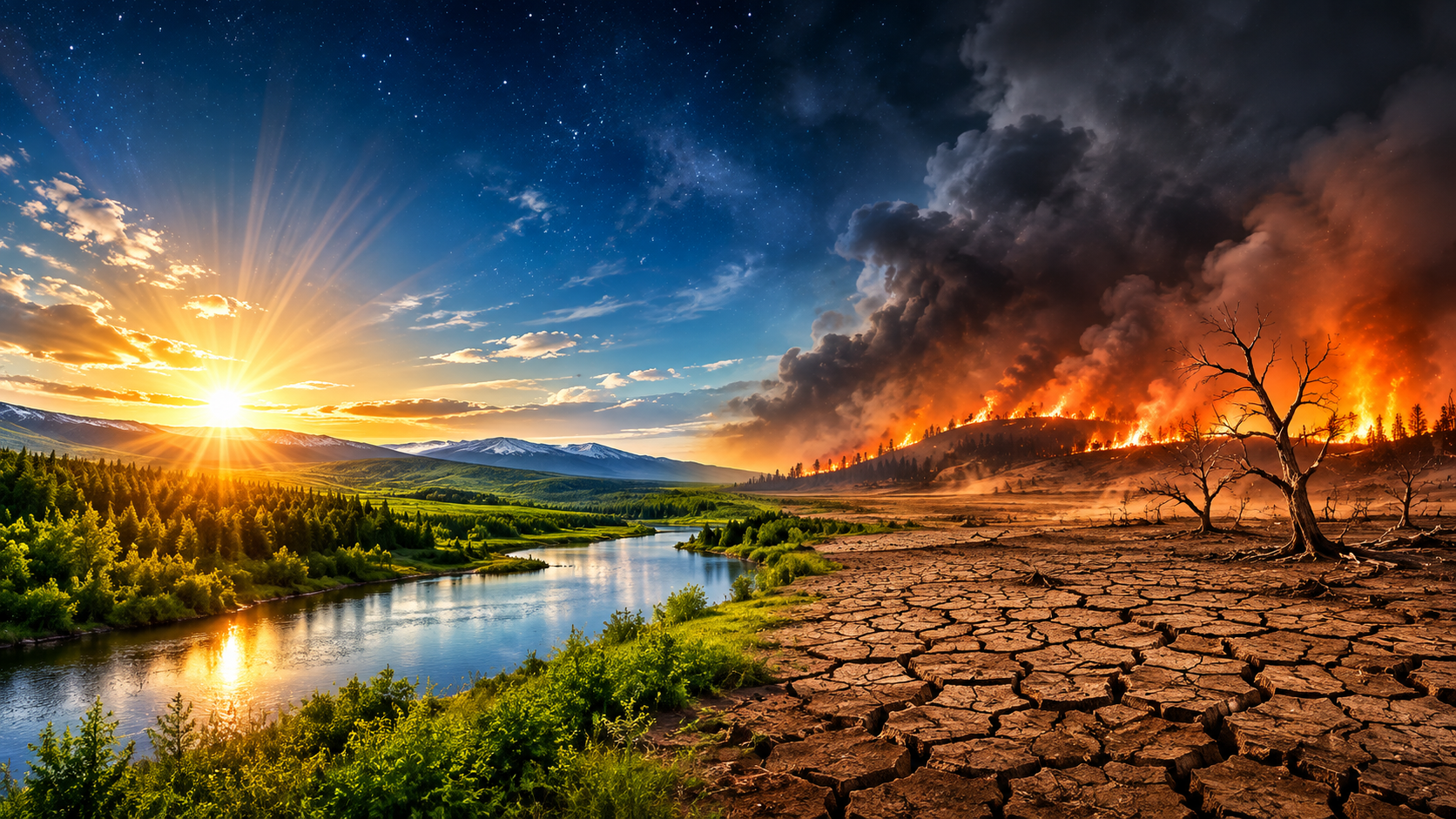
Scientists have identified nine limits that keep Earth stable enough for us to live on it. Seven are now broken. Here is what that means for your food, your water, your health and your wallet.
Today we’re starting with the big picture.
Imagine your doctor calls with your test results. Not one number out of range, but seven out of nine. That is, in effect, the call the planet received this September. Scientists track nine vital signs that keep Earth stable enough for farming, cities and ordinary life, and seven of them are now in the danger zone.
Over the next several minutes, we’ll explain what those nine limits are, what crossing them means for your food, your water, your health and your money, and why the news isn’t entirely grim, because once, the world actually fixed one of these problems. Let’s get into it.
The Nine Vital Signs
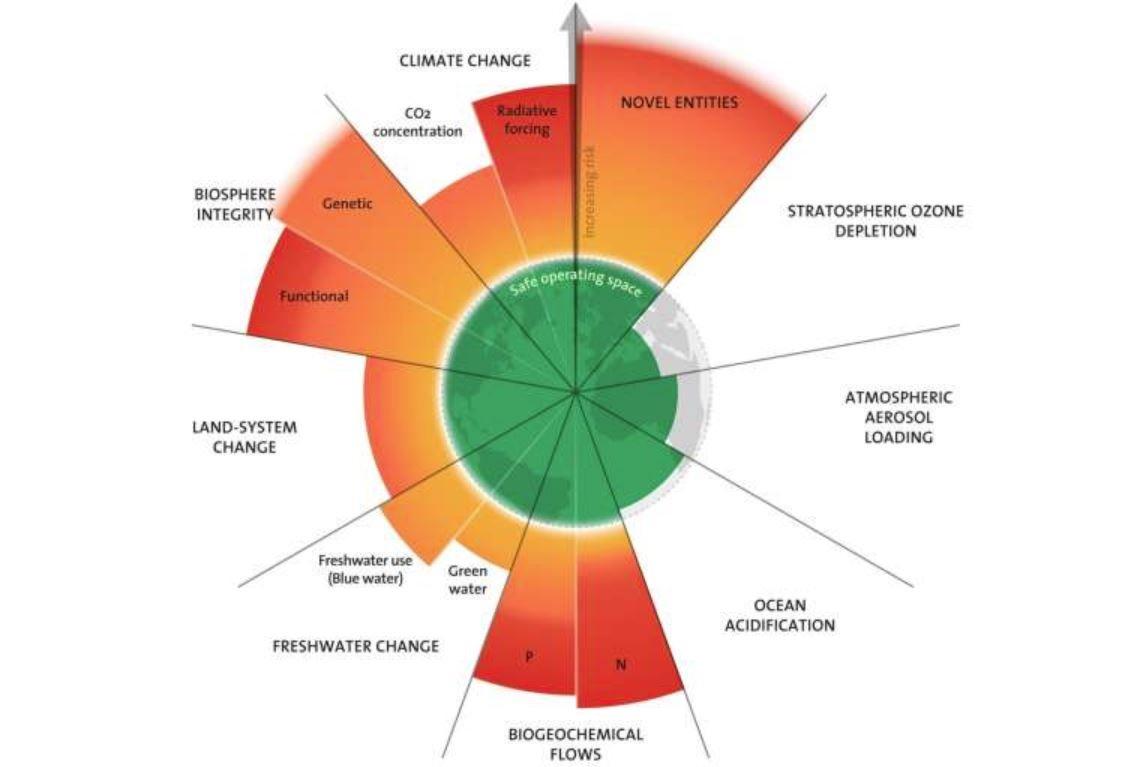
In 2009, an international team of Earth-system scientists led by Johan Rockström and Will Steffen asked a deceptively simple question: what keeps this planet stable enough for us? Our whole civilization, from the first farms to the modern city, has grown up inside the Holocene, the unusually steady stretch of climate since the last ice age. The team proposed that human pressure on nine Earth-system processes could push the planet out of that steady state. They called the safe zone “a safe operating space for humanity.” [1]
The nine processes are climate change, biodiversity loss (now called biosphere integrity), land-system change such as forests becoming farmland, freshwater use, the nitrogen and phosphorus cycles, ocean acidification, the ozone layer, airborne particles known as aerosols, and chemical pollution, which scientists now call “novel entities.” Each one gets a measurable control variable, a number you can track, like the concentration of carbon dioxide in the air. [1]
Cross the line and you enter a zone of increasing risk. Go further and you reach a high-risk zone. Crossing is not like flipping a switch, and the scientists are careful about that. Katherine Richardson, who led the 2023 update, compared it to blood pressure: a high reading doesn’t guarantee a heart attack, but it raises the odds of one. [2]
The boundaries are also linked. The original authors noted that crossing one can shift the others or push them over their own lines. [1] Keep that in mind, because it is why the rest of this story is about your dinner plate, your tap and your lungs, not only the thermostat.
The Scoreboard: From Three to Seven
When that first paper came out, the authors estimated that humanity had already crossed three of the lines: climate change, the rate of biodiversity loss, and the nitrogen cycle. [1] Since then, the count has only gone one way.
In 2022, researchers judged that chemical pollution had crossed its boundary, and that an earlier, narrower measure of freshwater had missed something big: the moisture in soil and plants, known as green water. [3][4] A 2023 assessment in the journal Science Advances put the tally at six of nine and noted that ocean acidification was close to tipping over. [5] In 2025 it did. The Planetary Health Check, an annual report card from the Potsdam Institute for Climate Impact Research in Germany, declared that ocean acidification had crossed, making seven. [6]
The newest report card came out in September 2026, written by more than 60 scientists. Its headline is not that a new boundary fell. It is that all seven broken boundaries are now at their highest recorded levels of transgression. [7] Carbon dioxide in the atmosphere hit a record 426 parts per million, compared with about 280 before the industrial era. Many scientists consider 350 the safe ceiling, and we passed that in 1987. [2]
Only two boundaries are still in the safe zone: the ozone layer and atmospheric aerosols. Even those come with footnotes. Aerosols are improving globally but remain beyond safe limits in places like South Asia, and the recovery of the ozone layer has plateaued. [8] Keep ozone in mind. We’ll come back to it, because it is the one place where the story turns hopeful.
What It Means for Your Plate
Start with the nitrogen and phosphorus boundary, because it is the strangest one. We broke it with something that works. Synthetic nitrogen fertilizer, made by an industrial process invented over a century ago, now supports roughly half of the world’s population, according to a widely cited analysis in Nature Geoscience. [9] Fertilizer is a large part of the reason the planet can feed as many people as it does.
The problem is what doesn’t end up in the crop. Excess nitrogen and phosphorus wash off fields into rivers and lakes, where they feed explosive blooms of cyanobacteria, often called blue-green algae. In August 2014, a bloom on Lake Erie put toxins into the tap water of Toledo, Ohio, and hundreds of thousands of people were told not to use their tap water for days. [10] Canadians are not watching from the sidelines. Lake Erie is shared with Ontario, blooms have worsened since the early 2000s, and the bulk of the phosphorus comes from the American side. Both countries have committed to cutting phosphorus loads by 40 percent from 2008 levels. [10] Water managers in southwestern Ontario say they have to treat every bloom as if it could be toxic.
Now add the living part of agriculture. A landmark 2016 assessment by the UN-backed science panel on biodiversity, known as IPBES, found that more than three quarters of the world’s leading food crops depend to some extent on animal pollination. It estimated that between 5 and 8 percent of global crop production, worth $235 billion to $577 billion a year, is directly attributable to pollinators. [11] Think coffee, cocoa, apples and almonds. The same assessment named land-use change, intensive farming and pesticides among the drivers of pollinator decline. [11]
Put together, the pattern is this: we have pushed farmland, fertilizer and pesticides so hard that the systems underneath them are showing strain. Your grocery bill is where that eventually lands.
The Water You Don’t See
When most of us think about water, we think about rivers, lakes and aquifers. Scientists call that blue water. The original freshwater boundary only counted blue water, and it was judged to be within safe limits. [4]
In 2022, a team led by Lan Wang-Erlandsson at Stockholm University argued that this missed half the picture. Green water is the rain that soaks into soil and the moisture that plants release back into the air. It feeds crops, forests and, eventually, clouds. When we clear forests, degrade soils and heat the climate, that moisture cycle drifts away from its Holocene normal. The team’s provisional estimate was that the green water boundary has already been crossed. [4] Note that word, provisional. It is an early estimate, not a settled fact.
Then there is the water falling from the sky. In 2022, Ian Cousins and colleagues at Stockholm University and ETH Zurich compared measurements of four “forever chemicals,” known as PFAS, in rainwater, soil and surface water against health guidelines. They found that rainwater often exceeded the US drinking water health advisory levels in force at the time for two of them, PFOA and PFOS. Soils around the globe were contaminated too, and because these chemicals barely break down, the authors argued the damage is poorly reversible. [12] To be fair, health guidelines for PFAS have been falling fast as the evidence has improved, which is part of the point. PFAS exposure is associated with reproductive, developmental, liver, kidney and immune problems and some cancers. [13]
PFAS is one small corner of a much bigger problem. The 2026 Planetary Health Check estimates that around 350,000 synthetic chemicals and compounds have entered the environment, with roughly 2,000 more added each year. Co-lead author Levke Caesar put it bluntly: our ability to invent and release new substances has far outrun our ability to test them. In her words, we are “flying blind.” [8]
Your Lungs and Your Seafood
The air-quality story is not itself a crossed boundary, since the global aerosol boundary is still in the safe zone. But it shows what is at stake when Earth’s systems drift. The Health Effects Institute’s State of Global Air report attributed 7.9 million deaths in 2023 to air pollution, about one in eight deaths worldwide, making it the second leading risk factor for early death after high blood pressure. [14] More than 90 percent of those deaths were in low- and middle-income countries. [14]
In Canada, the clearest threat is wildfire smoke. Between 2020 and 2024, smoke was responsible for an average of about 1,400 deaths a year in Canada, according to figures compiled by the Canadian Climate Institute. A single week of heavy smoke in June 2023 was estimated to have cost Ontario more than $1.2 billion in health impacts. [15] That year’s fire season burned roughly 17 million hectares, the largest on record. [16] Extreme heat and dry conditions intensified it. [16] Smoke doesn’t respect borders, and someone in Toronto or New York can feel it without ever seeing a flame.
Now the sea. The ocean absorbs part of the excess carbon dioxide we release, and that lowers its pH, making the water more acidic. That change is what pushed the ocean acidification boundary into the danger zone in 2025. [6] Shellfish feel it first, because acidic water makes it hard for them to build shells. In 2007, oyster larvae began dying at hatcheries on the US Pacific coast, and researchers later linked larval survival to the chemistry of the seawater flowing in. [18] Across the border, one British Columbia oyster farm reported 80 to 90 percent mortality among young shellfish. At that time, the cause wasn’t yet confirmed, but acidification was the main suspect. [17] The industry responded with monitoring networks and water-treatment systems that have generally worked, which is a useful reminder that early warning plus action can protect people. [18]
The Bill
It’s tempting to file all of this under “nature.” The insurers who price risk for a living do not. In 2020, Swiss Re Institute built an index of biodiversity and ecosystem services, things like pollination, clean water, soil fertility and coastal protection. It estimated that 55 percent of global GDP, about $41.7 trillion, depends at least moderately on those services. It also found that one in five countries has fragile ecosystems across more than a third of its land. [19] That is the economy, not the scenery.
The costs are already visible in the ledger. Canada’s spending on wildfire protection has been rising by about $150 million per decade since the 1970s and topped $1 billion in six of the last ten years. [15] When Hurricane Melissa hit Jamaica as a Category 5 storm in October 2025, it caused an estimated $8.8 billion in damage, and researchers found that climate change had boosted its peak winds by around 7 percent. [8]
Niklas Kitzmann, the lead editor of the 2026 report, described it this way: “The Earth is sending us her invoices for the breaching of these planetary boundaries.” [20] Those invoices show up as repair bills, health costs, insurance exposure and pressure on the crops and water we depend on.
Crossed Is Not the Same as Doomed
Before anyone panics, here is what “crossed” does not mean. The framework’s own authors say a planetary boundary is not a cliff edge or a global tipping point. [21] The lines are scientific judgments about where risk starts to climb, drawn with large uncertainties. The 2009 authors said so themselves. [1]
Critics have pushed on this. Montoya and colleagues argued in 2018 that, for biodiversity in particular, a single global threshold is implausible, and that setting policy around one could backfire. [23] The authors of the framework replied that they never claimed biodiversity has a global tipping point. [21] Political scientists Frank Biermann and Rakhyun Kim raised a different concern: that a small group of mostly Northern scientists defined the limits for everyone, and that global targets need a fairer political process behind them. [22]
That criticism has shaped the research itself. In 2023, a larger group of scientists published “safe and just” Earth system boundaries in Nature, which also ask how much harm people would suffer. They found that seven of eight globally quantified safe and just boundaries had already been exceeded. [24]
So how seriously should you take the count of seven? Take the exact line positions with some humility. But the direction of travel is not in dispute among these researchers: every boundary already breached is getting worse, not better. [7]
The One We Fixed
Here is the good news. In 1985, scientists at the British Antarctic Survey announced a hole in the ozone layer, the thin shield of gas that blocks harmful ultraviolet radiation. Two years later, the world signed the Montreal Protocol, a treaty that regulates the production and consumption of nearly 100 man-made chemicals that destroy ozone. [26]
It worked. A UN-backed scientific panel’s 2022 assessment confirmed that nearly 99 percent of the banned ozone-depleting substances have been phased out. If current policies hold, the ozone layer is expected to return to 1980 levels around 2040 for most of the world, around 2045 over the Arctic, and around 2066 over Antarctica. [25] The treaty has also helped avoid an estimated 0.5 degrees Celsius of global warming. [26] Ozone is the only boundary where the latest report card shows clear progress. [2]
Two honest asides. The 2026 Planetary Health Check notes that ozone recovery has recently plateaued, so the job isn’t finished. [8] And the lesson isn’t that every problem is as easy as ozone, since those chemicals were a defined group of about 100 substances, a far narrower target than climate change or 350,000 chemicals. But the template is worth noticing. Ozone was repaired by global rules aimed at the companies producing the chemicals, not by asking individual shoppers to sacrifice.
The authors of the 2026 report point in the same direction. They say companies should have to demonstrate that new chemicals are not harmful before putting them into products, and that the world needs a complete reform of how new substances are handled. [8] They also point to nature conservation as a low-hanging fruit that can help several boundaries at once, supporting climate, freshwater and more. [8]
Let’s pull it together. Scientists track nine vital signs that keep Earth stable, and seven are now outside the safe zone, every one of them still getting worse. Those aren’t abstract numbers. They are linked to the fertilizer behind your food, the water in your tap and falling from the sky, the air you breathe in smoke season, the shellfish on your plate, and the insurance and recovery costs that come due when systems fail.
But crossed doesn’t mean doomed. The lines are scientific judgments, not cliffs, and when the world agreed on strict rules for the producers of a harmful chemical, the ozone layer started to heal.
In the coming episodes, we’ll zoom in on individual pieces of this puzzle, from chemicals that were never tested to the water under our feet. For now, remember the doctor’s call. The numbers are bad, the treatment is known, and the earlier we start, the better the prognosis.
Sources
Numbers match the bracketed footnotes in the text. Peer-reviewed papers and official reports are the backbone; news coverage is labeled so you can tell the difference.
- Rockström, J., Steffen, W., Noone, K., et al. (2009). Planetary boundaries: Exploring the safe operating space for humanity. Ecology and Society, 14(2), 32. ecologyandsociety.org. Companion paper: Rockström, J., et al. (2009). A safe operating space for humanity. Nature, 461, 472-475. doi:10.1038/461472a
- Thompson, A. (2026). 9 “boundaries” keep Earth livable. We’ve breached 7 of them. Scientific American (news). Link
- Utrecht University (2022). Planetary boundaries update: freshwater at stake (university news release). Link
- Wang-Erlandsson, L., Tobian, A., van der Ent, R. J., et al. (2022). A planetary boundary for green water. Nature Reviews Earth & Environment, 3, 380-392. doi:10.1038/s43017-022-00287-8
- Richardson, K., Steffen, W., Lucht, W., et al. (2023). Earth beyond six of nine planetary boundaries. Science Advances, 9(37), eadh2458. doi:10.1126/sciadv.adh2458
- Planetary Boundaries Science Lab, Potsdam Institute for Climate Impact Research (2025). Planetary Health Check 2025. planetaryhealthcheck.org; summary via Stockholm Resilience Centre
- Planetary Boundaries Science Lab, PIK (2026). Planetary Health Check 2026 news release, EurekAlert. Full report: Caesar, L., Sakschewski, B., et al. (2026). doi:10.48485/pik.2026.25
- Mowbray, S. (2026, September 24). Earth life support systems are flashing red, warns 2026 Planetary Health Check. Mongabay (news, with interviews of report authors). Link
- Erisman, J. W., Sutton, M. A., Galloway, J., et al. (2008). How a century of ammonia synthesis changed the world. Nature Geoscience, 1, 636-639. doi:10.1038/ngeo325
- CBC News (2024, October 16). Toxic algal blooms threaten Canadian drinking water (news feature). Link
- IPBES (2016). Summary for policymakers of the thematic assessment on pollinators, pollination and food production. PDF
- Cousins, I. T., Johansson, J. H., Salter, M. E., Sha, B., & Scheringer, M. (2022). Outside the safe operating space of a new planetary boundary for per- and polyfluoroalkyl substances (PFAS). Environmental Science & Technology, 56(16), 11172-11179. doi:10.1021/acs.est.2c02765
- The Canadian Press / CTV News (2022). PFAS levels in rainwater have made it “unsafe to drink” globally (news). Link
- Health Effects Institute (2025). State of Global Air 2025. stateofglobalair.org
- Canadian Climate Institute. Fact sheet: Wildfires (cites Romanello et al., 2025; Sawyer et al., 2023; Government of Canada, 2024). Link
- Statistics Canada (2026). Catalogue 16-002-X, wildfire article. Link
- The Globe and Mail. Mystery surrounds massive die-off of oysters and scallops off B.C. coast (news; publication date not shown on the page reviewed). Link
- Impacts of coastal acidification on the Pacific Northwest shellfish industry and adaptation strategies implemented in response. Oceanography (The Oceanography Society). JSTOR
- Swiss Re Institute (2020). Biodiversity and ecosystem services: A business case for re/insurance. Press release
- Live Science (2026). We’re rapidly running out of time: 7 of Earth’s 9 life support systems already breached (news). Link
- Mace, Rockström, et al. Response to Montoya et al., Trends in Ecology & Evolution (PDF); and Stockholm Resilience Centre (2017), A fundamental misrepresentation of the planetary boundaries framework
- Biermann, F., & Kim, R. E. (2020). The boundaries of the planetary boundary framework: A critical appraisal of approaches to define a “safe operating space” for humanity. Annual Review of Environment and Resources, 45, 497-521. doi:10.1146/annurev-environ-012320-080337
- Montoya, J. M., et al. (2018). Critique of tipping points and the planetary boundary for biodiversity. Trends in Ecology & Evolution. PDF
- Rockström, J., Gupta, J., Qin, D., et al. (2023). Safe and just Earth system boundaries. Nature, 619, 102-111. doi:10.1038/s41586-023-06083-8
- WMO / UNEP / NOAA / NASA / European Commission (2022). Scientific Assessment of Ozone Depletion: 2022, Executive Summary (GAW Report No. 278). Link
- UN News (2023, January). Ozone layer recovery is on track, due to success of Montreal Protocol. Link
Leave a Reply