Why this debate matters now
In October 2026, Ottawa listed a proposed oil pipeline called Pacific Link as a “project of national interest” under the Building Canada Act.[1] News reports described it as the first project to receive that status.[3] The label means the project follows a faster, streamlined approval process, with construction targeted for September 2027 and an opening slated for 2032.[2][4]
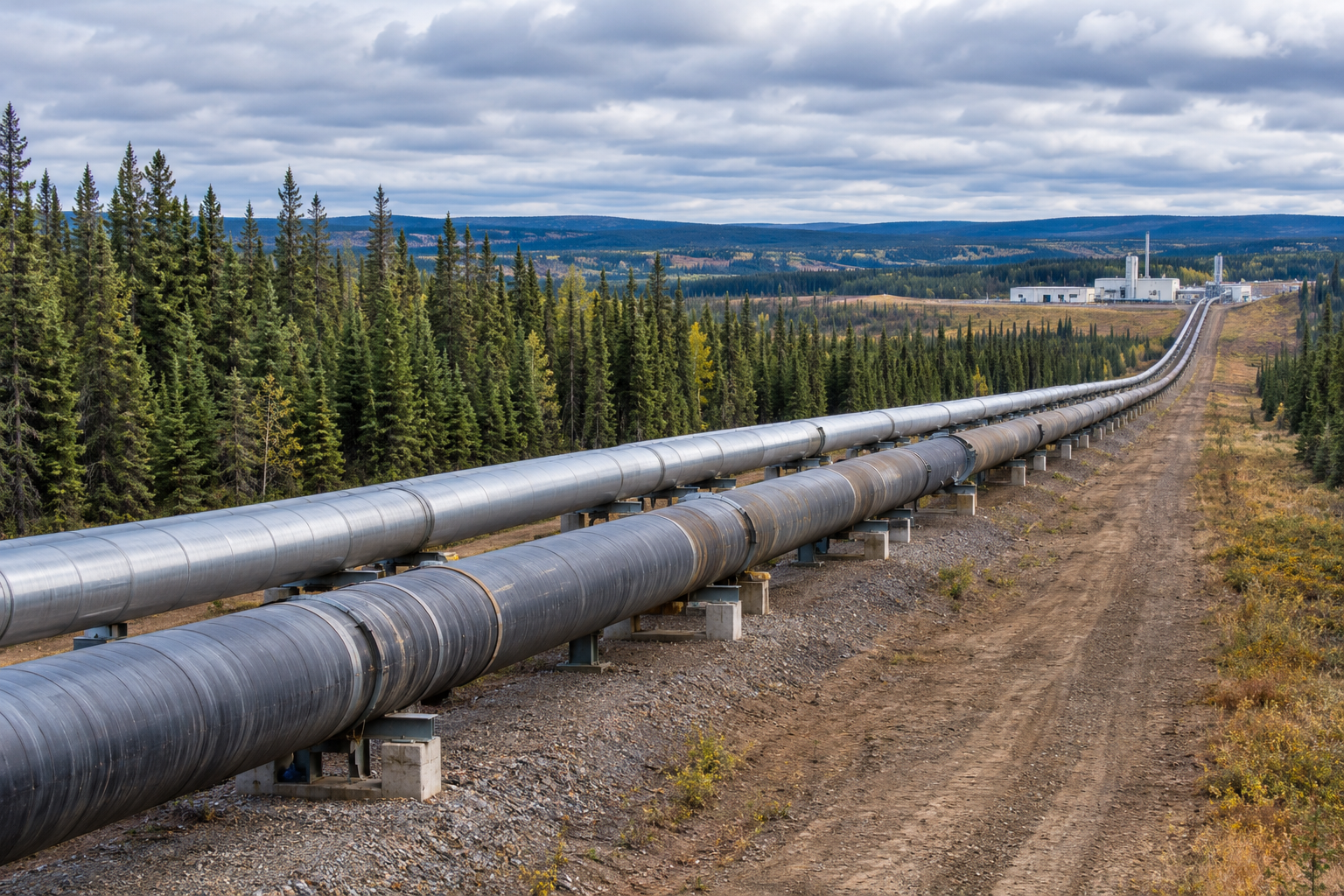
The pipeline would carry up to one million barrels of oil a day from Bruderheim, Alberta, to Roberts Bank, near Vancouver, where tankers would load it, mostly for Asian markets.[2][3] Canada and Alberta would share ownership, and Indigenous communities would be offered at least a 10% stake.[1] More than 130 Indigenous communities could be affected along the route.[5]
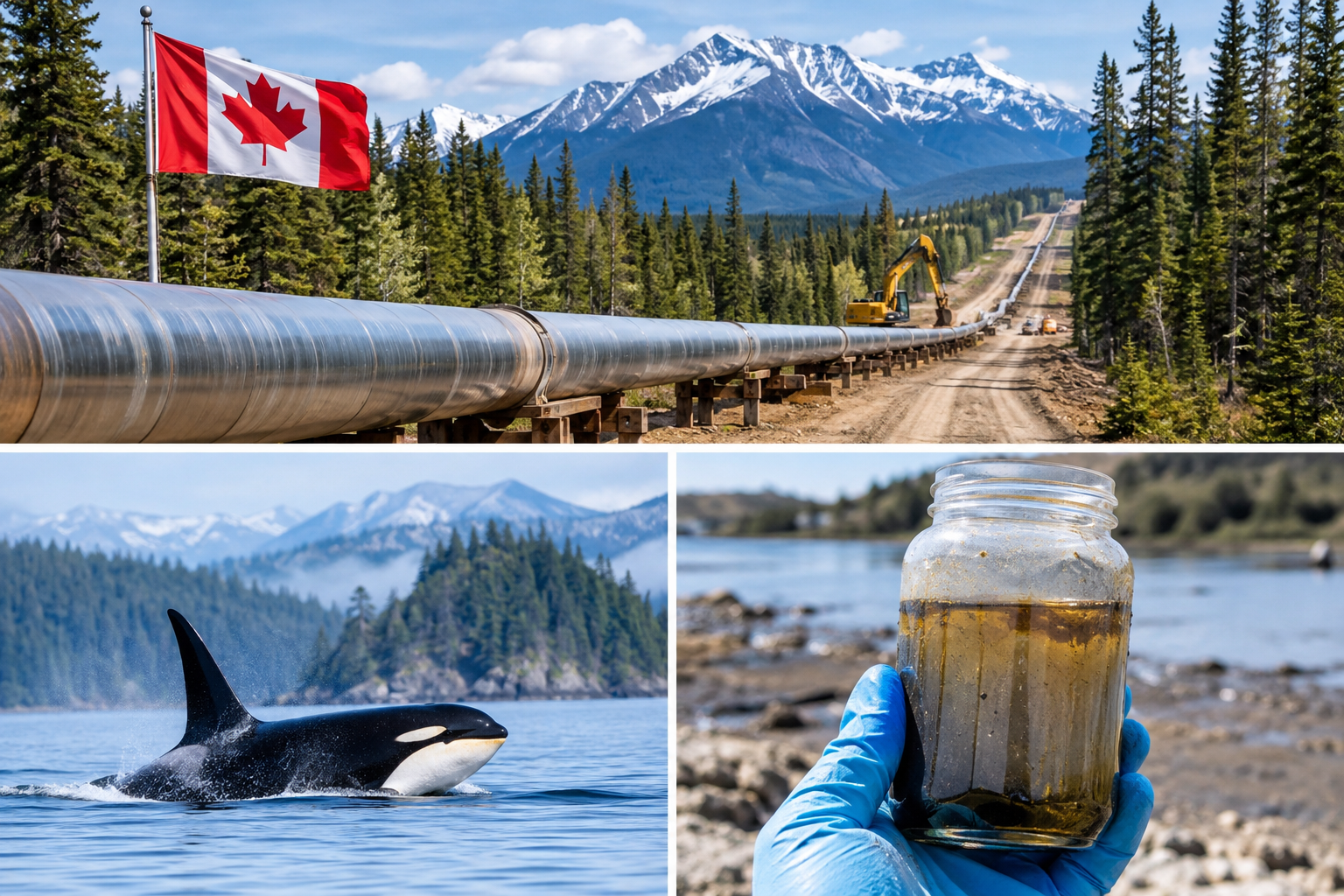
Supporters see a way to protect jobs and sell to more than one customer. Critics see risks to water, wildlife, health and the climate, and ask whether the nations along the route have truly agreed. Both sides raise real points. This article lays them out, explains the science and the law in plain terms, and leaves the conclusion to you. Earth Reform does not take a side here; our goal is to give you the facts.
Canada already depends on one customer
Oil and gas is one of Canada’s biggest exports, and almost all of it goes to one buyer: the United States.
Oil and gas exports were worth $182 billion in 2025, about a quarter of all goods Canada sells abroad.[6] The sector makes up about 6% of the economy directly and employs roughly 200,000 people.[6] Most of the crude oil goes south. About 91% of Canada’s crude exports went to the U.S. in 2024.[7] In 2025, only about 10% of oil and gas exports went to other markets.[8] Around two-thirds of Canada’s roughly five million barrels a day of crude comes from the oil sands in northern Alberta.[9]
In 2025, Canadian heavy crude sold for about US$12 a barrel less than the main U.S. benchmark.[7] Supporters of new pipelines argue that part of that gap comes from having few buyers.
That is why the word “dependence” cuts both ways. For supporters, the problem is relying on one customer, and a pipeline to the coast opens new ones. The federal goal is to double non-U.S. exports over the next decade.[8] For critics, the deeper dependence is on oil itself, and a new pipeline could lock that in for decades.
The case for new pipelines
Supporters make five main arguments.
- Jobs and income. The industry directly supports about 200,000 jobs.[6] Supporters also point to the tax and royalty revenue it generates for governments. About 11,300 of those jobs were held by Indigenous workers in 2024.[7]
- Trade independence. More buyers means better prices and less exposure to U.S. trade politics.[8] A Bloomberg/Nanos poll found 55% of Canadians favour expanding oil and gas exports over meeting the 2030 climate target, while 35% prefer the opposite.[12]
- A smaller footprint. Pacific Link would be buried beside the existing Trans Mountain pipeline for most of its route, rather than cutting a new corridor.[10]
- Indigenous ownership. Ottawa has offered Indigenous groups a collective 15% of Trans Mountain, after talks with 129 First Nations. Each investing nation is set to receive $2.5 million to make up for revenue it missed in earlier years.[11] Pacific Link promises at least 10%.[1]
- A cleaner, safer industry than before. Oil and gas methane emissions are down 46% from their 2014 peak, and the whole economy emits 37% less per dollar of output than in 2005.[13] Industry advocates note there has been no oil tanker spill on Canada’s West Coast in more than 50 years.[14]
Ottawa and Alberta have also linked pipeline support to stronger carbon pricing and carbon capture, technology that traps carbon dioxide before it reaches the air, according to reports on their agreement.[15]
The case for caution: environmental dangers
Critics point to four kinds of environmental risk, from the oil sands to the open ocean.
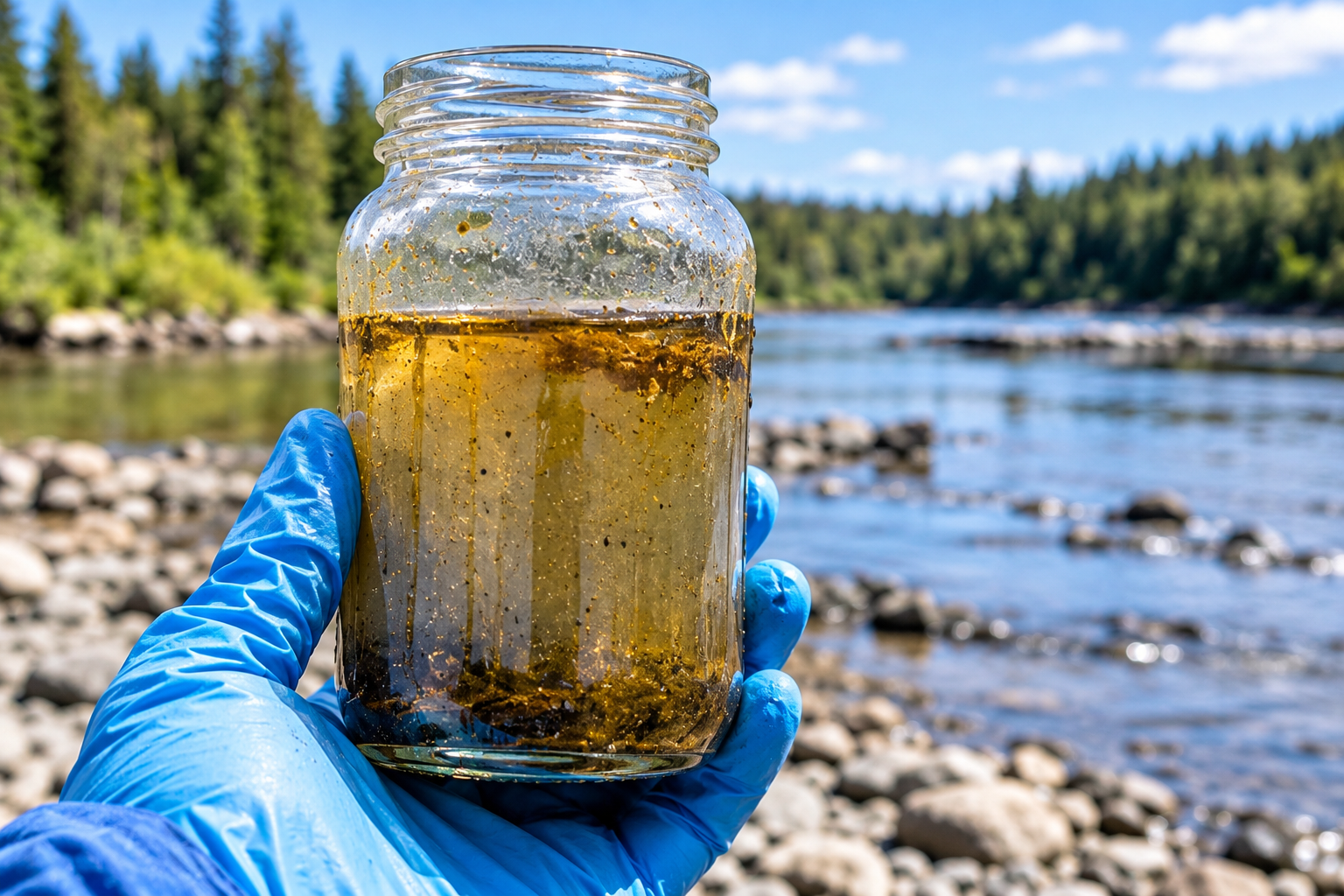
Spills on land and water. Oil sands crude starts as bitumen, a thick, tar-like oil. Much of it is thinned with lighter chemicals so it can flow through a pipeline, and the mix is called diluted bitumen, or dilbit. In 2010, an Enbridge pipeline carrying dilbit ruptured in Michigan and released about 3,700 cubic metres into a creek and the Kalamazoo River, affecting more than 60 kilometres of waterway.[16] Part of the bitumen sank to the riverbed, which made cleanup difficult.[16] A 2013 report by the U.S. National Research Council found that dilbit is no more likely than other oil to cause a pipeline to break, though spills can bring their own cleanup problems.[17]
Tankers and marine life. Pacific Link would end at Roberts Bank, in the Fraser River estuary. Environmental groups describe it as critical habitat for Southern Resident killer whales, a population of about 74 animals, and for some of the largest remaining salmon runs in the Salish Sea, the waters between B.C. and Washington State.[18][19] Friends of the San Juans estimates that tanker traffic carrying Canadian crude could rise by 591 trips a year,[18] and Raincoast Conservation says the 2024 Trans Mountain expansion already raised tanker traffic by up to seven times.[20] Choosing Roberts Bank keeps the northern B.C. tanker ban in place, but critics say it moves the risk to another sensitive coast.[18] Industry responds that Trans Mountain has loaded tankers in Burnaby since 1956 with no spill from tanker operations,[19] and that Pacific Link would build on spill-response upgrades made with the Trans Mountain expansion.[10] The St’át’imc Chiefs Council also worries about Fraser River wild salmon.[21]
Oil sands waste. Tailings ponds in Alberta’s oil sands hold more than 1.5 trillion litres of contaminated wastewater left over from extracting bitumen.[22] Mikisew Cree First Nation opposes proposals to release treated tailings into the Athabasca River.[22]
Climate. Oil and gas produces about 30% of Canada’s greenhouse gas emissions.[6] Prime Minister Carney has acknowledged that his current policies make the 2030 target of 40-45% below 2005 levels hard to meet.[12] The Pembina Institute, an energy policy group, argues that the Canada Energy Regulator’s own scenarios show the economy still growing on a net-zero path, though it would take strong policy such as a high industrial carbon price.[23] Supporters respond that these are projections, and that the jobs and revenue at stake today are real.
What it could mean for human health
Every environmental risk above is also a health risk. The evidence is stronger in some cases than others, so this section separates what is known from what is disputed.
Fort Chipewyan, Alberta. The community sits about 250 kilometres downstream of the oil sands. Preliminary findings from a study commissioned by Mikisew Cree First Nation show cancer rates there about 25% higher than the rest of Alberta between 1993 and 2022.[22] The province says there is no known causal link between oil sands development and cancer rates, that most adult cancer rates fall within normal provincial ranges, and that water tests show the water is safe to drink.[24] An earlier expert panel did not say cancer rates were normal. It said the cause could not be attributed to oil sands contamination on the evidence available.[25] In 2024, Ottawa committed nearly $12 million over 10 years to a community-led health study, after tailings water seeped from Imperial Oil’s Kearl mine site.[9] In plain terms: higher cancer rates have been reported, the cause has not been established, and the research that could settle it is still under way.
Spills and benzene. The chemicals used to thin bitumen can include benzene, a known cause of cancer.[17] After the Kalamazoo spill, benzene sometimes exceeded accepted levels in the air, and more than 100 residents were temporarily moved.[16] It lingered over the creek and river for a few days before drifting away.[17]
Indigenous rights and the question of consent
Canadian law requires governments to consult Indigenous peoples, and sometimes accommodate them, before approving a project that could affect their rights. This duty comes from section 35 of the Constitution.[26] The United Nations Declaration on the Rights of Indigenous Peoples (UNDRIP), which Canada has adopted into federal law, goes further. It calls for “free, prior and informed consent,” meaning agreement that is given without pressure, before decisions are made, with full information.[27]
The disagreement is over what the law requires.
The government’s position. Ottawa says its process meets its obligations. The Major Projects Office reports more than 140 meetings with Indigenous organizations,[2] and Prime Minister Carney has promised the major projects agenda will not undercut UNDRIP.[4] The justice minister has said the UNDRIP law does not give Indigenous peoples a blanket veto, then apologized for how the comment landed.[27] A Mi’kmaw senator’s proposal to write free, prior and informed consent into the major projects law, Bill C-5, was voted down.[28]
Concerns about the process. Pacific Link’s consultation window was two months, extended from one.[4] Cold Lake First Nations Chief Kelsey Jacko said the announcement did not reflect the partnership Carney has promised.[5] Athabasca Chipewyan First Nation said taking part in talks does not mean it consents.[3] The Union of B.C. Indian Chiefs rejected the designation as the product of an incomplete consultation.[29] A group of B.C. First Nations led by the St’át’imc Chiefs Council has filed a Federal Court challenge, arguing the designation shifts the question from whether the pipeline should go ahead to how.[21]
The tanker ban. The debate began with a possible northern route that would have required changing the northern B.C. tanker ban. Chiefs across Canada voted unanimously in December 2025 to reject any such change,[30] and Coastal First Nations said no offer of ownership would change their position.[31] Pacific Link’s southern route leaves that ban untouched.[18]
Voices in favour. Indigenous nations do not speak with one voice. Many see an opportunity: Ottawa says it consulted 129 First Nations before offering a stake in Trans Mountain,[11] and the Haisla Nation is majority owner of Cedar LNG, which a federal minister called economic reconciliation.[32] Supporters of equity deals say ownership gives nations revenue and a seat at the table. Critics respond that owning a share is not the same as having the power to say no.
Oil versus gas: what Coastal GasLink shows
Natural gas pipelines raise many of the same questions, and one of them is already built. Coastal GasLink is a 670-kilometre pipeline that carries gas to the LNG Canada export plant in Kitimat, B.C.[33]
The consent story. Twenty elected First Nation councils along the route signed agreements with the company. But five Wet’suwet’en hereditary chiefs said the project had no authority without their consent, because elected councils administer small reserves while the hereditary chiefs claim authority over the wider territory.[33] About 190 kilometres of the pipeline crosses that territory.[34] Elected councils are a system created under the Indian Act, while hereditary leadership is the Wet’suwet’en’s traditional system.[35] The split was not simple: one elected chief said his council signed to benefit its community.[36]
Equity followed the conflict. In October 2026, TC Energy struck a deal for Indigenous ownership as Coastal GasLink doubles its capacity, a trend reporting describes as a way to reduce opposition and risk.[37] The $33 billion LNG Canada expansion, which doubles export capacity, includes an equity opportunity for five nations,[38] and the Haisla Nation owns 50.1% of the electrified Cedar LNG.[32]
Local air quality. LNG Canada burned off, or flared, 350 million cubic metres of gas in 2025, among the highest LNG flaring totals in the world, and a mechanical problem has raised emissions.[39] The company and the provincial regulator say the emissions are not harmful to health, but some residents are worried.[39] Northern Health found Kitimat already has asthma rates 74% higher than the rest of the province, though the town’s aluminum smelter is also a major source of pollution.[40]
How the risks differ. A gas leak mainly releases methane, a potent greenhouse gas, and can ignite. An oil spill contaminates land and water. Gas also needs liquefaction plants and tankers, which bring their own emissions and local air pollution.
Can it work without harming Indigenous land?
The honest starting point is that a route from Alberta to the coast with no Indigenous territory on it does not exist. Pacific Link alone could affect more than 130 communities.[5] So the real question is how consent is obtained and what is done to limit harm. People who study this describe several approaches, each with limits.
- Make consent a real decision point. Give nations enough time, funding and information to decide, with the ability to say no before the route is fixed.
- Use existing corridors. Pacific Link would run beside the Trans Mountain pipeline for most of its length, which reduces new clearing.[10] But a shared corridor still crosses traditional territory, and it does not by itself mean consent.
- Offer Indigenous ownership. Equity brings revenue and a stronger voice, as with Cedar LNG.[32] But some nations say ownership cannot replace the right to refuse.[31]
- Let nations lead. Eagle Spirit, a proposed oil and gas pipeline corridor to northern B.C., won the approval of chiefs along its route and the backing of an investor, but it was cancelled when the federal tanker ban passed.[41] It shows that nation-led routing is possible, and that it is no guarantee a project will proceed.
- Reduce the need. Cutting emissions from production, through electrification and carbon capture, lowers the climate cost of each barrel. The Pembina Institute says carbon capture at scale would need a high industrial carbon price.[23]
None of these removes every trade-off. Which combination, if any, is acceptable is the question this debate turns on.
Where this leaves us
Pacific Link is still moving. Its conditions are still being finalized,[1] and a court challenge is under way.[21] The table below sets the main points side by side.
| Question | What supporters weigh | What critics weigh |
| Economy | Jobs, tax revenue and exports worth about a quarter of goods trade | Reliance on one sector as global demand shifts |
| Trade | New buyers beyond the U.S. | Locks in oil infrastructure for decades |
| Climate | Falling methane emissions, cleaner production, carbon capture plans | Largest-emitting sector, 2030 target at risk |
| Local environment | Strong tanker record, buried beside an existing pipeline | Spill and tanker risk to salmon, whales and rivers |
| Health | Governments and regulators say water and air meet standards | Unresolved cancer questions, benzene and air-quality concerns |
| Indigenous rights | Ownership, jobs and benefit agreements | Consent not secured, short consultation, nations divided |
A few questions can help you weigh it for yourself. How much weight do you give jobs and revenue today against emissions and ecosystems over the long term? Is selling to more buyers worth building new oil infrastructure? And what should count as consent from a nation, and who decides?
There are thoughtful people on every side of this. Whatever you conclude, the facts above are the starting point.
Sources
- Prime Minister of Canada, Prime Minister Carney lists the West Coast Oil Pipeline, now known as Pacific Link, as a project of national interest (Oct. 1, 2026)
- CBC News, Water, toxic waste and opportunity: Indigenous leaders react to Carney’s pipeline plan
- CBC News, Mayors, First Nations chiefs in Alberta’s oilsands region react tentatively to West Coast pipeline designation
- The Canadian Press, Indigenous communities given just two months to consult on West Coast Pipeline (Oct. 5, 2026)
- Alberta Native News, Pacific Link Pipeline: Indigenous leaders challenge Ottawa’s fast-tracked consultation timeline (Nov. 4, 2026)
- Natural Resources Canada, Energy Fact Book, Spring 2026, Section 6
- Canadian Association of Petroleum Producers, Frequently Used Statistics, June 2026
- ATB Financial, Canada as an energy superpower
- Bloomberg via Engineering News, Canada to fund health study on how oil sands impact Indigenous communities(Aug. 12, 2024)
- Cascadia Daily News, Objections mount in Washington state to proposed Canadian pipeline, tanker traffic
- CP24, Ottawa opens up 15% Trans Mountain equity stake to Indigenous groups on pipeline path (Sept. 22, 2026)
- Briefs.co, Canada will exceed emissions projections under Carney’s updated energy strategy
- Environment and Climate Change Canada, Greenhouse gas sources and sinks in Canada: 2026, executive summary
- Energy Now, Proposed Roberts Bank oil terminal would build on expanded West Coast marine safety system(Oct. 2026)
- Ricochet, The colonial playbook never ended: Canada’s pipeline deal proves it
- CEDRE, Kalamazoo River incident information sheet
- Society for Science, Unconventional spill
- Friends of the San Juans, Surging Canadian crude oil exports put the Salish Sea at risk
- Washington State Standard, Proposed oil pipeline to B.C. coast spurs alarm in Washington state (July 2, 2026)
- Raincoast Conservation Foundation, Extinction is too high a price for a pipeline (Aug. 2026)
- Canadian Lawyer, First Nations challenge Pacific Link’s approval under Building Canada Act
- Cabin Radio, Mikisew Cree say study shows cancer rates higher than rest of Alberta
- Pembina Institute, Rethinking Canada’s Energy Future (April 2026)
- Canada’s National Observer via MBC Radio, First Nation accuses Alberta of withholding cancer data
- St. Albert Today, Oilsands not linked to Fort Chip cancer, says panel
- Canadian Bar Association, Bill C-5, One Canadian Economy Act: submission
- Policy Options (IRPP), Fast-tracking obstacles (July 2025)
- CBC News, Amid new infrastructure bills, First Nations are concerned about the environment and their rights
- Union of B.C. Indian Chiefs, UBCIC rejects “national interest” designation for West Coast Oil “Pacific Link” pipeline (Oct. 1, 2026)
- The Canadian Press via Richmond Sentinel, Chiefs vote to reject changes to B.C. coastal oil tanker ban (Dec. 2, 2025)
- Watershed Sentinel, “It will never be built”: Coastal First Nations reject tar sands pipeline deal
- The Globe and Mail, Ottawa endorses Indigenous-led Cedar LNG as climate activists raise concerns
- CBC News, Coastal GasLink pipeline and Indigenous human rights
- North Shore News, The complicated truth about pipelines crossing Wet’suwet’en territory
- The Globe and Mail, A year after Wet’suwet’en crisis, First Nations question self-governance
- Energeticcity.ca, Why some elected Wet’suwet’en councils signed agreements with Coastal GasLink
- The Logic, TC Energy strikes deal with Indigenous groups for ownership stake in Coastal GasLink pipeline (Oct. 13, 2026)
- Lexpert, LNG Canada reaches final investment decision on Phase 2 expansion in Kitimat
- The Narwhal, LNG Canada flaring and Phase 2
- The Tyee, Exclusive: LNG expansion brings new health risks to Kitimat (Sept. 24, 2025)
- Indigenous Success, Equity partnerships represent a turning point for Indigenous communities
Source notes: figures come from the linked pages as of Nov. 15, 2026. Advocacy and industry sources (Friends of the San Juans, Raincoast, Pembina Institute, UBCIC, CAPP) are attributed in the text.
Leave a Reply