Welcome to Earth Reform. Today we look at the hidden cost of clean energy. The batteries in our phones, laptops and electric cars depend on cobalt and lithium, and getting them out of the ground has real consequences for people and places far away. We will visit cobalt mines in Congo, the salt flats of Chile, and also look closer to home, at what Ontario is doing. None of this is an argument against clean energy. It is an argument for doing it better.
Why the clean-energy shift depends on a few minerals
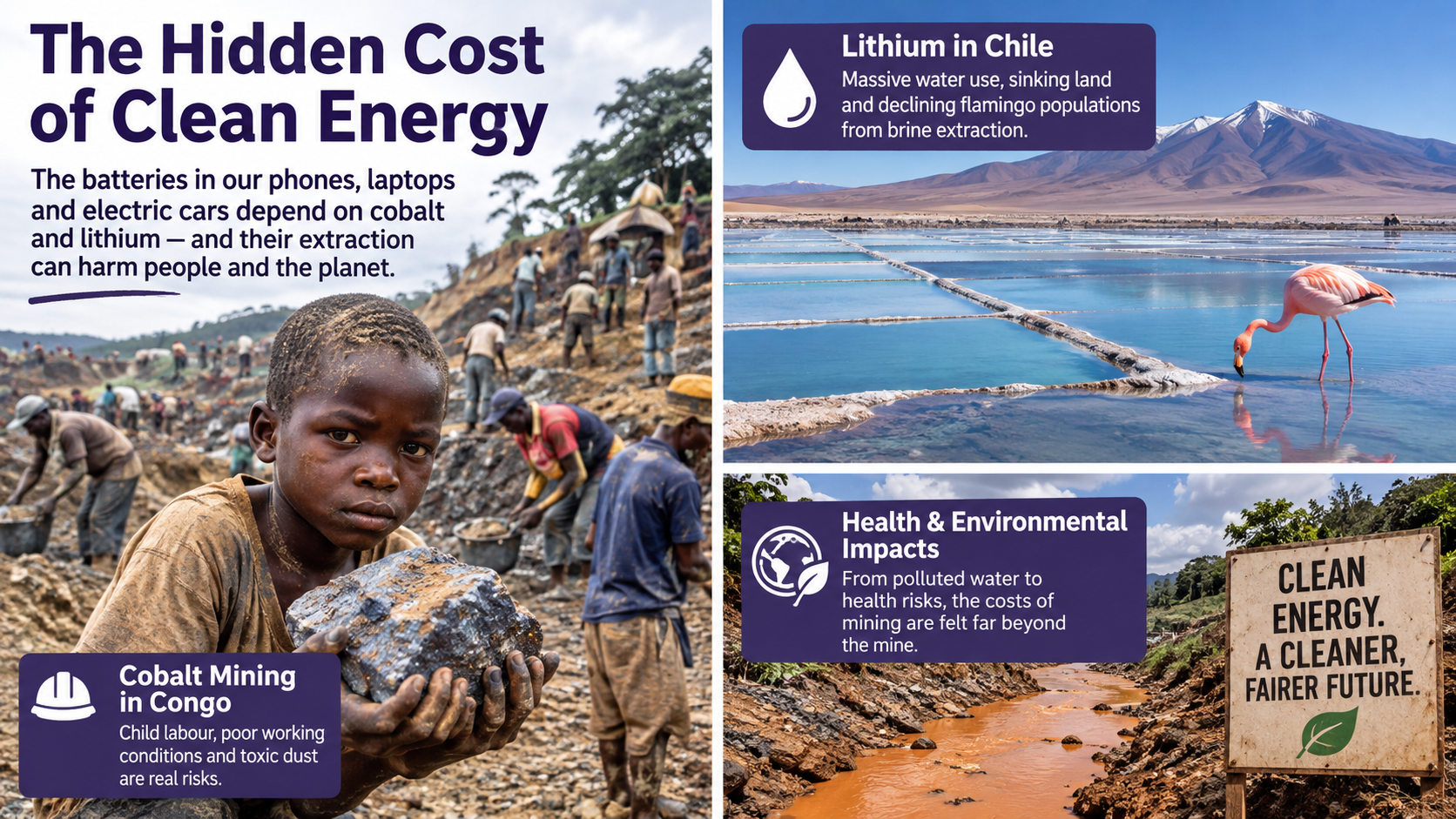
Electric cars, phones, laptops and grid batteries all depend on minerals, and two matter most here: cobalt and lithium.
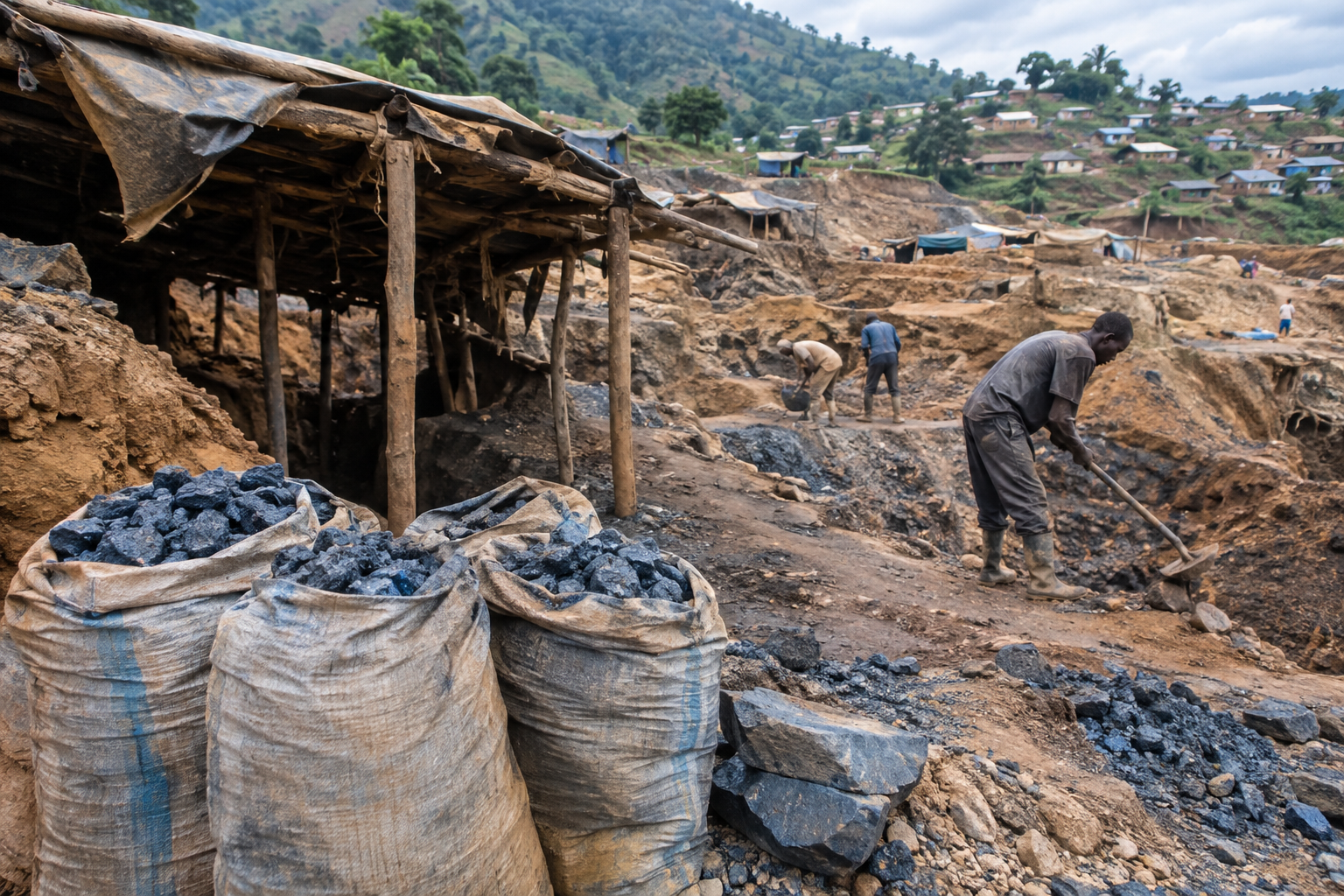
Cobalt is a critical ingredient in batteries for smartphones, laptops and electric vehicles. [1] The Democratic Republic of the Congo (DRC) supplies most of the world’s cobalt, and holds more than half of its reserves. [1][2] Estimates of how much comes from small-scale artisanal miners range from 15 to 20 percent of Congolese production [3] up to about 30 percent. [2]
Lithium comes mainly from two places: salty underground water, called brine, beneath the high salt flats of Argentina, Bolivia and Chile, and hard rock in Australia. Together they accounted for about 75% of global production in 2023. [5] The Atacama salt flat in Chile alone holds about a quarter of the world’s known lithium reserves. [4]
None of this is an argument against clean energy. Cutting emissions matters. It is an argument for cleaner and fairer supply chains, because the harm lands on specific communities far from the people who benefit.
Cobalt in Congo: mining by hand and child labour
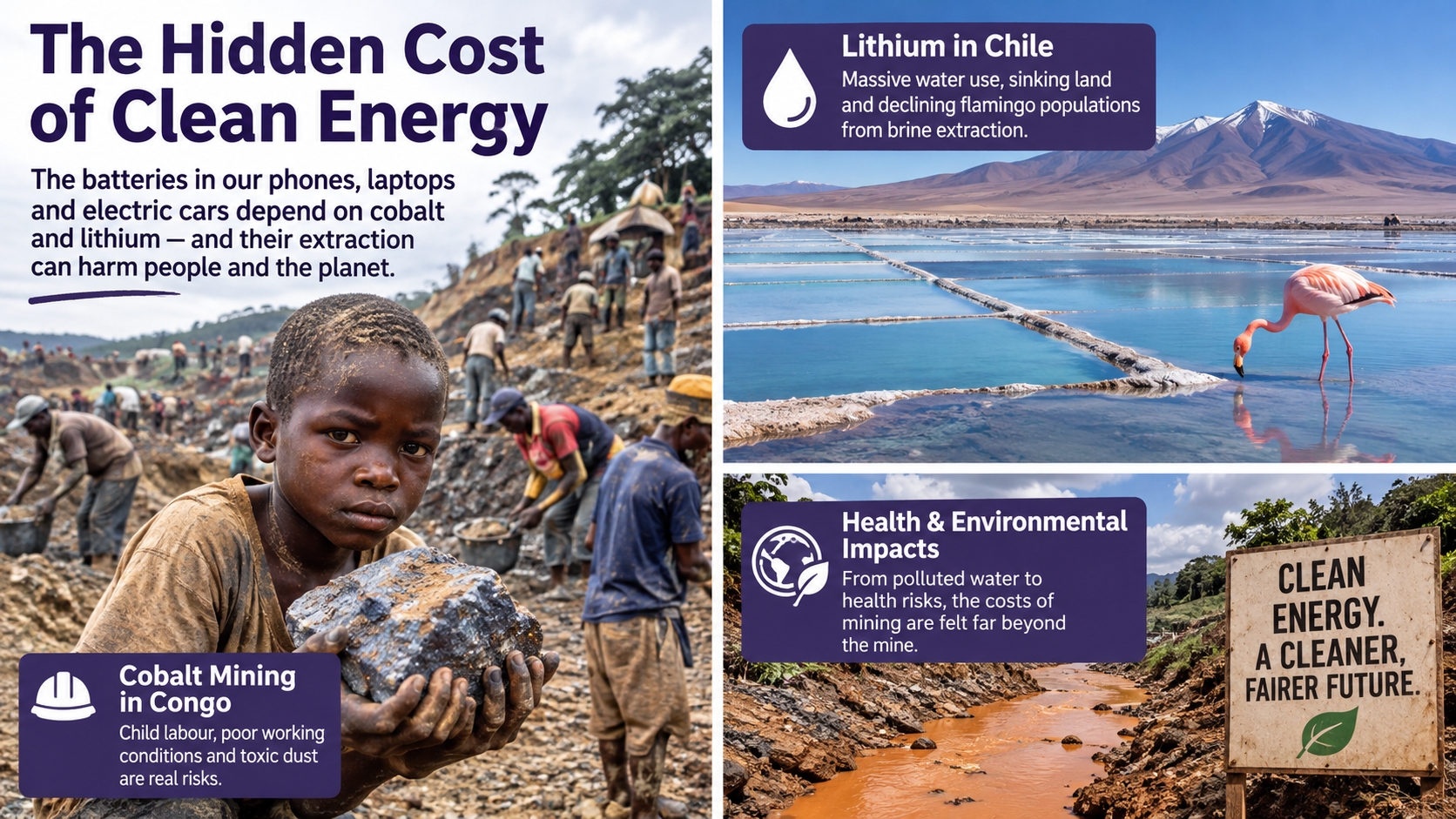
The worst conditions are in artisanal and small-scale mining, where people dig by hand with little machinery and almost no government oversight. [1] Researchers and human rights groups have documented exploitation, abuses and child labour in Congolese cobalt mining since 2000. [6] A US Department of Labor report from 2023 examined forced labour in the sector. [1]
Children and girls are among those affected. A recent study of girls’ work in artisanal cobalt mines found that their exposure to dust and toxic cobalt compounds is shaped by the division of labour and a lack of protective equipment. [2] Because child labour is officially prohibited, children run away when law enforcement officers come by. [2]
The picture is complicated, and the sources say so. One analysis found that the artisanal share of world cobalt mining has generally fallen since 2008, and that most artisanal production was processed in the DRC by Chinese firms or exported to China. [6] That means the supply chain runs through many hands, which makes it hard for any single buyer to say where their cobalt came from.
Lithium and water: the Atacama salt flats
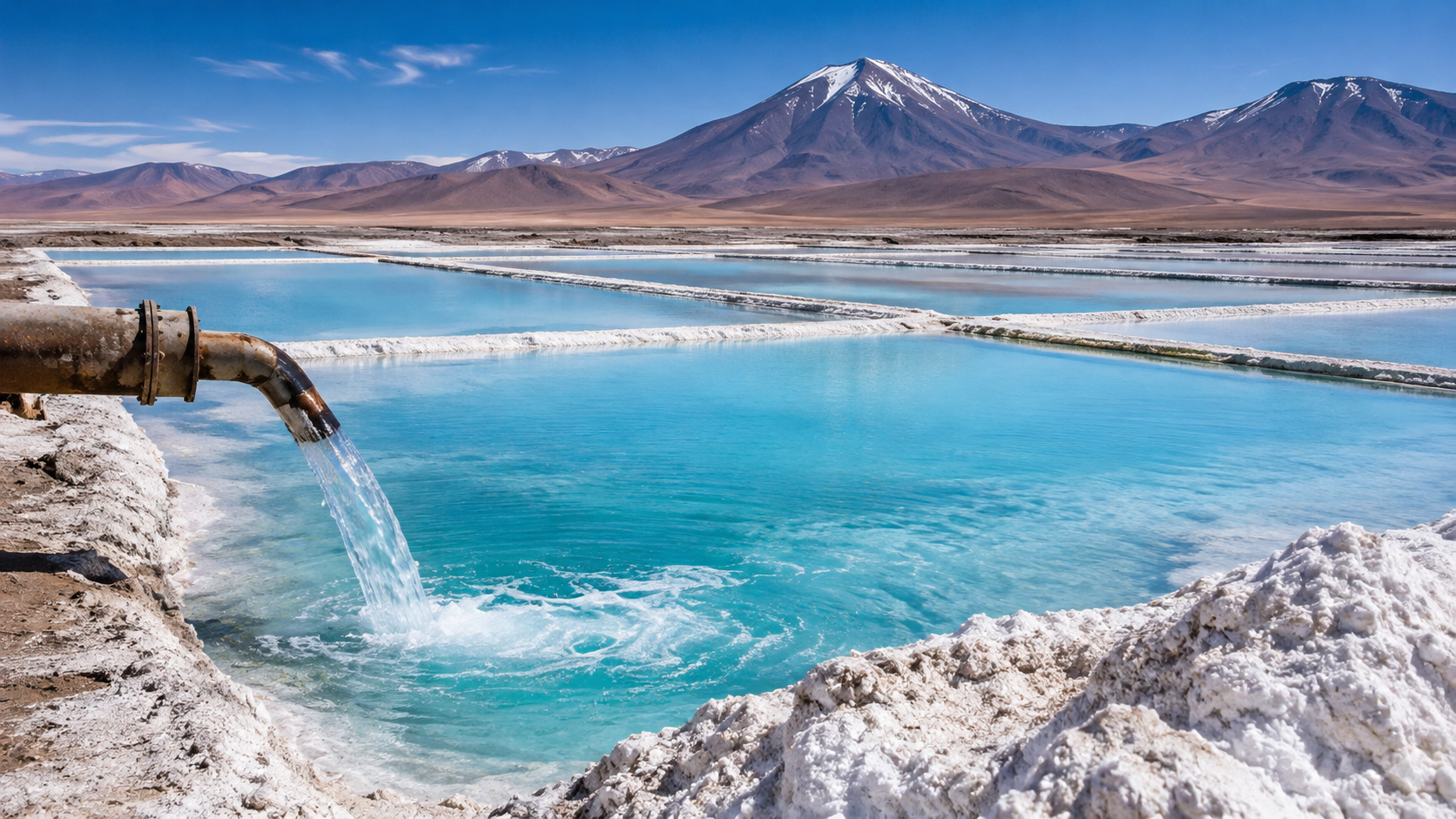
Lithium in Chile is pumped up as brine and left to evaporate in huge pools under the desert sun. [7] According to a report covered by Mongabay, producing one ton of lithium carbonate with the current technology means evaporating about half a million liters of brine, and almost all of that water is lost from the underground aquifer. [7]
The effects are visible. A 2024 study found that parts of the Atacama salt flat are sinking by 1 to 2 centimeters a year because of brine extraction. [7] Another analysis reports that groundwater levels in the salt flat have fallen by more than 10 meters in 15 years. [5] A 2022 study found that two of the three flamingo species in the salt flat declined by 10 to 12% in just 11 years, which researchers link to lithium extraction among other pressures. [8]
The Indigenous Lickanantay people live on this land, and they have protested lithium expansion for decades because of water. [4] Communities in the Atacama also report water shortages that affect their homes and farming. [20] Newer methods such as direct lithium extraction could reduce water use, although they bring their own challenges. [7]
Health and environmental harm to nearby communities
Cobalt: documented exposure. In the best-known study, from the Congolese city of Kolwezi, people living in a neighbourhood that had become an artisanal cobalt mine had much higher levels of cobalt in their urine and blood than people in a nearby control area. The difference was greatest in children. [3] Reports on this research also describe signs of DNA damage in children. [9] Cobalt dust can cause respiratory problems such as asthma and chronic bronchitis. [9] Inhaling cobalt dust can cause a serious lung condition called hard metal lung disease, according to a child-rights review. [11]
What is less certain. A review of health issues in small-scale mining cautions that the long lists of hazards are not present at every site. It also notes an unexpected finding: children from the surrounding community had higher urine cobalt than diggers working nearby, which points to dust in the wider environment as well as direct work. [10] Not every mine presents the same risk.
Lithium: environmental harm is clearer than health harm. The most visible impacts are on the desert ecosystem, including falling water levels, subsidence and declining flamingos. [8] An ecologist quoted by the same source says evidence on the health effects of lithium mining in Chile is still extremely limited and needs deeper epidemiological research. [8] That gap should be stated plainly rather than filled with guesses.
Why this matters to us
Most people reading this are holding or carrying a lithium-ion battery right now. Cobalt and lithium sit inside phones, laptops and electric vehicles, and the supply of both is concentrated in a few places. The DRC supplies most of the world’s cobalt, and the salt flats of Chile and Argentina together with Australian hard rock supply about three-quarters of its lithium. [1][5]
That concentration is a reason to care, even for people who never think about mining. The link between abuses in Congolese mines and advanced batteries has already led to global supply chain reviews, responsible sourcing programs and research on removing cobalt from battery designs. [6] A supply chain this narrow is also difficult to audit and difficult to replace quickly.
The point is not guilt. Ordinary buyers cannot trace the cobalt in a phone. The point is that the cleaner-energy future we are building on has costs that are easy to miss, and that the companies and governments shaping the supply chain have far more power to change them than any shopper.
The Canadian picture
Canada is positioning itself as a supplier of these minerals, and Ontario is at the centre of that effort. Electra Battery Materials is building a cobalt refinery in Temiskaming Shores, described as the first battery-grade cobalt refinery in North America. Once it is fully operating, it is expected to support nearly 6,500 tonnes of cobalt a year. [16] The federal government contributed $20 million to the project. [15] In 2026, Ontario also launched a $500 million Critical Minerals Processing Fund, aimed at refining in Ontario what is mined in Ontario. [17] These are plans and announcements, so it is worth checking each project’s current status before you publish.
Domestic mining brings its own trade-offs. In northern Ontario’s Ring of Fire, a mineral-rich area of environmentally sensitive peatlands, some First Nations have concerns about development, and any agreement will need to address them. [12]
Recycling offers a path that avoids some of those trade-offs. Aki Battery Recycling is a joint venture between the Three Fires Group and Electra, described as Canada’s first Indigenous-led lithium-ion battery recycling initiative, starting in southern Ontario. [13][14] Southwestern Ontario lacks the mineral-rich geology of the north, so a recycling approach fits the region. [18] Ottawa has also backed recycling technology, with $8.4 million to two companies in Kingston. [19]
Where a fix is obvious: recycle first, mine responsibly
The most direct fix is to need less new mining. Battery recycling shreds old cells into a material called black mass, and Electra’s process recovers critical minerals from it so they can go back into new batteries. [14] The company says this reduces the carbon footprint of the electric vehicle supply chain and lowers reliance on foreign sources. [18] Every tonne recovered is a tonne that does not have to be dug from the ground in Congo or pumped from a salt flat.
Two other levers exist. Researchers are working on battery designs that remove cobalt from the cathode. [6] And direct lithium extraction could cut the water needed for lithium, although it comes with its own challenges. [7]
This is another place where incentives fit naturally, although this part is my suggestion rather than a sourced finding. Rules that require recycled content in new batteries, take-back duties for battery makers, and tax credits for recycling capacity would grow the recycled supply. Supply chain audits for what must still be mined would add pressure for safer conditions. That could be a strong follow-up article.
There are no easy fixes for communities on the ground. A landmark deal in Chile to share lithium revenue with Indigenous communities has left them more divided than before. [4] Good intentions at the top do not automatically deliver justice at the source.
To sum up: most of the world’s cobalt comes from Congo, where artisanal mining has been tied to child labour and heavy metal exposure. Lithium in Chile’s Atacama is pumped from brine, which uses enormous amounts of water in one of the driest places on Earth. The health evidence is clearer for cobalt than for lithium. The most direct fix is to recycle the minerals we already have, and Ontario is already building toward that. Thank you for joining us at Earth Reform. The sources for everything in this article are listed below.
Sources
- American Bar Association, “Cobalt, corruption, and childhood: failures and risks in the global supply chain,” 2025. https://www.americanbar.org/groups/environment_energy_resources/resources/natural-resources-environment/2025-fall/cobalt-corruption-childhood-failures-risks-global-supply-chain/
- “Girls’ work in artisanal cobalt mines in the Democratic Republic of Congo,” 2026. https://link.springer.com/article/10.1007/s12115-026-01217-w
- Banza Lubaba Nkulu et al., “Sustainability of artisanal mining of cobalt in DR Congo,” Nature Sustainability, 2018. https://www.nature.com/articles/s41893-018-0139-4
- Climate Change News, “Landmark deal to share Chile’s lithium windfall fractures Indigenous communities.” https://www.climatechangenews.com/?p=83661
- Debates Indígenas, “A just energy transition? The impacts of lithium extraction on the Andean salt flats of Argentina, Bolivia, and Chile.” https://debatesindigenas.org/eng/a-just-energy-transition-the-impacts-of-lithium-extraction-on-the-andean-salt-flats/
- “China, the Democratic Republic of the Congo, and artisanal cobalt mining from 2000 through 2020,” PNAS. https://doi.org/10.1073/pnas.2212037120
- Mongabay, “Lithium mining leaves severe impacts in Chile, but new methods exist: report,” September 2025. https://news.mongabay.com/2025/09/lithium-mining-leaves-severe-impacts-in-chile-but-new-methods-exist-report/
- Back Market, “Mine My Phone: lithium mining in the Atacama Desert.” https://www.backmarket.co.uk/en-gb/mine-my-phone/lithium/mining-in-the-atacama-desert
- Humanium, “The current state of child labour in cobalt mines in the Democratic Republic of the Congo.” https://www.humanium.org/en/the-current-state-of-child-labour-in-cobalt-mines-in-the-democratic-republic-of-the-congo/
- “A review of health issues related to child labor and violence within artisanal and small-scale mining.” https://pmc.ncbi.nlm.nih.gov/articles/PMC7875191/
- “Human rights violations against children in the Democratic Republic of Congo, the international trade in minerals.” https://www.researchgate.net/publication/342646294_Human_rights_violations_against_children_in_the_Democratic_Re public_of_Congo_the_international_trade_in_minerals
- Mining Watch Canada, “A battery-powered green future? Canada has a strategy for that.” https://miningwatch.ca/node/11107
- Solar Builder, “Canada’s first Indigenous-led battery recycling venture moves forward in Ontario.” https://solarbuildermag.com/canada/canadas-first-indigenous-led-battery-recycling-venture-moves-forward-in-ontario/
- Recycling Product News, “Indigenous-led initiative closes the loop on battery materials in Canada.” https://www.recyclingproductnews.com/article/43608/indigenous-led-initiative-closes-the-loop-on-battery-materials-in-canada
- The Logic, “Feds kick in $20M for battery-grade cobalt refinery in Ontario.” https://thelogic.co/?p=2133788
- Motion and Mechatronics, “Ontario welcomes $100 million investment in province’s critical mineral processing supply chain,” September 2025. https://www.motionandmechatronics.ca/?p=80623
- E&MJ, “Ontario launches $500 million critical minerals processing fund.” https://www.e-mj.com/departments/processing-solutions/ontario-launches-500-million-critical-minerals-processing-fund/
- CIM Magazine, “From scrap to supply chain.” https://magazine.cim.org/en/indigenous-participation-in-mining/from-scrap-to-supply-chain-en/
- Mining.com, “Canada invests $6 million to boost critical minerals recycling in Ontario.” https://www.mining.com/?p=1159902
- Indigenous Peoples Rights International, “Indigenous people’s livelihoods at risk in scramble for lithium.” https://indigenouspeoples-sdg.org/index.php/english/ttt/1027-indigenous-people-s-livelihoods-at-risk-in-scramble-for-lithium-the-new-white-gold
Leave a Reply