Welcome to Earth Reform. Today we look at forever chemicals, known as PFAS, and how they end up on farms. The route runs through something most of us never think about: the sludge left over from sewage treatment, which is often spread on fields as fertilizer. In Maine, that led to contaminated milk, beef and crops, and some farms closed. We will look at what happened, what the health science says, how Canada and Ontario compare, and what can be done.
What PFAS are and why they never really go away
PFAS is short for per- and polyfluoroalkyl substances, a family of thousands of human-made chemicals. [2] They are used in firefighting foams, food packaging, cosmetics, pesticides and textiles, among other products. [1] Many of them break down extremely slowly in nature, which is why they are called forever chemicals.
The results are everywhere. Canada’s federal assessment reports PFAS throughout the country, including in places far from any known source. [1] Certain PFAS have been found in the blood of about 98% of Canadians, although levels of the best-known ones have been falling. [3] Researchers say the main routes into the general population are food, drinking water and house dust. [2] Some of these compounds stay in the body for years. [2]
This article looks at one route in particular: how forever chemicals reach the food we grow.
How they reach farms
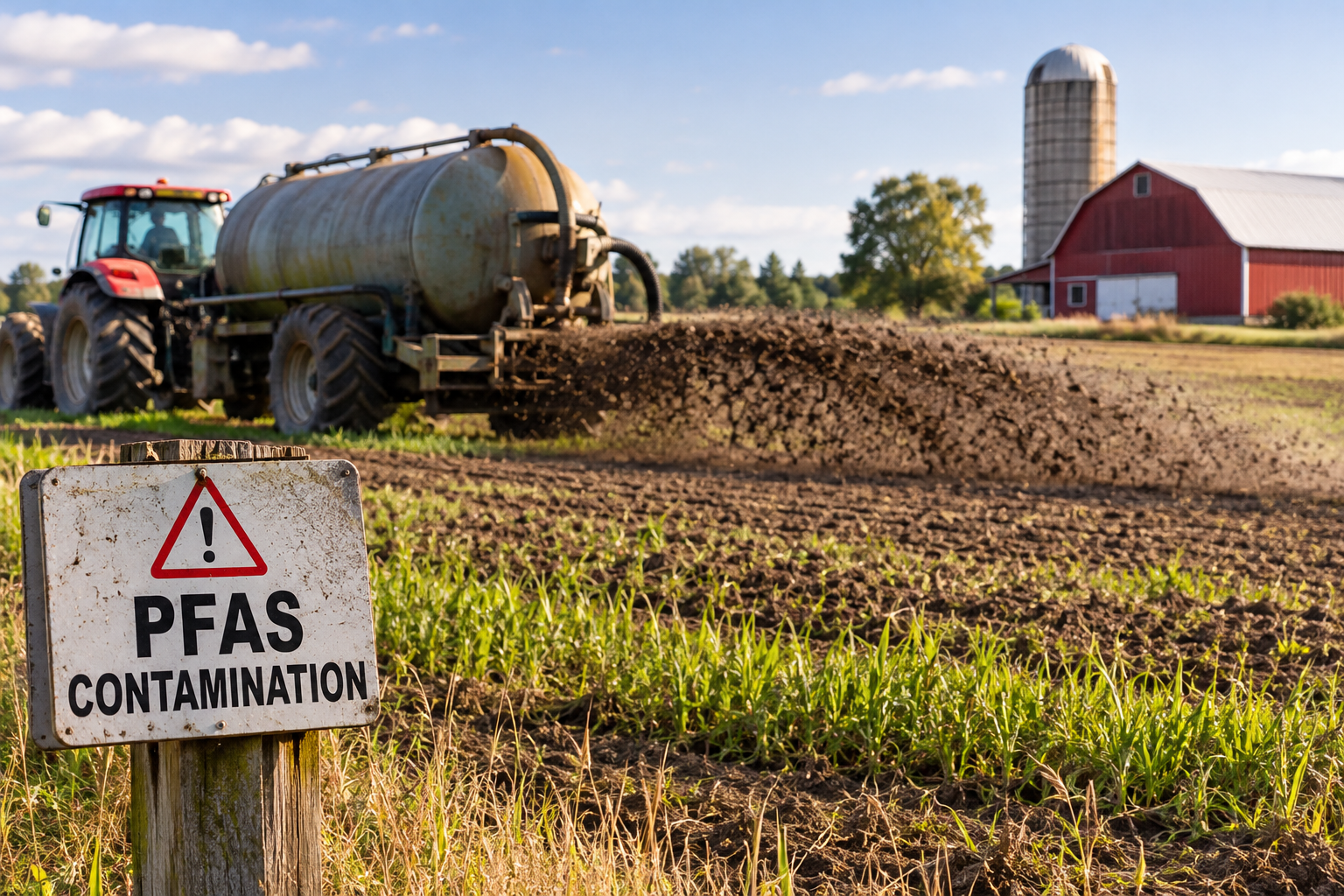
The route that has caused the most trouble is sewage sludge. Wastewater treatment plants were not designed to remove PFAS, so the chemicals end up in the leftover solids. [4] Those solids, called biosolids, are widely spread on farm fields as fertilizer because they supply nutrients and organic matter. [18] In Maine, farmers relied on sludge from local treatment plants for years to support their crops. [7]
PFAS get into sludge because homes, businesses and industry all send wastewater to the same plants. Some of Maine’s problem was likely caused by industrial sludge in the mix. [6] Canada’s federal report also lists releases into wastewater systems, composting of food packaging that contains PFAS, and land application of biosolids as ways these chemicals reach the environment. [1] Maine’s health agency adds that farms can also be contaminated through air and water. [5]
Once the chemicals are in the soil, they do not stay put. In Maine, testing showed that PFAS had already seeped into drinking-water wells and crop roots. [7]
Livestock, crops and milk: what has been found
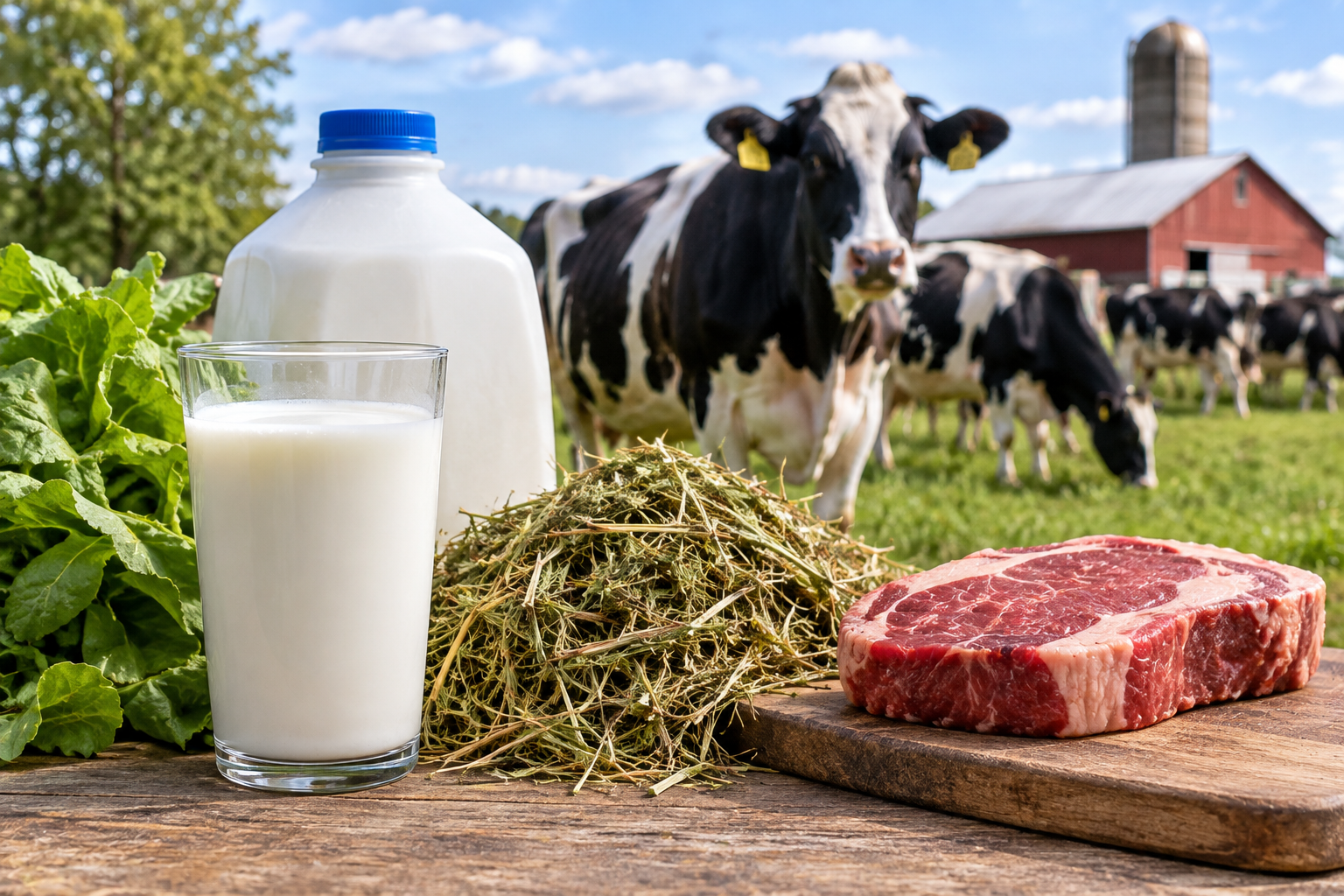
The best-documented case is Maine. Researchers from the Maine Centers for Disease Control studied a dairy farm whose soil had been contaminated by past sludge spreading. They tracked how PFOS, one of the best-known PFAS, moved from soil into grass grown for feed. [8] From there it moves into the animals, and then into milk and beef. [8]
The scale was serious. Some Maine dairy milk tested at about 30 times the safety threshold, among the highest levels ever recorded in food. [11] Contamination was found on more than fifty farms. [11] Maine set action levels for PFOS in cow’s milk in 2017 and in beef in 2020, to decide when products cannot be sold. [5] In 2019, a dairy farm that had been in business for over a century closed because it could not get its levels low enough. [7]
Many farms found ways to keep going. Only five of the more than sixty contaminated Maine farms had to shut down, according to one account, and one farm that switched from grass for cattle to growing grain appears to have reduced the problem, because the grain stalks seem to protect the harvested part of the plant. [10]
The US Environmental Protection Agency’s modelling points to the same pathways. It found that contaminated sludge could lead to excess risk through drinking water, milk, beef, eggs and some fruits and vegetables. [13]
Known and suspected health effects in humans
What is known. The most authoritative review is a 2022 report from the US National Academies of Sciences, Engineering, and Medicine. It found sufficient evidence linking PFAS exposure to four outcomes: a weaker antibody response to vaccines, abnormally high cholesterol, slower growth of babies before and after birth, and kidney cancer in adults. [14] These are statistical associations in groups of people, not a guarantee for any one person. In one study, people with the highest blood levels of PFOA had more than double the kidney cancer risk of those with the lowest. [4]
What is suspected. The evidence is weaker, which the report calls suggestive, for breast cancer, testicular cancer, thyroid problems, ulcerative colitis, high blood pressure in pregnancy and changes in liver enzymes. [4][14] Studies in laboratory animals link certain PFAS to reproductive, developmental, hormone, liver, kidney and immune effects. [16]
Why levels in the blood matter. The report advised that people with PFAS blood levels between 2 and 20 nanograms per milliliter may face a potential for adverse effects, especially sensitive groups such as pregnant women. [15]
What is not known. Most studies look at a small number of well-known PFAS, yet people are exposed to many at once, and Canada’s federal assessment notes that combined exposure may add up in ways that are not yet understood. [23] The National Academies also called for more research on gaps ranging from effects on the nervous system to bone density. [4]
The human cost: farming families and the food we eat
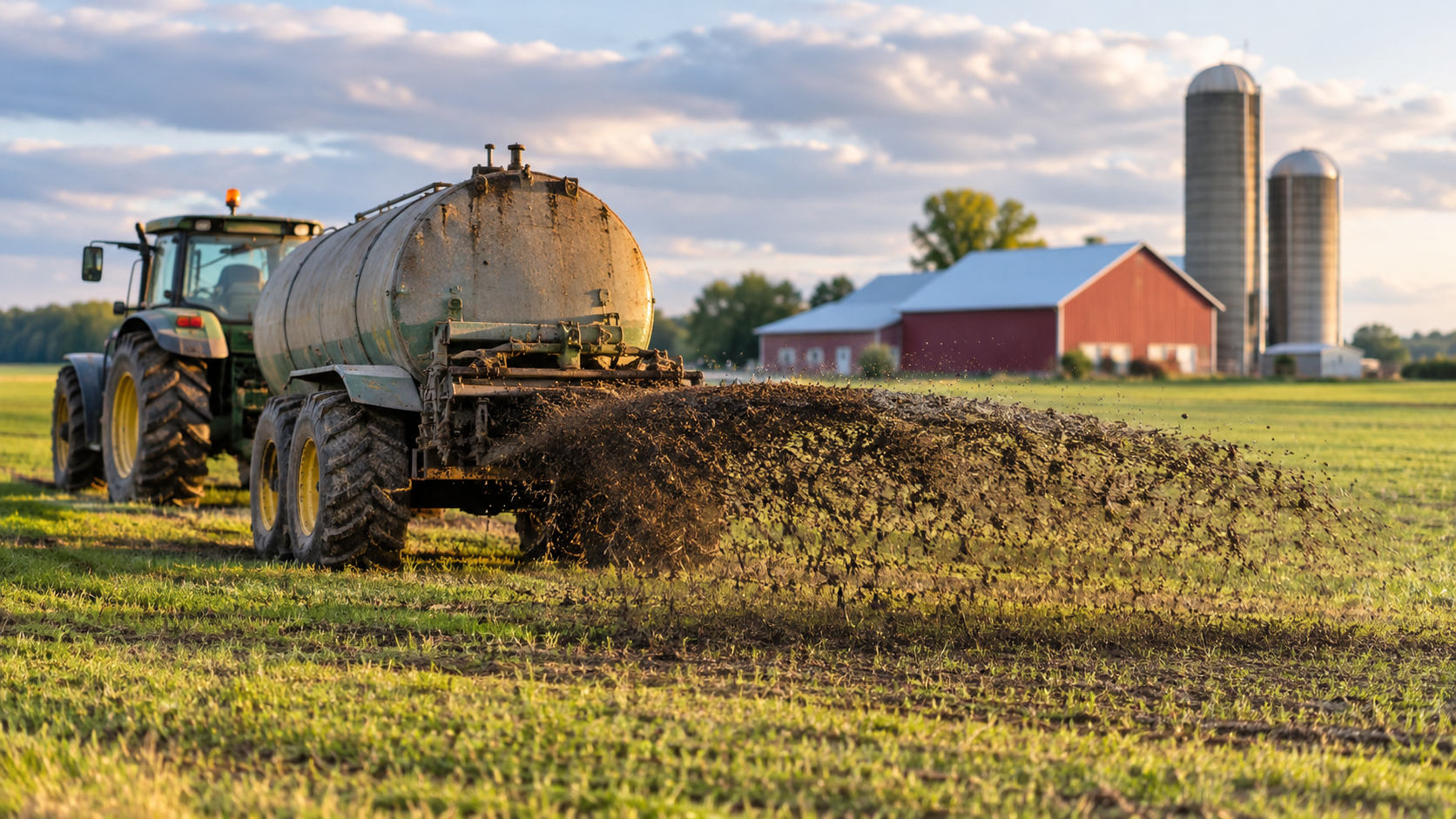
Farmers carried the first and heaviest cost. In Maine, several farms discovered unsafe PFAS levels in milk and beef after spreading sludge they had been told would help their soil. Some had to dump milk and cull herds, and some shut down entirely. [9]
Farm families may also face a personal health risk. In its January 2025 draft risk assessment, the US EPA found that acceptable risk thresholds may be exceeded in some modelled scenarios for a farm family when sludge containing just 1 part per billion of PFOA or PFOS is spread on land. [22] That assessment focused on people who live on or near affected farms or rely mainly on their products. It did not assess the general population, who typically eat a varied diet. [12] So the finding is about concentrated exposure, and it says little either way about ordinary grocery shopping.
For everyone else, the issue is the background load. Food is one of the main ways PFAS enter the general population, alongside drinking water and house dust. [2] Farm contamination is one entry point into that load, and it is one that can be controlled.
The Canadian picture
Canadian farms use a lot of sludge. Federal data cited by the National Observer show that Canadian farmers applied over 500,000 tonnes to their fields in 2020, and the same report identifies Ontario as the province that applied the most. [17] At the time of that report, Environment and Climate Change Canada said it had no measures in place to track PFAS in groundwater or farm soils. [17]
The Ontario evidence so far is more reassuring than Maine’s. A University of Guelph project that sampled Ontario biosolids and fields found PFAS in the biosolids, but no significant difference in soil concentrations between fields that received them and fields that did not. [18] The lead researcher, Ryan Prosser, says municipalities in Ontario do a fairly good job of source control, but he still believes the issue is worth watching. [18]
Federal rules have also tightened. Since October 18, 2024, the Canadian Food Inspection Agency enforces an interim standard: biosolids sold or imported in Canada as commercial fertilizer must contain less than 50 parts per billion of PFOS, which is used as a marker for PFAS. [19] At least 92% of Canadian biosolids already pass. [19] The agency covers import and sale, while the provinces regulate use and disposal. [24] Separately, new federal rules scheduled to take effect on June 30, 2026 prohibit the manufacture, use, sale and import of certain PFAS, including PFOS, PFOA and long-chain PFCAs, with limited exceptions. [20]
On food, an older federal survey (2013 to 2016) found no detectable PFOA or PFOS in any of 1,418 food samples, at a detection limit of 0.25 parts per billion. [3] That is reassuring, but the data are about a decade old and cover only two PFAS.
Where a fix is obvious: stop it at the source
The clearest lesson from Maine is that stopping PFAS at the source works better than cleaning up afterward. Michigan sharply cut levels of one PFAS in its biosolids by requiring upstream industries to reduce what they send to treatment plants. [6] The US EPA’s notice describes state pretreatment programs that cut PFOS in sewage sludge by 98%. [13] Canada’s food inspection agency has made the same point, saying contamination can be managed through source controls and through how biosolids are used. [25]
Without source control, the costs land on farmers and utilities. Maine’s ban on spreading sludge pushed the material into landfills. [7] One utility there is developing a thermal facility to destroy PFAS in sludge and produce PFAS-free biochar. [11]
This is where manufacturer responsibility fits naturally, although this part is my suggestion rather than a sourced finding. PFAS reach wastewater from industrial discharges and consumer products, so producer-pays cleanup funds and incentives for PFAS-free substitutes would target the origin of the problem. British Columbia has already taken the liability route, filing a class-action lawsuit against PFAS manufacturers in 2023. [21] A full article on manufacturer incentives could be a strong follow-up.
To sum up: PFAS collect in sewage sludge, and when that sludge is spread on farmland they can move into soil, crops, livestock, milkand beef. The strongest evidence of harm links PFAS to weaker vaccine response, high cholesterol, lower birth weight and kidney cancer. Farm families face the greatest exposure, and the evidence for ordinary shoppers is less clear. The encouraging part is that stopping PFAS at the source works. Thank you for joining us at Earth Reform. The sources for everything in this article are listed below.
Sources
- Environment and Climate Change Canada and Health Canada, State of Per- and Polyfluoroalkyl Substances (PFAS) Report, March 2025. https://www.canada.ca/en/environment-climate-change/services/evaluating-existing-substances/state-per-polyfluoroalkyl-substances-report.html
- Canadian PFAS biomonitoring study, Environmental Health, 2024. https://ehjournal.biomedcentral.com/counter/pdf/10.1186/s12940-024-01085-z.pdf
- Canadian Food Inspection Agency, PFOA and PFOS in selected foods, April 2013 to March 2016. https://publications.gc.ca/collections/collection_2026/acia-cfia/A104-706-2026-eng.pdf
- Science News, “Forever chemicals may pose a bigger risk to our health than scientists thought.” https://www.sciencenews.org/article/pfas-forever-chemicals-health-risk-water
- Maine CDC, “PFAS and agriculture.” https://www.maine.gov/dhhs/mecdc/healthy-living/health-and-safety/pfas-in-maine/pfas-and-agriculture
- Maine Public, “Our sewage often becomes fertilizer. Problem is, it’s tainted with PFAS.” https://www.mainepublic.org/2023-04-10/our-sewage-often-becomes-fertilizer-problem-is-its-tainted-with-pfas
- Sentient Media, “Maine was first to ban spreading PFAS-contaminated sludge on farmland. Now sludge is filling up landfills.” https://sentientmedia.org/maine-sand-now-sludge-is-filling-up-landfills/
- Maine CDC, “Maine CDC advances understanding of PFAS in crops grown for livestock feed,” 2024. https://www.maine.gov/dhhs/blog/maine-cdc-advances-understanding-pfas-crops-grown-livestock-feed-2024-11-06
- Sentient Media, “PFAS levels in sewage sludge put New York’s dairy and meat industry at risk.” https://sentientmedia.org/pfas-levels-in-sewage-sludge-put-new-yorks-dairy-and-meat-at-risk/
- The New Republic, “One state’s war on forever chemicals in milk.” https://newrepublic.com/article/187106/pfas-milk-maine-texas-biosolids-sewage
- Kleinman Center for Energy Policy, “Sewage sustainability: policies to balance PFAS mitigation and nutrient recycling.” https://kleinmanenergy.upenn.edu/research/publications/sewage-sustainability-policies-to-balance-per-and-polyfluorinated-alkyl-substance-pfas-mitigation-and-nutrient-recycling/
- US EPA, “Draft sewage sludge risk assessment for PFOA and PFOS: information for farmers,” January 2025. https://aglaw.psu.edu/wp-content/uploads/2025/01/03-Fact-Sheet-Farmers-Biosolids-1.14.25.pdf
- Federal Register notice summary, EPA draft sewage sludge risk assessment, January 2025. https://policyrisk.com/federal-register/2025-00734
- Environmental Health News, report on the National Academies PFAS guidance. https://www.ehn.org/pfas-testing-needed-2657763614/make-pfas-testing-available
- The New Lede, “PFAS testing needed for people with elevated exposures, US science advisors warn.” https://www.thenewlede.org/?p=864
- Health Canada, “Per- and polyfluoroalkyl substances (PFAS) in Canadians.” https://www.canada.ca/en/health-canada/services/environmental-workplace-health/reports-publications/environmental-contaminants/human-biomonitoring-resources/per-polyfluoroalkyl-substances-canadians.html
- National Observer, report on PFAS in Canadian sewage sludge. https://www.nationalobserver.com/node/31435
- Better Farming, “Are biosolids a forever chemical risk?” https://www.betterfarming.com/magazines/better-farming-ontario/featured-articles/are-biosolids-a-forever-chemical-risk
- Canadian Food Inspection Agency, notice to industry on the PFAS interim standard, June 2024. https://inspection.canada.ca/en/plant-health/fertilizers/notices-industry/notice-industry-implementation-interim-standard-and-polyfluoroalkyl-substances-pfas-commercial
- Canadian Water Network, “Canada is tightening its approach to PFAS,” June 2026. https://cwn-rce.ca/2026/06/24/canada-is-tightening-its-approach-to-pfas/
- New West Record, “Canadian regulators lag behind US after harmful forever chemicals found in fertilizer, say experts.” https://www.newwestrecord.ca/top-stories/canadian-regulators-lag-behind-us-after-harmful-forever-chemicals-found-in-fertilizer-say-experts-10080420
- Association of State Drinking Water Administrators, summary of the EPA draft risk assessment. https://asdwa.org/2025/01/24/epa-publishes-draft-risk-assessment-for-pfas-in-biosolids
- Environment and Climate Change Canada and Health Canada, Updated Draft State of PFAS Report, July 2024. https://www.canada.ca/en/environment-climate-change/services/evaluating-existing-substances/updated-draft-state-per-polyfluoroalkyl-substances-report.html
- Canadian Food Inspection Agency, notice to industry, May 2023. https://inspection.canada.ca/en/plant-health/fertilizers/notices-industry/2023-05-19
- Canadian Food Inspection Agency, news release, May 2023. https://www.canada.ca/en/food-inspection-agency/news/2023/05/the-canadian-food-inspection-agency-takes-action-to-address-forever-chemicals-in-the-environment.html
Leave a Reply