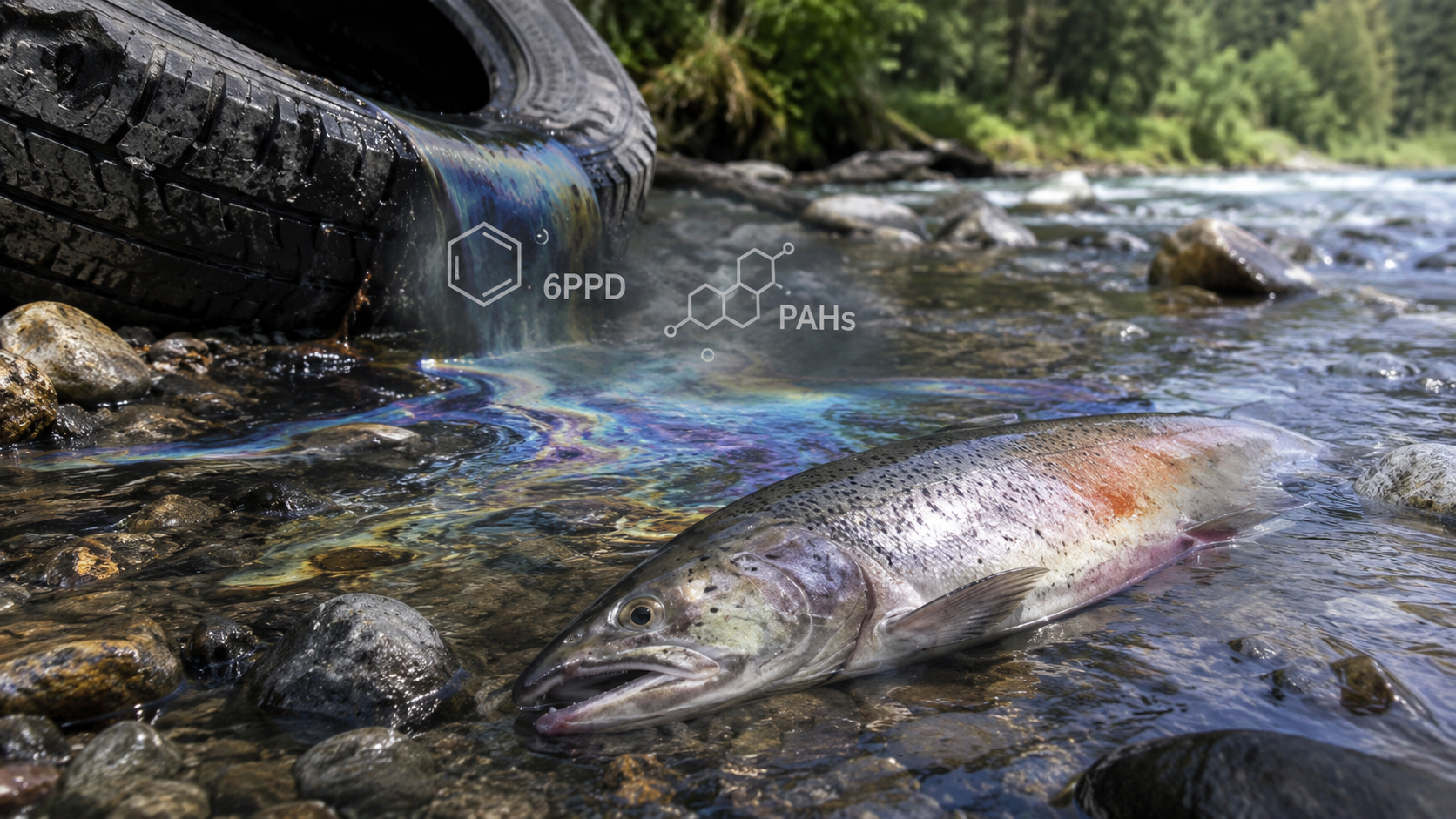
Welcome to Earth Reform. Today we look at a chemical found in almost every tire on the road. When it rains, it washes off the pavement and into streams, and it can kill salmon within hours. The same family of chemicals has also been found in human urine, blood and spinal fluid, and scientists are still working out what that means for our health. We will cover what is known, what is only suspected, what is happening in Canada, and what can be done about it.
The chemical in every tire
Every tire on the road is built to fend off a quiet enemy: ozone. This reactive form of oxygen in the air attacks rubber and makes it crack. To slow the damage, manufacturers mix an antioxidant called 6PPD into almost every car tire. [5] It works well, and it has been in use for decades.
The trouble starts after the tire is on the road. As it rolls, it sheds tiny particles of rubber. The 6PPD inside those particles reacts with ozone, which forms when vehicle exhaust meets sunlight, and turns into a different molecule called 6PPD-quinone. [2] Scientists did not identify that molecule until 2020. [1]
That makes this story different from a factory spill or a leaking pipe. It is a steady, everyday release that comes from ordinary driving. Anyone who drives, rides a bus, or lives near a road is part of the picture.
The salmon die-offs
Every fall, more than half of the coho salmon that return to Puget Sound’s urban streams die before they can spawn. In some streams, none survive. [3] For years no one could explain it. After heavy autumn rains, researchers watched healthy coho swim erratically and then die within hours. [2] Scientists ruled out warm water, low oxygen and known pollutants such as zinc. [3]
The breakthrough came when a team from the University of Washington Tacoma and Washington State University showed that stormwater alone could reproduce the symptoms, and that a solution made from tire wear particles was highly toxic to salmon. [3] Chemists then followed the toxic fractions through step after step of separation until a single molecule was left: 6PPD-quinone. [1]
The numbers explain why it is so dangerous. In roadway runoff and storm-affected creeks on the US West Coast, the team measured 6PPD-quinone at anywhere from below 0.3 to 19 micrograms per liter. The concentration that killed half the coho in testing was only 0.8 micrograms per liter. [1] A microgram per liter is one part per billion, about the same as one drop of ink in a backyard swimming pool.
The problem is not limited to Seattle. The same chemical turned up in runoff from Los Angeles and in creeks around San Francisco Bay. [6] Coho are also unusually sensitive. Chum salmon, for example, are much less affected. [7] Researchers even found that roughly one coho in thirty seemed largely unaffected, which they nicknamed “super-coho.” [4] Because coho react so strongly to runoff, scientists describe them as a sentinel species, a “canary in the coal mine” for roadway pollution. [2]
How it reaches people
Salmon meet 6PPD-quinone in the water. People can meet it in several other ways. Researchers list the likely routes as swallowing soil, sediment, dust or water, breathing in dust, and skin contact. [8] 6PPD itself has been found in soils, sediments, household dust and human urine. [9]
It also travels to places you might not expect. Rubber from recycled tires is used on playfields and recreational trails, and runoff from those surfaces can carry 6PPD-quinone into streams. [10]
Then there is food. In a laboratory experiment, lettuce plants took up 6PPD and 6PPD-quinone through their roots and moved them into their leaves. [11] That test used a much higher concentration than you would find in a normal garden, so it shows that uptake is possible, not that it is happening at that level. A separate study tested commercial leafy vegetables and found six tire-derived compounds in them. Its authors note that other produce may carry more and that how these chemicals travel from road to food still needs study. [12]

Known and suspected health effects in humans
What is known. People carry this chemical. Studies in China have found 6PPD-quinone in human urine, blood and cerebrospinal fluid, the fluid around the brain and spinal cord. [13] A study in Guangzhou, China, found higher urine levels in pregnant women than in other adults and children. [14] Researchers list three routes into the body: breathing, eating or drinking, and skin contact. [15] As of 2024, no US biomonitoring studies were available. [8]
What is suspected. Most evidence of harm comes from animals and cells, not from people. In mice, swallowing 6PPD-quinone caused liver damage, with inflammation and disrupted fat and sugar metabolism. [16] In a lab test on human liver cell lines, 6PPD-quinone looked more harmful than its parent chemical, 6PPD. [16] Scientific reviews also point to nervous system and immune effects in model organisms, and to liver, intestinal and reproductive damage in laboratory studies. [15][17]
An early human signal. A 2026 hospital study in China compared 283 people newly diagnosed with colorectal cancer to 515 healthy people. Higher urine levels of 6PPD-quinone and two related compounds went with higher odds of colorectal cancer. [17] This is an association only. Urine was collected within three days after diagnosis, so the study cannot show that the chemical caused the cancer, and the authors describe the link as new. It needs to be tested in other populations before anyone treats it as established. [17]
What is not known. No human disease has been proven to be caused by 6PPD-quinone. A March 2026 review from a UK professional association says that detection in the body shows exposure but not harm, and that long-term human data are limited. [18] Researchers also do not yet know how the toxicity of 6PPD relates to that of 6PPD-quinone, and the data are too thin to estimate one from the other. [8]
What it means for us
There is no single polluter here to blame, and drivers cannot opt out. The US Tire Manufacturers Association says it knows of no new motor vehicle tire without 6PPD. [20] Environmental lawyers in Canada note that all tires contain either 6PPD or another chemical from the same family. [21] So this is not about individual choices. It is about what is built into a product nearly everyone uses.
That has three practical consequences.
- Food and water. Salmon are a food source and, for First Nations, a cultural and ceremonial one. [24] Coho also act as an early warning for a wider pollution problem. [2] Lab work shows that crops can absorb tire chemicals. [11][12] How much reaches people through food is still an open question.
- Health. The exposure is real, and the evidence of harm is still early. Lab studies point to the liver, gut and reproductive system as the areas of most concern. [15][16][17]
- Money. When pollution is not stopped at the source, public budgets pay for cleanup. In 2022 the Washington legislature set aside $500 million over 16 years for stormwater retrofits, and the state transportation department is planning a $6 million project to treat runoff from one Seattle bridge, due in 2028. [19]
The Canadian picture
Canadian roads feed the same problem. A commercial lab presented data from coastal British Columbia and nearby regions at an industry conference, reporting 6PPD-quinone in 94% of water samples, at up to 740 nanograms per liter. [5] The concentration that killed half of exposed coho in the original study was 0.8 micrograms per liter, which is 800 nanograms per liter. [1] So the highest readings sat close to a lethal level. Environment and Climate Change Canada’s own planning document says monitoring has detected 6PPD-quinone in Canadian waters at levels that may concern coho. [22]
On policy, Canada’s 2018 screening of 6PPD found low concern, but it did not look at 6PPD-quinone, which scientists had not yet identified. [22] In February 2024 the law charity Ecojustice, acting for Raincoast, Watershed Watch Salmon Society and the Pacific Salmon Foundation, asked Ottawa to assess 6PPD. [23] On April 30, 2024 the Minister of Environment agreed to add it to the priority list, and the groups noted this was the first successful use of that request provision in the Canadian Environmental Protection Act. [9][23] By the end of 2024 the same groups said the federal work plan gave no firm timeline beyond starting the assessment in fall 2024. [26] A trade report in February 2026 still described the assessment as pending, with regulation possible if the chemical is found toxic. [27] I could not find anything newer, so check with Environment and Climate Change Canada before publishing.
There is also a human and cultural side. A petition to the Auditor General of Canada argues that weak coho stocks may limit First Nations’ ability to meet their food, social and ceremonial fishing needs. [24]
There is a Canadian bright spot too. Researchers tested a full-scale rain garden in Vancouver and found it kept more than 90% of 6PPD-quinone out of streams under typical storm conditions. [25]
Few environmental problems have two such clear places to intervene: the tire itself, and the runoff path from road to stream.
A fix that fits: tire makers
At the source. The tire industry says 6PPD protects tires from ozone cracking, a real safety issue, and that no commercially available alternative yet matches its safety and performance. [20] It has also acted. After California listed 6PPD tires as a priority product in October 2023, a consortium of 36 tire makers screened more than 60 candidates and advanced seven for further study. [20] The association’s website currently gives 2029 as the due date for its final report to California regulators. [20]
Two cautions apply. Some of the candidates belong to the same chemical family as 6PPD, which is a known risk of swapping one problem for another. [20][21] And Washington’s Department of Ecology concluded that it was hard to tell whether any alternative would actually be safer. [25]
This is where incentives look like a natural fit, although this part is my suggestion rather than a sourced finding. The slow, expensive steps are shared safety testing, toxicity testing and retooling. Public money for shared testing, tax credits for early adopters of a verified safer additive, or procurement rules for government fleets would speed those steps without lowering safety standards. That could be a strong follow-up article.
Along the path. Rain gardens and engineered soil filters work. In the Vancouver study, they kept over 90% of 6PPD-quinone out of streams in typical storms. [25] In King County, Washington, improved soil mixes always brought 6PPD-quinone below the state’s proposed safe level for aquatic life. [29] The tire industry also backs interim steps: street sweeping, pavement that sheds fewer particles, and keeping tires properly inflated. [28]
The encouraging point is that 6PPD is not a forever chemical. Once tires containing it leave the road, the damage stops. [21] That makes this one of the more solvable problems in environmental health.
To sum up: 6PPD keeps tires from cracking, but when it reacts with ozone it forms 6PPD-quinone, which kills coho salmon at tiny concentrations. It has been found in people, and early studies raise questions about the liver, the gut and more. No human disease has been proven to be caused by it yet. The encouraging part is that this is a solvable problem, both at the tire and along the path the rain takes. Thank you for joining us at Earth Reform. The sources for everything in this article are listed below.
Sources
- Tian et al., “A ubiquitous tire rubber-derived chemical induces acute mortality in coho salmon,” Science, 2021. https://doi.org/10.1126/science.abd6951
- Water Environment Federation, “Experts identify long sought stormwater contaminant behind salmon deaths.” https://stormwater.wef.org/2021/01/experts-identify-long-sought-stormwater-contaminant-behind-salmon-deaths/
- Washington State University News, “Tire-related chemical largely responsible for adult coho salmon deaths in urban streams.” https://news.wsu.edu/?p=210117
- Estuary News, “West Coast salmonids all tired out.” https://old.estuarynews.org/west-coast-salmonids-all-tired-out
- ESAA / SGS conference abstract, “6-PPD Quinone: Occurrence and Best Practices in Measurement.” https://esaa.org/wp-content/uploads/2024/02/SMART4.pdf
- US National Park Service, “Scientists discover silent threats to Pacific Coast salmon populations.” https://www.nps.gov/articles/000/scientists-discover-silent-threats-to-pacific-coast-salmon-populations.htm
- Earth.com, “What is killing coho salmon in urban streams?” https://www.earth.com/animals/what-is-killing-coho-salmon-in-urban-streams/
- Interstate Technology and Regulatory Council, “6PPD and 6PPD-quinone.” https://6ppd.itrcweb.org/effects-characterization-and-toxicity/
- Ecojustice, “Feds to investigate tire chemical implicated in mass salmon deaths.” https://ecojustice.ca/news/feds-to-investigate-tire-chemical-implicated-in-mass-salmon-deaths-but-urgent-action-needed-environmental-groups-react
- American Bar Association, “Tire-driven stormwater toxicity,” 2022. https://www.americanbar.org/groups/environment_energy_resources/publications/trends/2022-2023/september-october-2022/tire-driven-stormwater-toxicity/
- Castan et al., “Uptake, metabolism, and accumulation of tire wear particle-derived compounds in lettuce.” https://services.phaidra.univie.ac.at/api/object/o:1639158/download
- Sherman et al., “Uptake of tire-derived compounds in leafy vegetables and implications for human dietary exposure,” Frontiers in Environmental Science, 2024. https://doi.org/10.3389/fenvs.2024.1384506
- “Potential human health risk of the emerging environmental contaminant 6-PPD quinone,” Science of the Total Environment. https://www.sciencedirect.com/science/article/abs/pii/S0048969724052070
- “6PPD and 6PPD quinone in paired human plasma and urine from Tianjin, China,” Journal of Hazardous Materials. https://www.sciencedirect.com/science/article/abs/pii/S0304389424013979
- “Environmental and Human Health Risks of 6PPD and 6PPDQ: Assessment and Implications.” https://www.ncbi.nlm.nih.gov/pmc/articles/PMC12567608/
- “Effects of 6PPD-Quinone on Human Liver Cell Lines.” https://www.ncbi.nlm.nih.gov/pmc/articles/PMC11209231/
- “Associations Between Human Exposure to Substituted p-Phenylenediamine-Derived Quinones and Colorectal Cancer Risk,” Toxics, 2026. https://doi.org/10.3390/toxics14080705
- AGS, “6PPD-Quinone from tyres to streams,” March 2026. https://www.ags.org.uk/2026/03/6ppd-quinone-6ppd-q-from-tyres-to-streams-ecotoxicology-and-regulation-in-the-united-states-united-kingdom-and-european-union/
- KUOW, “Every tire produces a chemical that kills coho salmon. Can scientists pump the brakes?” https://www.kuow.org/stories/every-tire-produces-a-chemical-that-kills-coho-salmon-can-scientists-pump-the-brakes
- US Tire Manufacturers Association, “6PPD and tire manufacturing.” https://www.ustires.org/6ppd-and-tire-manufacturing
- Ecojustice, “What is 6PPD and what is it used for?” https://ecojustice.ca/news/what-is-6ppd-and-what-is-it-used-for/
- Government of Canada, “Plan of Priorities: substances prioritized for assessment under CEPA.” https://www.canada.ca/en/environment-climate-change/services/canadian-environmental-protection-act-registry/implementing-modernized-cepa/plan-of-priorities-landing-page/priority-substances.html
- Environment and Climate Change Canada, response to the request to assess 6PPD, April 2024. https://ecojustice.ca/wp-content/uploads/2024/05/Ecojustice-Response-to-Request-to-Assess-6PPD-under-section-76-of-CEPA.pdf
- Office of the Auditor General of Canada, petition “Effects of 6PPD tire rubber antioxidant on salmon and mitigation.” https://www.canada.ca/en/auditor-general/environmental-petitions/environmental-petitions-catalogue/effects-of-6ppd-tire-rubber-antioxidant-on-salmon-and-mitigation.html
- “Bioretention cells provide a 10-fold reduction in 6PPD-quinone mass loadings to receiving waters,” Environmental Science and Technology Letters. https://pmc.ncbi.nlm.nih.gov/articles/PMC10339781/
- Raincoast Conservation Foundation, “Urge Canada to regulate 6PPD,” December 2024. https://www.raincoast.org/2024/12/urge-canada-to-regulate-6ppd/
- Environmental Science and Engineering Magazine, “U.S. trial concludes over tire chemical impacts on endangered fish,” February 2026. https://esemag.com/water/us-trial-tire-chemical-impacts-endangered-fish/
- European Rubber Journal, “US tire group optimistic over search for 6PPD alternatives,” August 2024. https://www.european-rubber-journal.com/article/2095940/us-tire-association-optimistic-over-6ppd-alternatives-efforts
- King County Science and Technical Support Section, 6PPD-quinone bioretention study report, June 2024. https://www.ezview.wa.gov/Portals/_1962/Documents/6ppd-bmp/King_County_Lab_6PPDQ_Study_Report_Final%20(1).pdf

Leave a Reply