Welcome. Today’s story starts with a number that sounds like a typo.
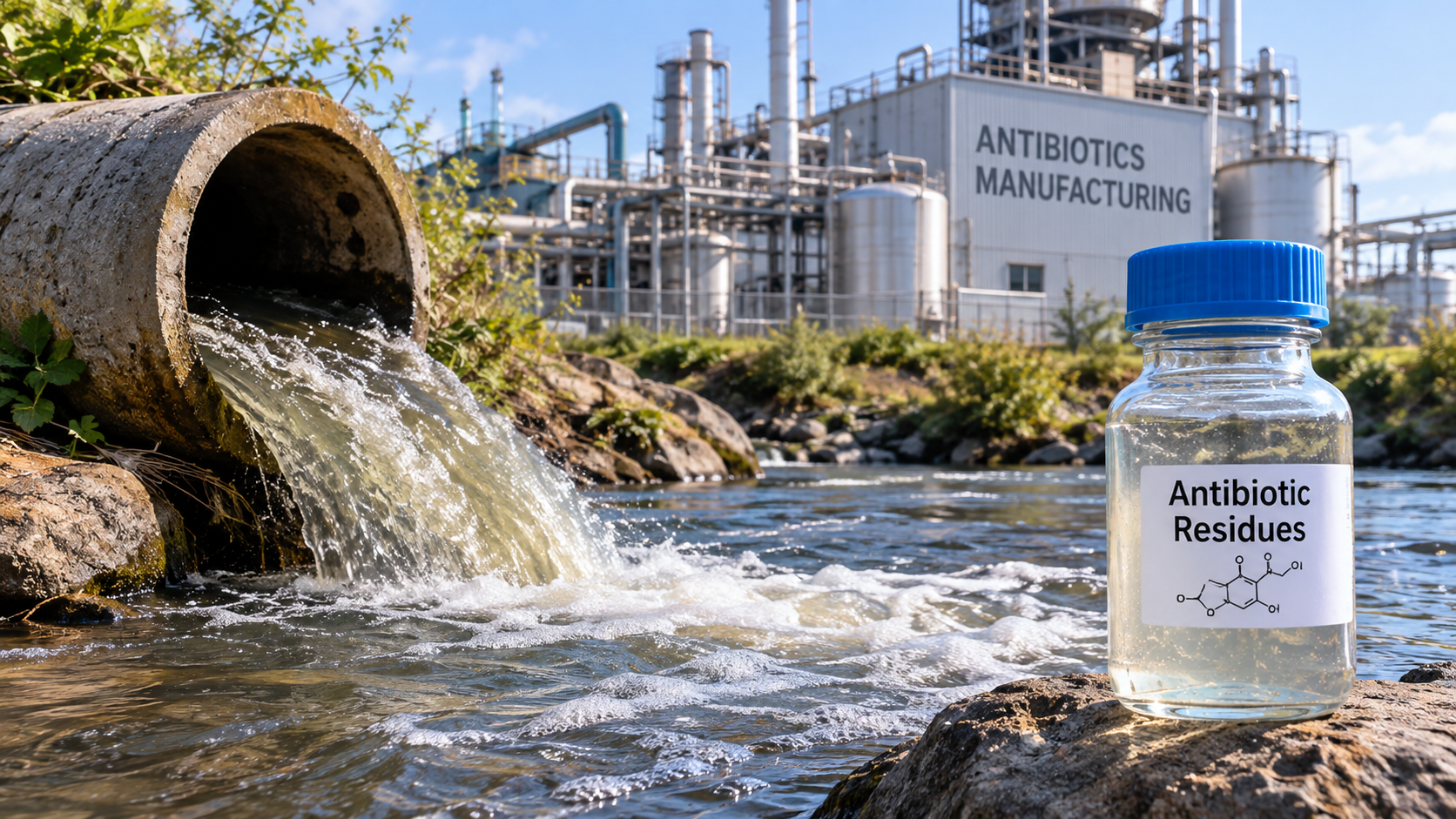
In 2007, Swedish scientists tested the wastewater leaving a treatment plant near Hyderabad, India. The plant served about ninety drug factories. The antibiotic ciprofloxacin in that water was more than a thousand times higher than the level that is toxic to some bacteria. [1]
Stop and think about that. Factories making medicine designed to kill bacteria were releasing it into local waterways at levels where surviving bacteria are forced to adapt.
When we talk about superbugs, we usually blame two things: doctors who overprescribe and farms that overuse antibiotics. Both are real. But there is a third source that most people have never heard of: the pollution created when antibiotics are made.
In this episode, we’ll look at what the science shows, where the evidence is strong, where it is still uncertain, and why a problem concentrated in a few industrial zones thousands of kilometres away can end up in a hospital near you.
The Threat We Already Know About
Antibiotic resistance is what happens when bacteria stop responding to the drugs meant to kill them. It can arise when a bacterium’s own DNA mutates, or when it picks up resistance genes from another bacterium, even one of a different species. [4] Every time antibiotics are used, bacteria that happen to survive get a head start. The more often and the more widely bacteria are exposed, the faster resistance spreads.
The human toll is already large. A landmark study in The Lancet estimated that in 2019, about 4.95 million deaths worldwide were associated with drug-resistant bacterial infections. Of those, 1.27 million were directly attributable to resistance, meaning deaths that would not have occurred had those infections been drug-susceptible instead. [2] The researchers found that this burden exceeded the deaths from HIV/AIDS or malaria that year. [2]
A follow-up analysis looked ahead. It found that resistance directly caused about 1.14 million deaths in 2021 and projected roughly 39 million cumulative deaths between 2025 and 2050 if nothing changes. [3] That works out to around 1.9 million direct deaths a year by 2050. The same analysis forecast the heaviest toll in South Asia, with an estimated 11.8 million deaths over that period. [3] The authors also noted that better care for severe infections and wider access to antibiotics could avert an estimated 92 million deaths over the same period. [3]
For years, the policy conversation has focused on two fronts: healthcare and agriculture. But a growing number of researchers argue this is not enough. As one of the field’s leading scientists put it after the 2024 United Nations political declaration on antimicrobial resistance, a global consensus has gradually formed that action in healthcare and the animal sector alone is insufficient. [5] The environment, and in particular the factories that make the drugs, needs to be part of the picture.
The Overlooked Source: Where Antibiotics Are Made
Most of the world’s antibiotics and their key ingredients are produced in a small number of regions, with India and China dominant. [6] Making an antibiotic generates wastewater containing leftover drug. If that water is not treated properly, the drug goes into rivers, lakes and groundwater.
The 2007 Hyderabad study was the first to show how extreme this can be. The researchers sampled the effluent from a treatment plant serving about 90 bulk drug manufacturers in Patancheru, a major production hub for generic drugs sold on the world market. They reported the highest drug levels ever recorded in any effluent. [1] Ciprofloxacin reached up to 31,000 micrograms per litre. [1] The team estimated that the plant released about 45 kilograms of ciprofloxacin in a single day, roughly 45,000 daily doses. [7] Larsson later described the concentrations as around a million times higher than those typically seen in ordinary sewage. [10]
Such levels are not just a chemistry curiosity. When researchers sequenced DNA from sediments downstream of the plant, they found very high levels of resistance genes and of the genetic elements that help bacteria swap them. [8] Researchers also found drugs in nearby lakes and in wells in surrounding villages. [10] One 2009 report noted that the plant had not been able to handle all the waste it received over the years. [7]
A subtle finding: right at the outfall, the antibiotic levels were so high that they overpowered even the resistant bugs. Scientists warned that such a hotspot could behave like a volcano, with resistance genes dispersing and settling elsewhere downstream or beyond. [9]
What the evidence does and does not show
This is the part to be precise about. Researchers agree that antibiotic residues clearly explain the extremely high resistance levels near some manufacturing sites. But a large 2019 study in Nature Communications found that, in most other environments, human fecal pollution is probably the main explanation for elevated resistance genes. [11] In other words, manufacturing is not the biggest driver of resistance everywhere. It is a concentrated hotspot where the pressure on bacteria is far more intense.
The scientific uncertainty is about the next step: how often resistant bacteria bred in these hotspots reach people and cause infections. A major review concluded that the pathways and mechanisms for transfer from environmental bacteria to pathogens are still largely unclear, but that concern is growing. [4] The same review noted that excessive antibiotic emissions from manufacturing have been reported in low- and middle-income countries and other regions. [4] The responsible position is that the risk is plausible, documented at the source, and not yet fully quantified downstream.
The Animal Side of the Story
Factories are not the only place where antibiotics meet bacteria in large quantities. Farms are the other major one, and the animals are on the receiving end.
A 2015 study in PNAS produced the first global map of antibiotic use in livestock. It estimated that farm animals consumed about 63,000 tonnes of antimicrobials in 2010 and projected a 67 percent rise by 2030. [12] The projection was driven by rising demand for meat and a shift from small-scale farming to large intensive operations where antibiotics are used routinely, including for disease prevention and growth promotion. [12] Two-thirds of the projected increase came from simply raising more animals, and one-third from the move to intensive systems. [12] The five countries of Brazil, Russia, India, China and South Africa were projected to see consumption rise by 99 percent, against an expected 13 percent growth in their human populations. [12]
The study also found that pigs and chickens receive far more antibiotics per kilogram of animal than cattle: an estimated 172 and 148 milligrams per kilogram, compared with 45 for cattle. [12] These are modelled estimates built on sales data from a limited number of countries, so they should be read as a map of the trend, not a precise ledger. [12] Newer surveillance data exists and is worth checking before quoting any single figure.
Why this is an animal welfare story too
Routine, preventive dosing is a feature of crowded production systems. One implication, offered here as analysis rather than a finding from the study, is that routine dosing can make it possible to keep large numbers of animals in conditions that would otherwise cause disease to spread quickly. The animals bear the cost of those conditions, and the wider world bears the cost of the resistance that follows.
There is also a human injustice thread. The study’s co-authors pointed out that roughly a billion poor people depend on livestock for survival. They typically raise animals in small backyard systems and use antibiotics only when animals are sick. As effective drugs become costlier and scarcer, these households are expected to take a disproportionate share of the consequences. [12]
One shared pool of resistance
Why does it matter that factories and farms are both part of the story? Because resistance does not respect boundaries. Researchers describe antibiotic resistance as a challenge involving the transfer of bacteria and genes between humans, animals and the environment. [4] The authors of the 2024 Lancet forecast likewise stressed that reducing deaths will require a combination of measures, including cutting inappropriate antibiotic use in farming and humans, infection prevention, vaccination and new antibiotics. [3] Manufacturing pollution is not a replacement for those explanations. It is a missing piece of the same puzzle.
Why This Reaches You
It is tempting to file this under “someone else’s problem”: a few industrial zones, far away. Three things make that comfortable view hard to defend.
1. Resistance is already a Canadian health problem
A 2019 expert panel report by the Council of Canadian Academies, requested by the Public Health Agency of Canada, estimated that about 26 percent of bacterial infections in Canada in 2018 were resistant to first-line antibiotics. [13] That year, about 14,000 deaths were linked to resistant infections, and around 5,400 were directly attributable to resistance. [13] Those numbers equal roughly 15 Canadians a day.
The bill is also financial. The panel estimated that resistance cost the Canadian healthcare system about $1.4 billion and reduced GDP by about $2 billion in 2018. [13] If resistance rises to 40 percent by 2050, it projected roughly 396,000 cumulative lives lost between 2020 and 2050 and a cumulative GDP loss of about $388 billion. [13] The report added that the burden would fall unevenly across socio-demographic groups. [13]
The global data show who is most at risk. Between 1990 and 2021, resistance-related deaths fell by more than half among children under five but rose by more than 80 percent among adults aged 70 and older. [3] Think of parents, grandparents, and anyone heading into surgery, chemotherapy or a joint replacement, all of which depend on antibiotics working.
2. Canada depends on the same supply chain
Generic drugs fill nearly three-quarters of all prescriptions in Canada. [14] A 2022 study by EY Canada for the Canadian Generic Pharmaceutical Association found that almost all of the active ingredients used to make generics in Canada are imported, with more than 60 percent coming from India and China. [14]
A caution is needed. Nothing here shows that any particular drug on a Canadian pharmacy shelf came from a plant with polluted discharge. That is exactly the problem: the public, and often the buyers, cannot tell. Oversight of manufacturing sites that supply Canada leans heavily on foreign regulators, which conducted about 85 percent of the inspections, according to data reported by CTV News. [15] And the WHO described antibiotic manufacturing as a documented source of pollution that remains largely unregulated. [16]
3. Resistance travels
Resistant bacteria move with people, food, animals and water. One researcher commenting on the Hyderabad findings warned that such hotspots could seed resistance well beyond the immediate area. [9] The 2024 Lancet analysis also found that among Gram-negative bacteria, resistance to carbapenems, antibiotics often held back for serious infections, grew faster than resistance to any other class. [3] When the drugs we hold in reserve start failing, a resistant infection anywhere is a risk everywhere.
That is why this is not only a story about distant communities. It is a story about a shared global resource: the ability of antibiotics to work.
What Could Change
The encouraging part of this story is that much of the fix sits with manufacturers, governments and the institutions that buy medicines, rather than with ordinary consumers.
In 2024, the World Health Organization released its first global guidance on limiting antibiotic pollution from manufacturing, with targets for managing wastewater and solid waste. It is not binding, but the hope is that regulators, buyers and auditors will build it into their rules. [16] Industry has moved too. The AMR Industry Alliance and the British Standards Institution published a voluntary manufacturing standard in 2022 and launched independent certification in 2023. By May 2025, over 60 antibiotic products across 15 geographies had been certified, and the standard was updated to align with the WHO guidance. [17]
The most interesting lever is purchasing. Healthcare buyers can reward clean production: for example, suppliers applying to the NHS England antibiotic subscription model must hold the BSI certification, and some Nordic procurement tenders also reference it. [17] Rules that favour cleaner manufacturers give companies a commercial reason to invest.
Regulation has proven harder. In January 2020, India proposed limits on 121 antibiotics in pharmaceutical effluent, which would have been a world first. [18] But a later analysis found that after about twenty months of debate, any mention of limits had vanished from the final published rule. [19] Critics have also argued that companies should not set their own standards. [18]
The lesson, as an analysis rather than a finding, is that mandates alone can stall when they raise costs for competitive producers. Which incentives and disincentives actually move manufacturers is now an active research question. [20] Pairing clear standards with support for treatment upgrades is a natural option to test.
Let’s pull it together.
Overprescribing and farm use are real drivers of superbugs, and nothing in this episode changes that. But the pollution from making antibiotics is a documented, concentrated hotspot that gets far less attention. From Hyderabad, we know that wastewater from drug factories has carried an antibiotic at more than a thousand times the level toxic to some bacteria, and that resistance genes were found downstream. What we do not yet know is exactly how often those hotspots lead to infections in people far away. That is a gap worth closing, not a reason to wait.
The fix is within reach: clear standards for manufacturers, transparency about where our medicines are made, and purchasing rules that reward clean production.
Next time you pick up a prescription, remember that the pill in your hand is part of a global chain, and that keeping antibiotics working is a shared project. Thanks for listening.
Footnotes and Sources
- Larsson DGJ, de Pedro C, Paxeus N. Effluent from drug manufactures contains extremely high levels of pharmaceuticals. Journal of Hazardous Materials. 2007;148(3):751-755. doi:10.1016/j.jhazmat.2007.07.008. PubMed
- Antimicrobial Resistance Collaborators. Global burden of bacterial antimicrobial resistance in 2019: a systematic analysis. The Lancet. 2022;399(10325):629-655. doi:10.1016/S0140-6736(21)02724-0. PubMed; comparison with HIV/AIDS and malaria per the IHME summary and the Oxford summary.
- GBD 2021 Antimicrobial Resistance Collaborators. Global burden of bacterial antimicrobial resistance 1990-2021: a systematic analysis with forecasts to 2050. The Lancet. 2024. doi:10.1016/S0140-6736(24)01867-1. Summaries: IHME, University of Oxford, CNN via KION (age trends).
- Larsson DGJ, Flach C-F. Antibiotic resistance in the environment. Nature Reviews Microbiology. 2022. Full text
- University of Gothenburg. Swedish research on antibiotic pollution becomes UN declaration after 17 years. Link
- Commentary (not peer reviewed): Time for India to step up fight against antimicrobial resistance. The Week(India), 2020. The claim that India and China produce about 90 percent of the world’s antibiotics comes from this piece. Link
- Chemists show how waste-water contamination affects ecosystem. Nature. 2009;457:640. Link
- Kristiansson E, Fick J, Janzon A, et al. Pyrosequencing of antibiotic-contaminated river sediments reveals high levels of resistance and gene transfer elements. PLoS ONE. 2011;6:e17038. Listed in the reference list of Larsson DGJ, Pollution from drug manufacturing: review and perspectives, 2014;369:20130571 (doi:10.1098/rstb.2013.0571), published in Philosophical Transactions of the Royal Society B, doi:10.1098/rstb.2013.0571.
- Dumped drugs lead to resistant microbes. Scientific American. Link
- Antibiotic pollution. New Scientist, 24 May 2019 (copy hosted by the Société Française de Microbiologie). PDF
- Karkman A, Pärnänen K, Larsson DGJ. Fecal pollution can explain antibiotic resistance gene abundances in anthropogenically impacted environments. Nature Communications. 2019. Summary: University of Gothenburg via EurekAlert
- Van Boeckel TP, Brower C, Gilbert M, et al. Global trends in antimicrobial use in food animals. PNAS. 2015;112(18):5649-5654. doi:10.1073/pnas.1503141112. Summary: Princeton University
- Council of Canadian Academies. When Antibiotics Fail. 2019. Council summary; coverage: CIDRAP, Insurance Portal (2020-2050 projections)
- EY Canada for the Canadian Generic Pharmaceutical Association. Canadian Generic Pharmaceutical Importing/Manufacturing Capacity Study, 2022 (news release). PDF
- FDA backlog raises scrutiny of Canada’s outsourced drug inspections (reporting CTV News data). Benefits and Pensions Monitor. Link
- WHO issues global guidance to limit antibiotic pollution from manufacturing. CIDRAP, 2024. Link
- AMR Industry Alliance. Standard update, May 2025 and Responsible Manufacturing page (NHS and Nordic procurement references)
- ReAct. Antibiotic pollution: India scores a global first with effluent limits, 2020; Down To Earth, draft rules covering 121 antibiotics, 2020.
- CIDRAP-ASP. The Limit of Limits: India’s Hurdles in Regulating Antimicrobial Pollution (report summary). Link
- Nijsingh N, Munthe C, Larsson DGJ. Managing pollution from antibiotics manufacturing: charting actors, incentives and disincentives. Environmental Health. 2019. doi:10.1186/s12940-019-0531-1. Link
Leave a Reply