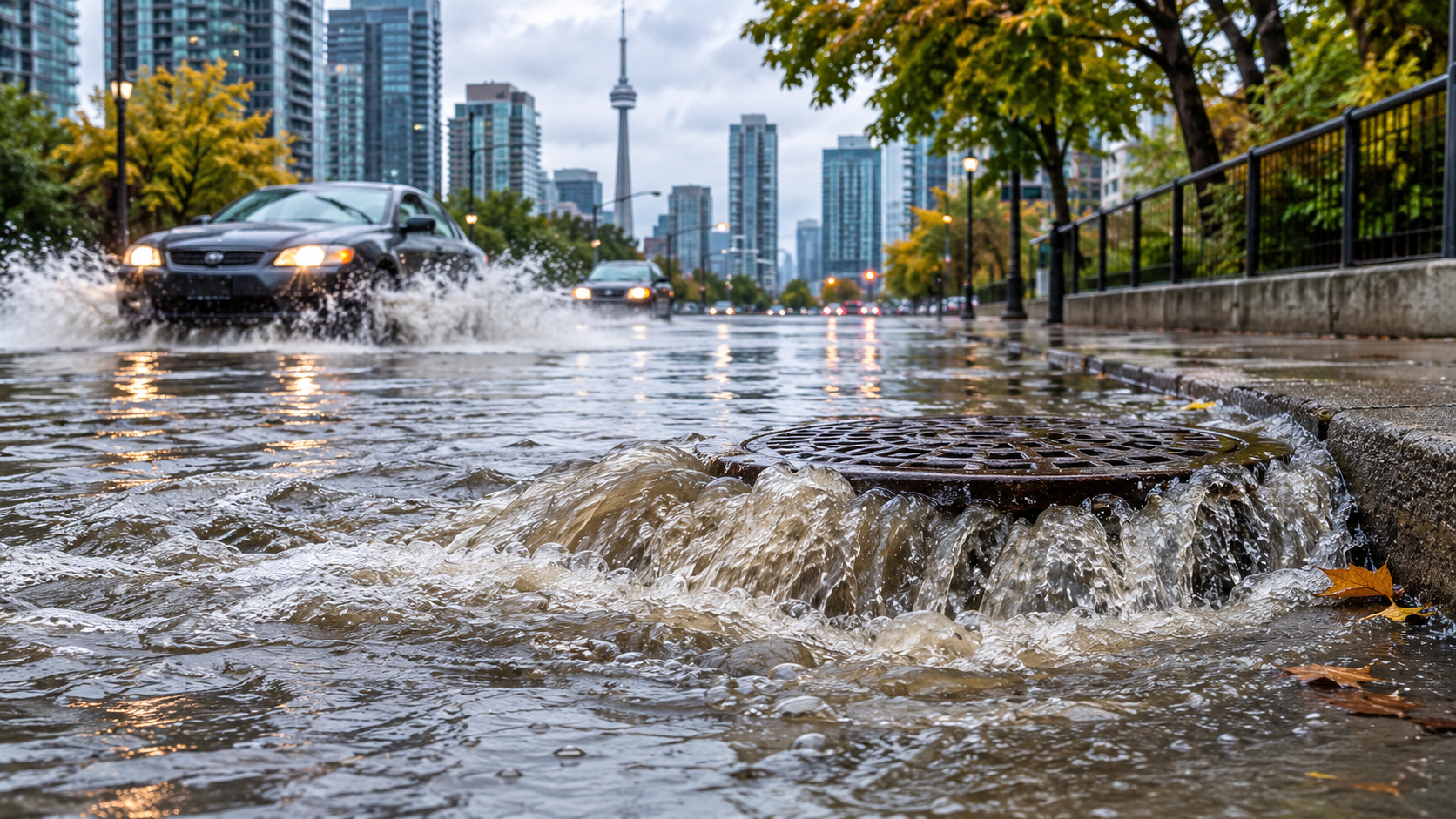
Picture this. It’s a warm summer night, and the sky opens up. It’s the kind of rain that turns a street into a river in twenty minutes. You’re upstairs, a little annoyed about the weather. Then you hear a gurgle from the basement. The floor drain is bubbling. And what’s coming up out of it isn’t rainwater. It’s whatever was in the pipes under your street.
Most of us never think about those pipes until the day they fail. Today, we’re going to change that. We’ll look at how a city’s sewers really work, why many older cities were built so that they overflow on purpose, what that means for our rivers, our lakes and our health, and what it costs us. And because this is the practical part, we’ll finish with what you can do to keep your own basement dry.
Some of what you’re about to hear will change how you look at a storm drain. Let’s get into it.
The Pipes Under Your Street
Under a city, rain and sewage travel in one of two ways. Newer neighbourhoods have two separate networks. Sanitary sewers carry what goes down your toilet and sinks to a treatment plant, and storm sewers carry rain from street drains to the nearest creek, river or lake.[1]
Many older cities have just one pipe. These are called combined sewers, and they carry sewage and stormwater together. In dry weather, everything flows to the treatment plant. In heavy rain, the pipe fills faster than the plant can take it, so the system includes relief points, called overflow outfalls, that release the mixture straight into a river or lake.[2]
Here’s the part that surprises people: that isn’t a malfunction. It’s the design. Combined sewers spread through North American cities from the mid-1800s, when the goal was to get waste away from where people lived, and nobody was thinking much about what a river could absorb.[3] The main pipes were often sized to handle storms as rare as once in ten years. Anything bigger was meant to spill.[4]
How common is this? About 700 municipalities in the United States still have combined sewer overflows.[2] In Canada, municipal systems released about 223 million cubic metres of untreated wastewater in 2022, counting both overflows and systems that provide no treatment at all. That’s 3.8 percent of everything collected, and it leaves out Quebec’s overflow volumes, which aren’t available.[5] Toronto alone has about 80 combined sewer overflow outfalls and around 2,600 storm sewer outfalls.[6]
What Happens When It Pours
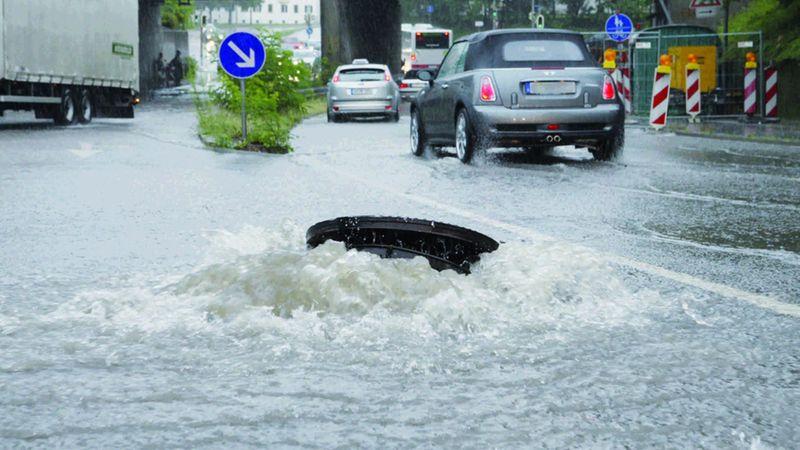
Think of a storm as a race. Rain hits roofs, roads and driveways, and because pavement doesn’t soak anything up, most of it rushes toward the drains within minutes. The pipes fill. What happens next depends on which kind of system you live on.
On a combined system, the overflow outfalls open and the mix of rainwater and sewage goes into the river or lake. On a separated system, the sanitary pipes aren’t supposed to get any rain at all. But they do. Downspouts, foundation drains and sump pumps connected to the sanitary line send clean rainwater into it, and cracks and broken joints let groundwater seep in. Engineers call this inflow and infiltration.[7] Add a heavy storm, and a pipe designed for sewage is suddenly carrying a river.
When the pipe under the street is full, the water has to go somewhere. It follows the path of least resistance, which is up, through the lowest opening in the system. That’s often a basement floor drain, a toilet or a laundry sink. That’s a sewer backup.
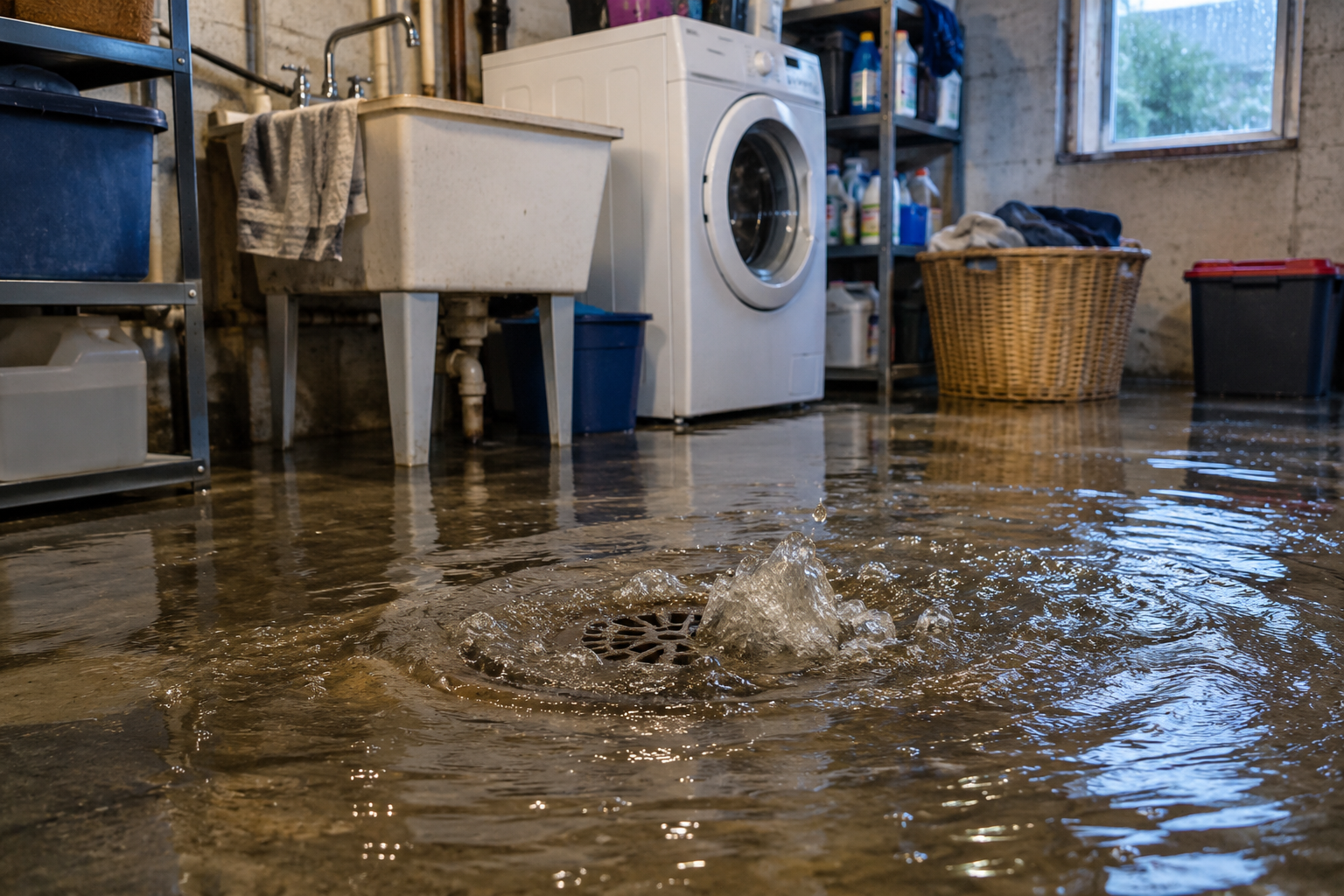
Basements flood in three ways: sewer backup, seepage through the foundation when the ground is saturated, and surface water flowing in through windows, doors or window wells.[8] There’s even a clue to tell them apart. City of Toronto staff note that clearer water usually points to a surface drainage problem, while muddy water can point to a blocked sewer line.[9]
Sometimes the overflow is planned. In November 2015, Montreal released untreated wastewater into the St. Lawrence River so crews could repair a major sewer interceptor. The city had announced eight billion litres. Federal officials ordered extra monitoring and other conditions, and an independent panel concluded that the planned release was not ideal, but less risky than an uncontrolled failure. The work finished early, and the city reported that about five billion litres had been released.[10]
Why It’s Getting Worse
Three things are stacking up at once.
First, the rain itself. Warmer air holds roughly 7 percent more moisture for every degree Celsius of warming, and observations show short, intense downpours getting heavier at about that pace.[11] Canada’s Changing Climate Report concluded that more intense rainfall will raise urban flood risks.[12] Under a high-emissions scenario, a rainstorm with a one-in-twenty chance of happening in any year is projected to become a one-in-ten-year event by mid-century.[13]
Second, the pipes. Many were laid for the cities and climate of decades ago, and a good share are aging. The 2019 Canadian Infrastructure Report Card found that about 30 percent of water infrastructure, including watermains and sewers, was in fair, poor or very poor condition.[14]
Third, hard surfaces. Roofs and pavement don’t absorb water, so rain reaches the pipes in minutes. Researchers studying Philadelphia named extensive paved cover, together with combined sewers, as a recipe for overflows after heavy rain.[15]
Here’s what that looks like on the ground. On July 16, 2024, more than 100 millimetres of rain fell on parts of Toronto and southern Ontario in about two hours.[16] Pearson airport recorded 97.8 millimetres, its fifth-wettest day on record, and at the peak about 167,000 customers lost power.[17] Insurers counted an estimated 22,400 claims and $899 million in losses, with much of the damage coming from sewer backup because municipal systems couldn’t handle the volume.[16] A few weeks later, the remnants of Hurricane Debby dropped about 170 millimetres on southern Quebec. Sewer systems failed, basements flooded, and insured losses of $2.8 billion made it the costliest insured event in that province’s history.[16]
You may have heard that rising water levels are the culprit. That’s true on the Atlantic and Pacific coasts, where local sea-level rise is expected to increase coastal flooding.[12] But for most inland cities, the bigger driver is intense rain landing on pipes that weren’t built for it.
What It Means for You
Start with your health. Researchers in Massachusetts compared emergency room visits after extreme rainfall in towns with combined sewers and in towns without them. Only in the towns whose combined sewers discharged into a river used for drinking water did visits for stomach illness rise, by about 13 percent over the next eight days.[1] That estimate sits right at the edge of statistical significance, so treat it as a signal, not a verdict.
A 2024 Boston University study looked at towns along the Merrimack River. After accounting for rainfall, the risk of an acute stomach illness was 62 percent higher in the four days after the very largest overflows.[3] It was about 22 percent higher after large ones.[18] The risk didn’t depend on whether people drank the river’s water, so the authors suspect other routes, like recreation. They also say they can’t rule out drinking water as a pathway, and that more research is needed.[3] These are American, observational studies, but the pipes and the physics are the same here.
And if sewage backs up into your own basement, the City of Toronto warns of exposure to waterborne diseases and advises throwing out contaminated items and removing soaked drywall and insulation.[9]
Now the money. The July 2024 Ontario flood averaged about $39,000 per claim.[16] Flood and water-related insured losses in Canada have grown by more than 300 percent over the last twenty years, compared with the two decades before.[19]
And here’s the trap. Sewer backup damage is covered only if you bought that optional coverage.[20] Overland flood coverage is a separate option. After the 2024 Toronto floods, some residents had one but not the other, and some had limits on how much they could claim, so part of their damage wasn’t covered.[16]
So it shows up as a gurgling floor drain, a ruined basement, and a claim that may not be covered.
What You Can Do About It
Cities can’t do this alone. Toronto’s own guidance says that improvements to the public system can’t fully protect a home, so homeowners need to act too.[9] Here’s a checklist, roughly in order of value.
- Find out what you’re on. Ask your city whether your street has combined or separate sewers, and whether your drains and downspouts are connected correctly. A licensed plumber can do a home plumbing assessment, which Toronto now subsidizes.[9][21]
- Disconnect your downspouts. Rainwater from your roof shouldn’t go into the sanitary sewer. In Toronto it’s mandatory, and it reduces both basement flooding risk and polluted runoff.[9] Aim the water at your lawn, away from the foundation.[8]
- Consider a backwater valve. It’s a one-way gate in your main drain that closes if sewage tries to flow backward. It should be installed by a licensed plumber and inspected, sit downstream of all your basement fixtures, and be maintained.[22] The insurance industry’s research institute is clear that a valve alone isn’t enough, so think of it as one part of a package.[23]
- Add a sump pump with a battery backup. Pumps move water slowly, need upkeep, and stop working when the power goes out.[24] In the July 2024 storm, about 167,000 Toronto Hydro customers lost power at the peak.[17]
- Manage the surface. Clear eavestroughs and street grates, fix grading that slopes toward the house, and watch window wells and driveways that slope toward the garage.[9]
- Keep your sewer line clear. Wipes, grease and tree roots are common causes of blockages.[9]
- Check your insurance. Ask specifically about sewer backup and overland flood coverage, and what the limits are.[20]
- In a flood, have your utility shut off the power before you go in, limit water use if you suspect a sewer backup, and report it to 311 so the city can spot patterns.[9]
And ask your municipality about subsidies. Toronto offers up to $6,650 per eligible property for this kind of work.[9]
What Cities and Industry Can Do
Cities are spending serious money. Toronto’s Don River and Central Waterfront program has a budget of more than $3 billion, built around a 22-kilometre tunnel system meant to capture combined sewer overflows and send them to treatment instead of the river.[25] But separating or storing combined sewage everywhere is expensive, and the Boston University researchers note that many cities can’t afford it without help from senior governments.[3]
Some of the most practical tools pair rules with money. Toronto’s subsidy program is an incentive, now worth up to $6,650 per eligible property.[9][21] And the Institute for Catastrophic Loss Reduction has argued for making backwater valves mandatory in new homes, because code wording is interpreted unevenly and many new houses still get built without them.[26] Rules plus incentives is a pattern worth watching, and it’s a story for another day.
So here’s what to carry with you. Under many of our cities, sewage and rainwater share pipes that were built to spill when it pours, and heavier storms are making those spills more frequent. The cost lands in three places: our rivers and lakes, our health, and our basements and insurance claims.
You don’t have to wait for the city to fix it. Find out what kind of sewer you’re on. Disconnect your downspouts. Ask a plumber about a backwater valve and a battery-backed sump pump. And read your insurance policy before the next storm reads it for you.
Thanks for listening. If this changed how you look at a storm drain, share it with a neighbour. They might be glad to hear it before the next big rain.
Notes and Sources
- Jagai, J. S., et al. (2015). Extreme precipitation and emergency room visits for gastrointestinal illness in areas with and without combined sewer systems: an analysis of Massachusetts data, 2003–2007. Environmental Health Perspectives, 123(9), 873–879. doi:10.1289/ehp.1408971
- U.S. Government Accountability Office (2023). Clean Water Act: EPA Should Track Control of Combined Sewer Overflows and Water Quality Improvements (GAO-23-105285). gao.gov
- Boston University School of Public Health (2024, May 23). Sewage Overflows Linked to Increase in Gastrointestinal Illnesses. Reports on Haley, B. M., et al. (2024), Environmental Health Perspectives, 132(5), doi:10.1289/ehp14213.
- U.S. EPA (archived). Combined Sewer Overflow (CSO): History.
- Statistics Canada (2024, Nov. 1). Municipal wastewater systems in Canada, 2021–2022. The Daily.
- City of Toronto (2017). Don River and Central Waterfront Project (presentation by M. D’Andrea).
- Utilities Kingston. Glossary: inflow and infiltration, foundation drainage.
- Sandink, D. (2009). Handbook for Reducing Basement Flooding. Institute for Catastrophic Loss Reduction.
- City of Toronto. Basement Flooding (accessed Nov. 18, 2026).
- Canada Water Agency. Annex 2 – Chronology of events (discharge of untreated wastewater in the St. Lawrence River, Nov. 2015).
- Fowler, H. J., et al. (2021). Anthropogenic intensification of short-duration rainfall extremes. Nature Reviews Earth & Environment. PDF
- Environment and Climate Change Canada (2019). Canada’s Changing Climate Report: Headline Statements.
- Insurance Bureau of Canada (2019, April 2). Release reproducing the Environment and Climate Change Canada backgrounder.
- Federation of Canadian Municipalities et al. (2019). Canadian Infrastructure Report Card: news release.
- De Roos, A. J., et al. (2020). Heavy precipitation, drinking water source, and acute gastrointestinal illness in Philadelphia, 2015–2017. PLOS ONE, 15(2), e0229258. doi:10.1371/journal.pone.0229258
- Insurance Bureau of Canada (2025, Oct.). 2024 Summer of Catastrophe across Canada. Loss estimates from CatIQ.
- CBC News (2024, July 16). Severe Toronto storm causes flooding, major power outages.
- WBUR (2024, May 28). Sewage discharges increase risk of hospital visits for residents near Merrimack River, study finds.
- Insurance Bureau of Canada. July and August Niagara Region flooding causes nearly $360 million in insured damage (flood loss trend, citing CatIQ).
- Insurance Bureau of Canada (2026, July 2). Ottawa flooding: key insurance guidance for affected residents.
- City of Toronto (2026). City of Toronto to almost double the amount of basement flooding subsidies starting May 1.
- City of Windsor. Backwater Valve.
- Institute for Catastrophic Loss Reduction. Backwater valve booklet.
- Town of Aurora. Basement Flooding.
- City of Toronto (2020, Feb. 19). Cleaning up our waterways: Coxwell Bypass Tunnel and the Don River and Central Waterfront project; and program page.
- Siskinds LLP. Summary of the Institute for Catastrophic Loss Reduction report on backflow prevention code interpretation.
Statistics and costs are as reported by the sources above as of November 18, 2026. Several cited studies are U.S.-based and observational.

Leave a Reply